Showing posts with label global warming. Show all posts

Thursday, 17 November 2022

"Carl Sagan testifying before Congress in 1985 on climate change"

The video below popped on YouTube. Watch carefully from 3 mins 20 seconds or so, this is where he launched (or re-launched) the Big Climate Lie.

Note how Sagan constantly refers to "Earth's surface", not mentioning clouds. By implication, he is including clouds when considering solar radiation absorbed (or else his calculation wouldn't give the answer of about 30 degrees), so the obvious next question would be "Do clouds and cloud free ocean/land surface, in total, radiate upwards the same amount as they absorb in solar radiation?", as a reality check if nothing else, to which the answer is a resounding "Yes."

If the answer were "No", then this would raise a lot of questions - maybe there is a positive (or a negative) Greenhouse Effect? if so, what causes it?

Sagan neatly sidesteps this obvious question, and at 4 mins 20, launches into an alternative reality where clouds don't exist, and the solar radiation absorbed by clouds and oceans/land is all directly absorbed by the land/oceans. If it were, it would be a lot cooler - he is mathematically correct in saying that land/oceans would be about 30 degrees cooler than they are (the accepted figure nowadays is 33 degrees). James Hansen explained the calculation in more detail in 1988, three years later.

[Enjoy the cutaway shots of Al Gore with dollar signs rolling in front of his eyes.]

At 4 mins 30 Sagan concludes, "And why is it too low... it's too low because something was left out of the calculation. What was left out of the calculation..?"

An attentive listener would have screamed, "The clouds, you moron!", but nope.

Sagan of course trots out his preferred answer: "The Greenhouse Effect" and then waffles on about CO2 trapping heat and all that nonsense.

Monday, 19 September 2022

More circular logic from the Science Deniers

I submitted my simple explanation as to why Earth's average surface temperature is what it is* over on hard-core pseudo-scientific Alarmist website Science of Doom.
---------------------
* Skip to next dashed line if you are familiar with this explanation, but here's the crash course:

A planet will settle at a temperature so that it is emitting as much LW radiation to space as it gets in SW radiation from its sun. On earth, only the cloud tops and the cloud free sea/land can directly absorb solar radiation coming IN (this is an agreed amount, 240 W/m2 average), and the self-same cloud tops and the cloud free sea/land surface have to emit the same amount of IR radiation directly OUT to space. Cloud tops and sea/land HAVE TO settle at the temperatures they are to maintain this balance.

There is a separate closed cycle that operates between clouds and the sea/land below them, which can be ignored when we look at LW going to space (yellow box in my third diagram in the first link). However this closed cycle works (it's heinously complicated), it will always be overridden by the fact that the temperature difference between sea/land and cloud tops is dictated by the lapse rate, which in turn is dictated by gravity; the specific heat capacity of the atmosphere; and the impact of the latent heat of evaporation (plus/minus a few other bits, like geo-thermal or electrical energy).

Imagine the lapse rate like the surface of a still reservoir. The water surface will be level. If you pump water from one end to another, it will not change the 'flatness'; the water will just sink back in the opposite direction and end up level again. Similarly, the atmosphere can 'pump' as much radiation energy down as it likes (cooling things higher up and warming the sea/land); an equal and opposite amount of energy will flow back up again to reinstate the fixed and known lapse rate (cooling the sea/land and warming things higher up).

Maybe the sea/land warms up the air above it by conduction/convection, which in turn warms the air above that, all the way up? Maybe there's more evaporation from the sea/land? Maybe the sea/land just reflect the radiation back up? Overall effect as measured by thermometers = net nothing.

And surely, it is only absolute temperatures that we care about, not the precise mechanism of how it happens?
--------------------
On with the story.

The comments and replies are difficult to follow because of nesting of replies-to-replies and because they simply deleted some of my replies. They started off by just calling me a Climate Denier etc, but one commenter, Frank, humoured me. His first attempt was "Why do you assume that cloud emissivity is 0.7? The Climate Models assume 0.95 or 1.0?" I just looked this up from sources dating back to the 1970s, when scientists wanted to find out stuff with being prejudiced as to the answer. I put him straight with half a dozen references and his last response is this:

Mark: There are two energy balances you need to deal with: the energy balance across the TOA and the energy balance at the surface. The [Kiehl and Trembert] energy budget has both. The existence of DLR is only important to the surface energy balance. You can only “prove” DLR doesn’t exist or transfer heat to the surface by studying the energy balance AT THE SURFACE.

I never said that there wasn't any downwards longwave radiation. I just said that you can ignore it when estimating likely temperatures - see my level reservoir example.

Energy balance across the TOA is the simplest because you only need to deal with radiation, which in principle can be calculated given the known temperature and composition of the atmosphere.

This seems to be his tacit admission that my simple calculation is in fact correct.

Calculating the energy balance at the surface is more complicated, because you need to add convection of latent and simple heat and DLR to the energy fluxes arriving at the surface. You completely ignore latent and sensible heat, and therefore CAN’T DRAW ANY CONCLUSIONS ABOUT DLR!

'Energy balance' is in fact very easy because you don't need to worry about what type of energy it is. You can work out from sea/land upwards, layer by layer, how much total energy each layer has - mainly thermal energy (warmth), with significant amounts of potential energy (gravitational energy - which goes up with increasing altitude/falling temperature) and latent heat (which is highest immediately above the oceans and tails off as you go up when gaseous water vapour releases that energy again by condensing).

And you find that the total energy at all altitudes in the troposphere is exactly the same, which is what you'd expect, it's like entropy. Radiation is just one of many mechanisms that works towards that balance, making sure that the lapse rate is maintained, radiation energy itself is not conserved or stored and does not show up in the overall balance (don't confuse stocks with flows!).

(NB This energy balance does not hold in the stratosphere, where the sunshine warms things from above when ozone absorbs it (converts it to thermal energy), so total energy goes up with increasing altitude - up to the point where the air is too thin and there is no measurable ozone. The same as oceans, which are warmed by sunlight from the top down. Water is not a gas, so there is no lapse rate. Again, red herrings.)

So... he believes in some magically self-reinforcing one-way energy transfer system and ignores all the other effects that cancel it all out again. it's like believing in the sloping water surface on a reservoir -and that once you have got a slope, it will become ever steeper of its own accord and you can turn off the pumps. Sorry, not good enough and it's obviously nonsense. It's an answer desperately looking for a question.

Onwards, ever onwards!

Saturday, 17 September 2022

The Roman Warm Period

It is widely accepted by historians that there was a Roman Warm Period of a few centuries, straddling either side of AD 1. When it started to cool down, there were famines, unrest and wars for scarce (food) resources and the western Roman Empire in western Europe collapsed. The eastern Roman Empire aka. Byzantine Empire, being further east and south and a bit warmer struggled on for a few more centuries, but hey.

Then came the Dark Ages, when it was cooler and history is murkier, people were too busy fighting with each other or simply struggling to survive to leave much recorded history. Then was the Mediæval Warm Period, a time of exploration and expansion, formation of larger states (Vikings got as far as Greenland). The wheels fell off again in about AD 1300 when things cooled down (very quickly) and we had the Little Ice Age. Rinse and repeat, famines, unrest, wars etc, esp. in the 1600s.

The Little Ice Age ended in the mid-to-late 1800s, since when we have had the Modern Warm Period. There have been few weather-related famines, and certainly no global ones, for the past fifty years or more, apart from the fairly local ones caused by wars and/or incompetent or downright malevolent governments (which in turn lead to wars...). It's having plentiful food that we really care about. You can survive the cold if you are well-fed; warmth is no good to you if you are starving.

That's what history teaches us. No links because I assume that this is all widely accepted. Sorry for the Euro-centric view, but that's the history I learned. Chinese and Asian history, which is as well recorded as European history, seems to show a similar timeline of rises and falls of civilisations.

The Alarmists reveal themselves to be the true Climate Deniers and swear blind that temperatures remained unchanged for thousands of years until shooting up over past fifty or a hundred years (the Hockey Stick graph), with past temperatures being adjusted down and current temperatures adjusted up.

What is the point of this brief canter through history? The point is that the Alarmists now have the cheek, temerity and gall to use clear evidence of the Roman Warm Period as evidence that... there is sudden and unprecedented climate change:

From Reuters:

ZANFLEURON PATH, Switzerland, Sept 11 (Reuters) - A rocky Alpine path between two glaciers in Switzerland is emerging for what the local ski resort says is the first time in at least 2,000 years after the hottest European summer on record.

The ski resort of Glacier 3000 in western Switzerland said this year's ice melt was around three times the 10-year average, meaning bare rock can now be seen between the Scex Rouge and the Zanfleuron glaciers at an altitude of 2,800 metres and the pass will be completely exposed by the end of this month.


In other words, it's about as warm now as it was 'at least' 2,000 years ago. Which is not really Earth-shattering news, if you are prepared to learn from history. Whether the approx. 1,000 year warm/cool cycle since AD 1 is a coincidence or there is an underlying natural pattern, nobody knows. Records don't go much further back than that, although there is some ice-core evidence of a Minoan Warm Period about 1,000 years before the Roman Warm Period.

Saturday, 28 May 2022

Scientific Approach

This just about sums up Alarmism, which is somewhat ironic, as the author of this particular strip is a True Believer.

Sunday, 20 March 2022

Belgian Waffle - the magical properties of CO2

In real life on Earth, the physical layer which absorbs most radiation from the Sun and which also emits most (= a lot more than half) radiation to space is the clouds. So the clouds have to reach a certain temperature dictated by SB-Law, and their actual temperature is higher than that because clouds have significantly less than 100% emissivity. Not uncoincidentally, typical average cloud altitude = effective emitting altitude of 5km (link to article with a classic 'let's ignore clouds and pretend that it's CO2 at work' explanation). 

Clouds have to warm up the surrounding air to the same temperature. In turn, the air above and below the clouds is correspondingly cooler or warmer because of the gravito-thermal effect (the trade-off between thermal and potential energy aka the lapse rate, which is g/Cp as adjusted for latent heat of evaporation/condensation). That dictates the air temperature at sea level on Earth.

The extra bit of sunshine that directly hits (and warms) the land or ocean is a side show in these calculations because clouds are constantly moving sideways, evaporating and re-condensing. You do two calculations - what would temperature be with 100% cloud cover and what would temperature be with 0% cloud cover and choose the higher temperature. The air warms up and cools down very slowly and smooths out any extra from direct sunshine. And we have established that the 'greenhouse effect' is much smaller in largely cloud-free areas.

Nobody (apart from me) seems to have bothered doing the calculations, because it would debunk the CO2 theories. The calculations themselves are straightforward, the problem is the values for cloud altitude, thickness, emissivity, they are moving, disappearing and re-forming etc There are no exact or precise answers, it's all ranges, mid-points, averages and estimates. Nonetheless, the general principles are simple enough and we can work backwards from actual, averaged out temperature observations to get values (for altitude, emissivity, temperature, lapse rate etc) that stack up with measurements in real life.
-------------------------------------------
The CO2 theorists tie themselves in knots over this. They have to ignore clouds and reverse engineer an explanation of why CO2 *miraculously* has the same effect as clouds *actually* do. Here is the best they have dreamed up, from astronomie.be (hence the hilarious pun in the title of this article).

Surprisingly, CO2 has another side effect, a cooling effect. Stop yourself, however, if you think this could compensate for global warming. This process has been going on, and has been studied, for a long time already, and clearly, it hasn’t neutralised the warming trend. So, what is going on exactly..?

Carbon dioxide molecules are very efficient at absorbing and re-emitting heat in the form of infrared radiation. In the lower atmosphere, air molecules are tightly packed together, like people at a summer festival, and so the heat that one molecule re-emits is immediately absorbed in the same atmospheric region. This is the greenhouse effect, an overall heating of the troposphere.

The middle atmosphere is much less dense (the middle and upper atmosphere combined only hold 15% of the total mass). Here, the infrared radiation that is re-emitted by CO2 molecules is reabsorbed much less and more radiation escapes out into space. This leads to an overall loss of heat, and thus causes a cooling effect.


Based on these flawed assumptions, you can plot CO2 vs likely temperature thusly:
- No CO2 - no cooling or warming effect;
- Small amount of CO2 - cooling below initial temperature;
- Critical amount of CO2 - no cooling or warming relative to initial temperature;
- More CO2 than that - warming effect relative to initial temperature.

So it would look like this:
That is either a) total bollocks or b) completely contradicts the rest of CO2 theory. Or c) both. Or d) CO2 theory itself is bollocks. CO2 is supposed to absorb radiation and re-emit some that would have gone to space back down to the hard surface. Fair enough. So CO2 can't possibly have a cooling effect. However little there is, it must reflect some radiation i.e. have some warming effect, however slight.

To use an analogy, a sheet of normal window glass reflect a tiny bit of light and lets most through - you normally don't notice this when you are looking out of the window by day. If you stack two or three panes of glass, you notice the reflections more. If you stack ten panes of glass, it's like a partially transparent mirror. If you stack twenty panes, you basically have a mirror. What they are saying is that one pane reflects no light at all; a few panes will allow more light through than hits them; if you have 'enough', the two effects cancel out; and if you have more than 'enough', you have a mirror.

There is no such curve for glass (if you plot 'amount of light reflected' vs 'number of panes'), it's an upwards slope and doesn't dip below zero. There is no reason to assume, to the extent that CO2 has any effect whatsoever, that it would be anything other than an upwards slope that doesn't dip below zero.
------------------------------------------
To sum up, air above the clouds (which the CO2 crowd call the 'effective emitting altitude') is cooler than Earth's 'effective temp' (which in practice is the cloud temp, duh, see first paragraphs above) but this is not because the CO2 is Hoovering warmth away into space. It is because the lapse rate works both ways. Below clouds = warmer, above clouds = cooler.

Saturday, 11 December 2021

"How do we know more CO2 is causing warming?" Part 2

Easy, just take it as a given.

The British Antarctic Survey, who really ought to know better, have come up with this piece of nonsense:

It is often said that the temperature ‘leads’ the CO2 during the warming out of a glacial period. On the most recent records, there is a hint that the temperature started to rise slightly (at most a few tenths of a degree) before the CO2, as expected if changes in Earth’s orbit cause an initial small warming.

But for most of the 6,000-year long ‘transition’, Antarctic temperature and CO2 rose together, consistent with the role of CO2 as an important amplifier of climate change (see Fig. 4 overleaf).

In our modern era, of course, it is human emissions of CO2 that are expected to kick-start the sequence of events. We see no examples in the ice core record of a major increase in CO2 that was not accompanied by an increase in temperature.


If we look at Fig 4: we can also see that the converse could be true, as they start to imply, then rapidly back-pedal from, presumably before they are hauled up in front of the Inquisition for heresy. They then go on to state a fairly conclusive proof why CO2 isn't causing warming, presenting it as proof of the opposite.

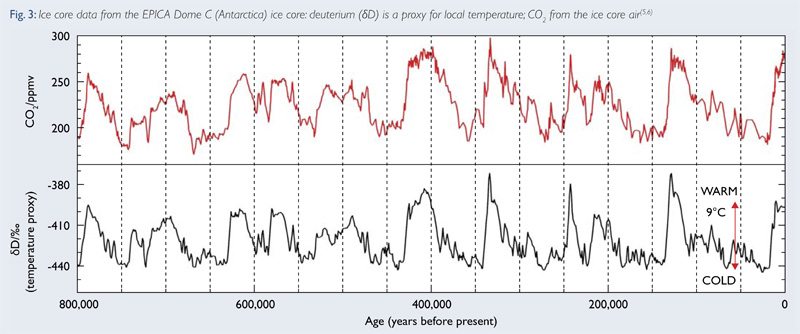
From the air in our oldest Antarctic ice core, we can see that CO2 changed in a remarkably similar way to Antarctic climate, with low concentrations during cold times, and high concentrations during warm periods (see Fig. 3 overleaf). This is entirely consistent with the idea that temperature and CO2 are intimately linked, and each acts to amplify changes in the other (what we call a positive feedback).

Well, no, if it was positive feedback, the warming would release more CO2, which would cause more warming, which would release more CO2, which would cause more warming and so on, until the seas boiled away into space. This they haven't done, from which we conclude that a rise in CO2 levels cannot both cause warming and be caused by it. Since no-one seems to dispute the latter, then the conclusion about the former is obvious.

Sunday, 30 May 2021

Temperature vs stratospheric ozone levels

Is there a correlation between ozone levels and surface temperature?

I downloaded the stratospheric ozone level figures from here (for Southern Hemisphere, but those are the only detailed ones I could find) and the Central England Temperature Record figures from here (I know that England is not in the Southern Hemisphere, but their figures are reliable).

Annual averages jump about, so I used the five-year rolling average for temperatures.

The co-efficient of correlation for a year's five-year average and the same year's ozone levels is 60%. It increases steadily to 80% if you assume that the temperature lag is one, two, three... eight years (and falls off again after that - it's down to 50% if you assume twelve years, 37% if you assume thirteen years), which conveniently suggests that ozone levels are the cause and temperature is the effect, so I went with an eight-year lag.

The left hand axis for ozone levels is inverted, as we expect lower ozone levels to cause higher temperatures.

Here's the chart. Looks fairly convincing to me. There is a clear mismatch from 2011 to 2016, but it's all back in line from 2017 onwards. If there is a link - and I cheerfully admit that this might all be sheer coincidence - then we'd expect to see average temperatures to fall slightly over the next five years*. Not sure what happens after that:
* The average temperature for May 2020 to 2021 is slightly lower than that for May 2015 - April 2016, so the 2021 5-year average will drop towards the number 'predicted' by 2013's ozone levels.

Friday, 28 May 2021

A painted clock is right twice a day

I've just stumbled across this classic in The Guardian from 2018:

Thirty years ago, James Hansen* testified to Congress about the dangers of human-caused climate change. In his testimony, Hansen showed the results of his 1988 study using a climate model to project future global warming under three possible scenarios, ranging from ‘business as usual’ heavy pollution in his Scenario A to ‘draconian emissions cuts’ in Scenario C, with a moderate Scenario B in between.

Changes in the human effects that influence Earth’s global energy imbalance (a.k.a. ‘anthropogenic radiative forcings’) have in reality been closest to Hansen’s Scenario B, but about 20–30% weaker thanks to the success of the Montreal Protocol in phasing out chlorofluorocarbons (CFCs)**.

Hansen’s climate model projected that under Scenario B, global surface air temperatures would warm about 0.84°C between 1988 and 2017. But with a global energy imbalance 20–30% lower, it would have predicted a global surface warming closer to 0.6–0.7°C by this year. The actual 1988–2017 temperature increase was about 0.6°C. Hansen’s 1988 global climate model was almost spot-on.


Classic lack of self-awareness there. The outcome was somewhere vaguely near his mid-estimate, and presumably miles off his lower- and upper-estimates. That's hardly "spot-on", is it?

** The Montreal Protocol was indeed successful in reducing CFC production, hooray. But the pre-existing CFCs are still working their way through the system and are still causing most or all of the current slight warming, reducing the impact of CO2 down to zero.

* James Hansen is the one who came up with the trick of calculating the effective temperature of Earth assuming two-thirds cloud cover, and then contrasting that (low) temperature with with the actual temperature of land/ocean surface (warmer) and ignoring the actual temperature of clouds (colder). See top of third column on page 1 here. He dresses it up in scientific language to cover his traces.

If you include the actual temperature of clouds when calculating the overall actual temperature, it would bring it down to pretty much the same as the effective temperature, i.e. if he had done an honest comparison, like-with-like, he would have had no evidence for a CO2-caused Greenhouse Effect whatsover.

Wednesday, 26 May 2021

"pV = nRT"

Alarmists and Physics Deniers don't actually know what this equation signifies and make themselves look silly by trotting it out as if it somehow supports Alarmist Theory and/or debunks the Gravito-Thermal Effect.

Nothing of the sort. There's a full explanation and worked example at ChemGuide.co.uk. This is basic first year level GCSE Physics and nothing controversial.
-------------------------------------
Let's apply it to typical temp, pressure, density at sea level:
Pressure = 101,325 Pa
Volume = 1 m3
Mass of air in 1 m3 at 'standard temperature and pressure' = 1.227 kg
n = number of moles of gas in 1 m3 = mass/m3 divided by molecular mass of 'air', which is 29g/mole
R = universal gas constant* = 8.31441 J/K/mol
Temp = 288K

Stick in the numbers on the right hand side, 1,227/29 x 8.31441 x 288 = 101,314. Close enough to 101,325!
------------------------------------
Now we've got the hang of it, what's the likely temperature at 10 km altitude?
Wiki tells us that pressure up there is 26,300 Pa, density is 416 g/m3.
The left hand side is 26,300 x 1 = 26,300
The right hand side is 416/29 x 8.31441 x T = 119.3 x T
So 119.3 T = 26,300; and T = 26,300/119.3 = 220K

Which is exactly what the blue line on Wiki's chart - and real life measurement - show. Wiki's chart is what you get if you just start by assuming ever increasing density in a gravitational/acclerating field and working from there (see diagram 5).

In fact, you can assume constant density, desnity which increases linearly or geometrically as you go down, there would still be a similar profile with increasing pressure and hence temperature towards the surface. Basic maths. Any other outcome is mathematically impossible unless you assume that density increases with height at an implausible rate (in which case, what happens at the top?).
------------------------------------
* Keen-eyed readers will know that this is Avogadro's number x Boltzmann's constant.

Sunday, 16 May 2021

You win some, you lose some.

From The Barents Observer:

Russia’s Arctic and Far North regions could become arable in as soon as 20 to 30 years as climate change accelerates permafrost melt, opening up vast swathes of land to agriculture, the country’s environment minister said Tuesday.

From The Guardian:

A third of global food production will be at risk by the end of the century if greenhouse gas emissions continue to rise at their current rate, new research suggests. Many of the world’s most important food-growing areas will see temperatures increase and rainfall patterns alter drastically if temperatures rise by about 3.7C, the forecast increase if emissions stay high.

Tuesday, 4 May 2021

AGW theory is based on two blatant 'diagonal comparisons' (Part 2)

In Part 1 I showed how they use a sneaky 'diagonal comparison' (i.e. they don't compare like-with-like) to create the illusion that Earth is warmer than it should be.  Part 1 covers the balance between Earth's system and the Sun/outer space.

Then there's what goes in within the Earth's system itself. The other sneaky thing they do is to say that the atmosphere is far warmer than it is, it's just a straight lie. From NASA's Earth Factsheet:

Terrestrial Atmosphere
Surface pressure: 1014 mb
Surface density: 1.217 kg/m3
Scale height: 8.5 km
Total mass of atmosphere: 5.1 x 10¹⁸ kg
Total mass of hydrosphere: 1.4 x 10²¹ kg
Average temperature: 288 K (15 C)


Say what?

Imagine you are asked to measure the average temperature of the water in a deep lake. If you just take the surface temperature, you might get ~288K. But that's not the average temperature of the all the water in the lake. By and large it gets colder as you go down, so the true average is much lower.

The reverse applies in the troposphere (the lowest ~11km of the atmosphere). This is the bit we are interested. It's where the weather happens and the layer which warms and cools the surface.

It gets cooler as you go up, so if you only measure the temperature in the warmest layer, at or slightly above sea-level (where most measuring stations are), you will get an artificially high average temperature (i.e. ~288K).

~288K is fair estimate of the average surface temperature, but that's something completely different to the average temperature of the air in the troposphere. That's a lot colder. If you take a fair sample of readings at all altitudes, you would get ~255K, which is not uncoincidentally the temperature we expect from looking at the Earth vs Sun/outer space balance. See also Climatologists are Flat Earthers.

The vertical temperature gradient is no mystery. Basic maths, a rudimentary understanding of the Gas Laws and common sense (principles and worked example) tell us that it must be warmer than the ~255K average at sea level and colder than the ~255K average at the top of the tropopause. They worked this out in the 19th century and it was part of normal physics textbooks until a few decades ago. There's a given amount of thermal energy, and gravity and the Gas Laws constantly recycle it downwards.

The precise temperature gradient (aka 'lapse rate') is primarily the trade off between thermal energy (temperature) and potential energy (altitude). We all know that warm air cools as it rises. Energy cannot be created or destroyed, so what happens to the 'lost' thermal energy? Easy - air loses thermal energy as it rises... and gains potential energy. The reverse happens with Chinook and Föhn winds (Föhn is German word, pronounced 'fern' and is also the name for a hand-held hair dryer), when falling air warms up. So the lapse rate = gravity ÷ the specific heat capacity of 'air'.

(The lapse rate is reduced by the latent heat of evaporation, which has the opposite effect. The surface is cooled when water evaporates, the latent heat manifests itself again higher up when water vapour condenses. The latent heat in one gram of water vapour is enough to warm a cubic metre of air by about 2 degrees, it's a lot.)
------------------------------------------
The AGW theorists make great play of the fact that Earth's surface (being ~288K, not ~255K) radiates ~390 W/m2 but only ~240 W/m2 gets to space. They claim that the missing ~150 W/m2 is trapped by 'greenhouse gases'. This is part of Diagonal Comparison #1. Two-thirds of the surface doesn't radiate directly to space because it's covered by clouds; some of the surface radiation is reflected back down (in a quite literal sense, like clouds reflecting visible light) and the clouds themselves emit the required ~165 W/m2 to space. The average emitted to space ≈ 240 W/m2, which is what Earth receives from the Sun.

The AGW steamroller never stops of course. For sure clouds reflect some infrared radiation back down (which is why a cloudy night is warmer than a clear night), but clouds don't 'trap' radiation or warm the surface overall; on the whole, it's cooler if it's cloudy (there's no 'positive feedback'). And clouds certainly do not warm the atmosphere overall, the extra warmth under a cloud is equal and opposite to the missing warmth above it.

Radiation isn't pollution like plastic in the oceans, it can transform into other forms of energy instantaneously. Trying to account for it is like trying to catch sunshine in your hands. You cannot add, subtract, multiply 'radiations', the maths is insane but entirely unnecessary to explain and understand the basic equilibrium position with temperatures etc. You need to bring in radiation to reconcile the warming effect of Ozone Depletion, but that's another story...

Monday, 3 May 2021

AGW theory is based on two blatant 'diagonal comparisons' (Part 1)

The theory goes as follows:
1. Earth is 33 degrees warmer than it should be based in incoming solar radiation alone;
2. This is due to 'greenhouse gases' and 'trapped radiation';
3. Hence more greenhouse gases = higher temperatures.

Item 1. is based on the most outrageous Diagonal Comparison of all time. If this is not a valid comparison, then we need not concern ourselves with whether 2 and 3 are valid*.

The Hansen approach is:
1. Calculate the average effective (i.e. expected) temperature** of clouds, land and ocean surface. He just calculates one overall average temperature based on weighted average albedo (reflectiveness) of clouds, land and ocean surface, which is pretty close to the weighted average expected temperature of clouds, land and oceans separately. The key here is that land and ocean surface below clouds are ignored when calculating this expected temperature.
2. Compare that with the actual temperature of land and ocean surface... completely ignoring the actual lower temperatures of clouds.

A proper scientific comparison compares like with like!

So if you calculate the effective temperature of clouds, land and ocean surface (ignoring land and oceans below clouds), you have to compare it with the actual temperature of clouds, land and ocean surface (ignoring the land and ocean surface below clouds)... and you end up with a 'Greenhouse Effect' of +/- zero, zilch, nothing. Here are the numbers. (Cloud top altitude in pale blue as that is my best estimate and the variable most worthy of research or debate).

It all matches up nicely. Actual temperature ≈ expected temperature and outgoing infrared radiation ≈ incoming solar radiation. There is no 'missing radiation' or 'trapped radiation':
References:
Tutorial on the Greenhouse Effect, this explains how it is calculated.
How high in the sky are clouds?
Scientists detect world's coldest cloud hovering over Pacific Ocean
What is Earth’s surface emissivity?

* The real explanation for the apparent 33 degree difference is far simpler. The most plausible reason for the recent slight increase in temperatures is Ozone Depletion, but these have been crowded out. Whether you understand or agree with these is irrelevant to the question of whether there is any evidence for 'greenhouse gases' causing 33 degrees of warming in the first place.

** Effective Temperature is the hypothetical temperature that a planet would have to be to emit as much radiation as it receives from its star, assuming 100% emissivity. But it is a good first approximation for the actual temperature for a fast-spinning planning planet with a thick atmosphere, like Earth.
-------------------------------------------------
The other Diagonal Comparison is that the official average surface temperature is NOT representative of average troposphere temperature, which is what we are interested in. Surface temperature measurements are 33 degrees warmer than the average temperature of the troposphere because measurements are weighted towards very low altitudes. This would not be so if Earth were covered with very high mountains. I'll cover that in Part 2, and then I'm done with this nonsense.

Saturday, 1 May 2021

How to estimate pressure and temperature using density as a starting point

As a fun maths challenge, I decided to apply the principles outlined in Acceleration ≈ gravity and see whether I could get sensible results by applying basic maths, basic physics and common sense.

Let's assume that you are only given the following measurements (taken from the US standard atmosphere):
1. Pressure at sea level = 101.325 Pa
2. Temperature at sea level = 288 K
3. Density at sea level = 1,200 kg/m3 (a bit on the low side?)

T x D ∝ T. We would do it the long way round by using Barry to find pressure at each altitude; then inserting the temperautre based on the lapse rate to find density at each altitude.

But what if you are also told that D at the top of the troposphere (10 km altitude for simplicity) = 400g/m3? It's actually much easier. You can interpolate everything else, including the likely lapse rate.

1. Set up your Excel sheet, type in the given numbers (pale yellow)
2. You can assume that density changes in straight line, but it is more realistic to assume it changes geometrically, so it goes up by a factor of 1.011 (3^0.1) for each km lower (doesn't make much difference)
3. Then work out the 'mass of the air/m3' for each 1 km 'slice' of altitude. That's just density x 1,000. I hid this column to simplify it a bit.
4. We know that the total mass of air at sea level must be enough to create a pressure of 101,325 Pa at sea level, so it must be 101,325/9.801 ≈ 10,338 kg total, so you put in 2,649 kg (pale blue) as a balancing figure (to get it to add up to 10,338 kg).
5. Pressure = force ÷ area, so it is simply 'mass of air above that altitude' x gravity (9.801 m/s2) per m2, so e.g. at 9 km, it's 2,649 kg + (446 g/m3 x 1,000 m) = 3,095 kg x 9.801 = 26 kPa
6. Temperature ∝ pressure/density i.e. temperature = pressure/density x constant 'k'
7. Work out 'k' = (288 x 1.2)/101 = 3.411 in this example (it's not a universal constant, you work it out individually each time)
8. Temperature at each altitude = pressure/density at that altitude x 3.411.

The results match the Standard Atmosphere very well. The T, and P results for top of troposphere are pretty bang-on. It does show that the lapse rate is lower than the accepted mid-figure 6.5 K/km at low altitudes and higher at higher altitudes. This is not unrealistic, as there is more absolute humidity at lower altitudes, but that's probably a happy accident and it averages out to ~6.5 K/km overall:
All this neither proves nor disproves the Physics Denier's contention that sea level temperature would be ~33 degrees cooler without 'greenhouse gases' (disproving that is far simpler and requires little or no maths, just facts and logic), but I love a maths challenge.
------------------------------------------
These workings also give a good understanding of the real world, against which you can test various Physics Denier theories - like the 'Top Of Atmosphere' theory, which says the temperature at the Effective Emitting Altitude (about 5 to 6 km up) is fixed at 255K, but sea level temperatures are 33 degrees warmer than that solely because of 'greenhouse gases'. This is an alternative explanation for the observed lapse rate of ~6.5 K/km, but it has to be that much anyway because of gravity, in other words... the 'Top of Atmosphere' theory assumes that gravity doesn't exist.

Or... do they mean that without greenhouse gases, the Effective Emitting Altitude would be sea-level (so sea level temperature would be 255K) and the gravity-induced lapse rate would stay much the same? On Mars, there is about thirty times as much CO2 as there is on Earth, but the Greenhouse Effect is negligible on Mars (5 degrees at most) and the Effective Emitting Altitude is no higher than it is on Earth. So that fails on the facts. Hmm.

Sunday, 25 April 2021

Acceleration ≈ gravity

The effects of acceleration and gravity aren't exactly the same of course, but we can generate 'artificial gravity' by spinning things round, like swinging a bucket of water in a horizontal plane - the water stays in, the same as it would if you just put the bucket down. As a reality check, I put some marbles in the centre of a smooth, flat plate on a record player turntable. When I lifted the needle to get it turning, all the marbles hit the edge of the plate within a second or so.

For all the 'Physics Deniers' out there, let's work out what would happen if you had a large, well-insulated tube of air (the larger and longer the better) being spun around an axis at one end (the faster the better).

1. While standing still, the density, pressure and temperature are constant along the whole length (I haven't bothered with units or numbers on the axes, this is about basic principles):
2. When it is spinning around the axis, the gas will be pushed towards the outer end (the same as the marbles on a plate). So density goes up at the outer end and down at the axis end. I've assumed that the increase is linear for now:
3. The pressure at any point along the tube is the mass of all the gas to the left of it pressing 'down' on it, which is the area of the 'density' shape to the left of that point (multiplied by the strength of the artificial gravity). The length and height of the upper triangle both increase by the same multiple with each step to the right, so the area increases by that multiple to the power of 2. So pressure increases geometrically from left to right: 4. Temperature is proportional to pressure divided by density. There are no physical barriers along the tube, it's all in equilibrium, so you can use the Gas Laws to calculate T if you know D and P (or indeed, calculate any variable if you know the other two). The ratio of P/D increases from left to right. So temperature goes up from left to right in a straight line (crudely speaking, T ∝ P/D and P ∝ D^2, so T ∝ D^2/D => T ∝ D): This is the bit the Physics Deniers can't or won't understand. The gas can't become isothermal again, because the density and pressure at each point in the tube are dictated by the amount of gas, the length of the tube, how fast it is spinning etc, and temperature is the result of all that, temperature can't just make up its own mind what to do. So the inner surface at the outer end becomes warmer than when it was standing still, and the inner surface at the axis end becomes cooler. No thermal energy has been added to the gas - it is just distributed differently.

A real life application of a similar effect is the vortex tube, which uses centrifgual forces to split air at a certain starting temperature into a stream of much colder air and a stream of much warmer air.

5. What relevance does this have to the gravito-thermal effect? Simple, you just rotate Diagram 4 clockwise by 90 degrees and relabel the axes. This now resembles the measured profile of the troposphere. You can multiply T and D at any altitude, divide that by P at that altitude and you get the same answer.
The other and even easier to understand explanation for the temperature profile in the atmosphere is that when air rises, it converts thermal energy to potential energy (cools); when air falls (or presses down on air beneath it), it converts potential energy to thermal energy (warms). Actually it is gravity and the Gas Laws that says there must be a lapse rate and the formula g/Cp just tells us how much the lapse rate is.

So the other way of modelling the whole thing is by just knowing the effective/average temperature and the lapse rate. We know that Earth receives enough sunshine to warm the atmosphere to an average of ~255 degrees (effective temperature), which is (by definition) the temperature half-way up the troposphere (the same as the temperature half-way along the spinning tube = the starting temperature). So you subtract ~5.5 x lapse rate ~6.5 degrees to find temperature at tropopause and add the same amount to find the temperature at sea level. You can work backwards to find pressure and density at different altitudes (for example by using the Barometric Formula or trial and error).

The equilibrium and actual observed profile is that for every 100m fall, density increases by ~1.115%; pressure increases by ~1.373%; and the ratio pressure-to-density increases to give a lapse rate of ~6.5 degrees/km. These three variables are inter-dependent, one does not 'cause' the others, they are in balance, like two playing cards balanced in an inverted 'V'. Each card is holding the other one up.

And if we have two different approaches which both give you the correct answer, you can be fairly confident that the approaches themselves are correct.

But whatever the explanation, it reminds us that the effects of gravity and artificial gravity/acceleration are very similar; and acceleration due to gravity is a lot, it is slightly more than the acceleration of a car that can do 0 to 60 mph in three seconds*. The laws of physics that apply to a bucket of water also apply to a spinning tube also apply to the troposphere.
---------------------------------------
6. "But what about radiation and greenhouse gases?" shout the Physics Deniers. Well, what about them? You can explain what happens in the spinning tube or the vortex tube without mentioning them and they are irrelevant when you rotate the diagram and have real gravity instead of artificial gravity. In the spinning tube, there was a fixed amount of thermal energy to start off with, which was recycled towards the outer end. Earth gets enough sunshine to keep the whole system at a steady average ~255K (fixed - see 7.) and the laws of physics ensure that the thermal energy is recycled downwards to cool the air at higher altitudes to ~220K and warm the surface to ~288K.

7. For sure, land and the ocean surface are emitting more radiation than actually gets to space (which must be approx. equal to the amount received from the Sun each day) but there's no point subtracting one from the other, it's not comparing like with like. We calculate the effective temperature ~255K by treating clouds as part of the 'surface', so the 288K at the hard surface/ocean surface is a red herring; the effective temperature should be compared with the overall average temperature of the top surface of clouds (two-thirds) and land and ocean surface (one-third), which is a lot closer to ~255K than ~288K.

The surface is as warm as it is, and emits the corresponding amount of radiation, it simply doesn't care what happens higher up. Somehow or other, the whole system will ensure that incoming and outgoing radiation balance, whether we point the finger at greenhouse gases trapping radiation or the low emissivity of clouds. Nature finds a way**.

* People picture the atmosphere (or anything else) resting on the Earth's surface as a static situation. In some ways, you can imagine the surface accelerating upwards at 9.8 m/s (a car doing 0 to 60 mph in three seconds) and pushing everything up accordingly. Imagine a ship moored in a river flowing at 10 knots, there's a bow wave in front of it. Or the same ship travelling up a canal at 10 knots, there's the same bow wave. If you lean over the bow and look straight down, you can't tell whether the ship is moored or moving. So it's like the Earth's surface is a giant piston pushing and compressing (hence warming) a ten-ton 'bow wave' of air in front of it.

** The top 1m of the ocean surface only radiates away about 1.4% of its total (thermal) energy overnight, sufficient to cool it by ~4K, which matches up with the typical diurnal temperature range for the surface of a fairly still ocean and the air immediately above it. Losing energy by radiation is a slow and inefficient process - blacksmiths quench red hot steel by plunging it into water; how much longer would it take if they held the red hot steel just above the surface of the cold water and allowed radiation to do its thing?

Here endeth today's lesson. I'd rather be a Climate Denier than a Physics Denier.

Saturday, 24 April 2021

Gassing off

This is just one of many articles about the government's "ambitious" target to phase out new gas boilers by the mid 2030s. All the articles I've read take the saving in "greenhouse gases" to be a good and vitally necessary thing, naturally, stating that they do (not may) cause global warming.

However, this like every other article I could find on the internet completely ignores the fact that the amount of gas used in domestic heating is 26 million tons of oil equivalent per year, which just happens to also be the total consumption of electrical energy in the UK. So, to phase out gas heating, the electricity generating capacity of the UK will have to double, without using fossil fuels, as replacing gas burned in boilers with gas burned in power stations would be a pointless and extremely expensive exercise.

Not only that, but the whole distribution network right down to the feeds to the meters will have to be uprated to carry the additional load. Needless to say, there is no announcement from the government about starting either of these upgrades.

I would like to think that the government's targets are just pious hopes expressed with an eye to a general election in 2024, but I'm not going to hold my breath. We live in an era of policy-based evidence, after all.

Wednesday, 21 April 2021

CO2 and the effective emitting altitude (2)

The 'top of atmosphere' theory of global warming is based on two actual facts:
a) The gravito-thermal effect exists (as adjusted for latent heat of evaporation/condensation), which is why temperatures fall by ~6.6 degrees/km as you go up through the troposphere (agreed).
b) Atmospheric density falls as you go up; so the amount of CO2 per cubic metre falls as you go up (agreed).

The theory says that a significant amount of radiation emitted below the 'effective emitting altitude' (at which CO2/m3 is a certain critical value) cannot escape to space; the 'thick' CO2 blocks it. Only as much radiation makes it past the 'effective emitting altitude' (above which CO2 is 'thin' enough to allow it through) as a planet receives from the sun, so they balance out and surface temperatures stabilise (all this is probably correct as well, by definition).

The theory also assumes that the temperature at the 'effective emitting altitude' is constant, which is circular logic. The 'effective emitting altitude' is just whatever altitude happens to be the same temperature as the planet's effective temperature, which in turn is only a ball-park estimate of actual surface temperatures. And radiation does not have a temperature anwyay - compare a 2,000 Watt electric fire with a 2,000 Watt radio transmitter. But hey.

THEREFORE, the theory concludes, IF overall CO2 levels increase, the effective emitting altitude goes up (you have to go higher up before CO2/m3 drops below the critical level) AND as a result of that, surface temperatures must go up - you are adding more km altitude x 6.6 degrees/km to a constant to work back down to the surface temperature.

The theory is intellectually appealing and it's difficult to prove or disprove the logic just using logic. All we can do is test the theory against 'real life'.

In the first test, we established that CO2/m3 at Earth's effective emitting altitude (~ 5km up) is ~0.5 g/m3. If the theory holds, the effective emitting altitude pre-1880 would have been ~3km up ≈2 km lower than now and surface temperatures would have been ~13 degrees lower than now. Surface temperatures (at the end of the Little Ice Age, natch) were only ~1.3 degrees lower than now, one-tenth of what the theory predicts, so the theory looks flawed to say the least.

I have given this some more thought and there's another way of testing the theory; we can apply the same logic to Venus, Earth and Mars and see if CO2/m3 levels at each planet's effective emitting altitude are similar. If they are, then that backs up the theory.

We find that the CO2/m3 level at the effective emitting altitude is ~3,500 g/m3 on Venus; ~0.5 g/m3 on Earth and ~18 g/m3 on Mars. The calculations are tortuous and took me all yesterday evening, so I won't bore you with them. The three planet's effective temperatures are quite similar (~230K, ~255K and ~205K) so I see no need to adjust for that. These CO2/m3 figures are so far out of line (whatever the margin of error in my workings) as to be meaningless.

So the theory fails this test even worse that it failed the first test. Having scored 10% on the first test (epic fail), it's not even trying to pass the second one. It's like handing in an essay about the Brontë Sisters at the end of a metalwork practical session.

Wednesday, 14 April 2021

Climatologists are Flat Earthers

Agreed facts:

1. If Earth had no atmosphere, then the average surface temperature would be about 255K (actually it would be higher because no atmosphere = no clouds = lower albedo = less sunlight reflected = more sunlight absorbed = warmer, but let's gloss over that bit). The turquoise is the surface, the sky appears black (like on our Moon): 2. Elevation or altitude would make no difference, the tops of mountains would be the same temperature as 'sea level' (like on our Moon):

3. We have an atmosphere, and because of the gravito-thermal effect, it is not 255K all the way up. It about 33 degrees warmer than that at sea level and 33 degrees cooler than that at the tropopause (the boundary between troposphere, warmed from below, and the stratosphere, warmed from above). The tropopause is on average about 11 km up, the altitude at which long distance airliners fly. Which is why mountain peaks more than half way up (Everest) are cooler than 255K at the top.

The Alarmists insist that the extra 33K at sea level is purely due to 'greenhouse gases' (some of them insist that the gravito-thermal effect can only exist if there are 'greenhouse gases' in the atmosphere), they are Flat Earthers and ignore everything to the right of the dotted line:

4. If Earth's surface were a lot more mountainous, covered in mountain peaks a lot higher than Everest which reached the tropopause, the overall average surface temperature would be about 255K, exactly the figure we would calculate from sunlight alone.

We would teach kids about the gravito-thermal effect to explain why mountain peaks are cold and valleys are warm, and the world would be a better place. Alarmists simply refuse to address this simple debunkation:
5. Of course, this does not explain small, shorter term fluctuations in temperatures, as we have seen over the past half-century*, but you can't just assume that a bit of CO2 = 33 degrees extra surface temperature and extrapolate from there. The Alarmists miserably fail to even try to explain how CO2 can cause warming at sea level but cooling on mountain peaks, even though mountain peaks get more sunshine than the surface, and although there is less CO2 above mountain peaks, there is still some.

* The most likely explanation, if this is indeed man-made, is ozone depletion caused by CFC gases. This is of serious concern. As it happens, this is also what might be causing cooling in the stratosphere. But I am well-versed in Alarmist pseudo-explanations - their take is that more CO2 in the stratosphere causes that cooling because it is at lower density and thus magically radiates more away from Earth than back towards it.

I suppose you could adapt this twisted-logic to explain the lower temperatures on mountain peaks and up where airliners fly, if you were capable of Double- and TrebleThink. The logical collorary of that would be that it would be warmer on mountain peaks if there were no CO2 in the atmosphere, or something completely mental.

Saturday, 27 February 2021

Here we go again...

From the BBC:

A mortgage guarantee scheme to help people with small deposits get on the property ladder is set to be announced at next week's Budget. The government will offer incentives to lenders, bringing back 95% mortgages which have "virtually disappeared" during the pandemic, the Treasury says.

An extension to the Stamp Duty Land Tax "holiday" is also on the cards.
-------------------------------
From The Daily Mail:

Biden bombs Syria border crossing and 'kills 22' Iran-backed militia fighters in retaliation to rocket attacks that injured American troops and killed a contractor in Iraq.

The poor sods will be looking back fondly at the Trump years.
-------------------------------
And for a bit of light relief, a "global warming causes cooling" story from The Guardian:

Rahmstorf said: “We risk triggering [a tipping point] in this century, and the [Gulf Stream] would spin down within the next century. It is extremely unlikely that we have already triggered it, but if we do not stop global warming, it is increasingly likely that we will trigger it.”

Research in 2018 also showed a weakening of the AMOC, but the paper in Nature Geoscience says this was unprecedented over the last millennium, a clear indication that human actions are to blame. Scientists have previously said a weakening of the Gulf Stream could cause freezing winters in western Europe and unprecedented changes across the Atlantic.

Wednesday, 17 February 2021

"My confusion and anger ended when our host showed me the real physics"

I did a bit of light trolling at Science of Doom and elicited this response:

You are confusing several topics.

No I'm not. They are confusing the issue, as he later confirms:

Elsewhere I have discussed why it is simplest to consider the steady-state balance or imbalance at the TOA [top of atmosphere]. An imbalance at the TOA is created by rising GHGs slowing down the rate of radiative cooling to space. DLR is an internal radiation flux that moves heat WITHIN our climate system and therefore isn’t important to the radiative imbalance at the TOA. A “rising effective emitting layer" is important to the balance at the TOA.

Since AGW is a very complicated subject, it is often explained with a variety of models paradigms including: Increasing DLR “warms” the surface, CO2 “traps” heat, CO2 acts as a blanket or insulation, GHG’s act as shell or layer around the Earth (Willis promotes a “Steel Greenhouse” Model) and a “rising effective emitting layer” model (promoted here and by Linden among others). IMO – and others probably do disagree – all of these models are flawed.


Which was exactly my point. Notice how he first says that the "'effective emitting layer' is important" and then says that the "'rising effective emitting layer' model [is] flawed". I have spent a year wading through these endless layers of crap:

When I first came here (on the advice of Steve McIntyre), I was continuously frustrated and intemperate, because I KNEW that doubling CO2 would double the number of photons emitted by CO2 and usually halve the distance they traveled between emission and absorption. I couldn’t see why doubling CO2 would change anything – which turns out to be an excellent first approximation to the truth. The reduction in radiative cooling [to] space from 2XCO2 is barely more than a 1% change despite doubling the emission of photons by CO2. (As best I can tell, the rising effective emitting layer model doesn’t take into account the doubled emission of photons by doubled CO2.)

Luckily, Salvation is at hand for those Who Know And Want To Believe:

My confusion and anger ended when our host stopped talking about models and paradigms for AGW and showed me the real physics: Schwarzschild’s equation for radiation transfer. This is the equation that climate scientist use to predict that a doubling of CO2 will slow radiative cooling to space by about 3.5 W/m2. Unfortunately, this equation is a differential equation that must be numerically integrated over the path radiation takes, and therefore may or may not be meaningful to you...

I do not pretend to understand this equation numerically, but the gist of is what common sense would tell us: some gases are better 'insulators' against radiation than others, in the same way that some gases are better for thermal insulation than others, so radiation (or thermal energy) comes out of one side more slowly than went in on the other - but it still gets through in the end. Wow, big deal.
--------------------------------------------------
Basic physics tells us that everything can radiate (we are told hat N2 and O2 can't, let's just accept that) and that the temperature of the atmosphere falls with increasing altitude (because of the gravity-induced lapse rate). Therefore, stuff which is higher up will be radiating less than the surface. Outgoing radiation is about one-third from the warmer surface and two-thirds from cooler clouds (which themselves have only about 75% emissivity) and if you average those out, you get the same answer as what is actually observed, which is what is needed to keep the atmosphere at a steady-state temperature.

PS, the figure of 3.5 W/m2 (which he himself dismisses as "barely more than a 1% change") is a key part of the Alarmist belief system. This was originally derived by simply assuming that warming over an arbitrarily chosen time period was directly caused by changes in CO2 levels. They later reverse engineered the answer they wanted from an equation not necessarily designed for this purpose. Even if correct, that equates to a surface temperature which is about 0.7 degrees warmer for every doubling of CO2. Again, big deal. (This is of course wholly at odds with Al Gore's claim that temperatures rise by about 1 degree for every 5% extra CO2, not that he ever retracted it or that the Alarmists even notice the discrepancy - if Al Gore's chart had been a good predictor, then temperatures would be about 10 degrees warmer than they actually are.)

Sunday, 14 February 2021

"The Amazing Case of 'Back Radiation' – Part Three"

I dipped back into Science of Doom again for a giggle and ended up at this fine article, it's the third article in a series which is basically a long list of things which are undisputed. The series builds up to this:

Wavelength Dependence on the Temperature of the Source

Of course, radiation from different temperature sources do have significant differences – in aggregate. What most, or all, believers in the imaginary second law of thermodynamics haven’t appreciated is how similar different temperature Planck curves can be:

Notice the similarity between the 10°C and the -10°C radiation curves. Alert readers who have pieced together these basics will already be able to see why the imaginary second law is not the real second law. If a 0°C surface can absorb radiation from 10°C radiation, it must be able to absorb radiation from -10°C radiation. And yet this would violate the imaginary second law of thermodynamics...

Conclusion

[Downward longwave radiation] is emitted by the atmosphere, reaches the surface and is absorbed by the surface. This absorption of energy changes the surface temperature. The physics behind this are [sic] very basic and have been known for around 100 years. Proving that the surface doesn’t absorb DLR should be a walk in the park for anyone with a small amount of cash. But only if it’s true.


Say what now?

Let's assume the ground is zero degrees C. Case A: air from the south wafts in which is +10 C. We'd expect the ground to warm up a bit (and the air to cool a bit). Case B: air from Siberia wafts in which is -10C. A sane and rational person would expect the ground to cool further (and the air to be a bit less cold), but apparently, the ground will warm up almost as much as if the air were +10C rather than -10C. This would to energy appearing out of nowhere (because the air is also getting less cold) and so is clearly impossible.

And I'm not aware that the Second Law says that objects can't absorb radiation from cooler objects. That is a red herring and neither here nor there - if the warmer object is emitting more than it is absorbing, it is cooling down. What the 'Law' says, among many other things, is that heat goes from warm objects to cold objects. Whether that is due to conduction or radiation or anything else is a secondary issue. The word "radiation" only appears once in the very lengthy Wiki article (and once again in the footnotes). Rather conveniently for the forces of common sense and reason, it's in the following sentence:

The second law is concerned with the direction of natural processes. It asserts that a natural process runs only in one sense, and is not reversible. For example, when a path for conduction and radiation is made available, heat always flows spontaneously from a hotter to a colder body.

They seem to be trying to convince themselves of something that in their hearts they know is not true.
---------------------------------------
The Alarmists sometimes use the warming effect of clouds, which is noticeable at night, as evidence to support this nonsense.

That is a different effect. The clouds are emitting their own 'colder' radiation (which has no effect), and also reflecting 'warmer' radiation emitted by the surface back to the surface (which does have an effect), at exactly the same 'warm' frequencies (colours don't change when reflected in a mirror) which the surface absorbs, reducing the net energy radiated away by the surface, thus warming it up (or at least, slows down the cooling process).

Even if you go with the Alarmist theory, if clouds reflect 60% of radiation at all frequencies, this makes it (say) 5 degrees warmer. CO2 can't re-emit downwards more than half of one-tenth of frequencies of radiation, so pro rata, that means about 0.42 degrees of warming and it can never be more than this, no matter how much CO2 there is.

Furthermore, if we are dabbling in crude radiation calculations, CO2 emits at 14 - 16 microns. Using Wien's Displacement Law, this is the peak radiation emitted by a blackbody which is only about 200K, i.e. about negative 70 degrees C. Which sure as heck can't warm the surface, that's just not happening.