From The Telegraph:
Buckfast sales in Scotland surged 40 per cent after Nicola Sturgeon introduced alcohol minimum pricing, according to an official analysis that prompted more warnings her flagship public health policy had backfired...
The Tories said that minimum unit pricing (Mup) had prompted drinkers to switch from cheap drinks such as cider - the cost of which rose substantially - to stronger beverages like Buckfast. The price of the tonic wine was unaffected by Mup's introduction in May 2018 as it costs around £8 per bottle, more than 50p per unit of alcohol.
One might almost think that producers of the stronger stuff had a hand in this misguided legislation, as it sets a barrier to entry to cheaper competitors...
Tuesday, 15 November 2022
Tee hee
Posted by
Mark Wadsworth
at
12:49
13
comments
Labels: Alcohol, Barriers to entry, Scotland, Taxation
Wednesday, 19 January 2022
An auction with a price cap is not an auction
This story is quite baffling, from Yahoo News/Reuters:
LONDON (Reuters) - BP, Shell and utility Iberdrola were among the winners of seabed rights to develop Scottish offshore wind projects, in an auction which raised nearly £700 million ($958 million) for public spending... Crown Estate Scotland, which manages the Scottish seabed, said on Monday that proceeds from the first such leasing deal in around a decade will go to the devolved Scottish government.
This is land value tax in action - the sea bed and the wind were created by nobody and thus belong to everybody and nobody, so the government is perfectly entitled to claim dibs and auction it off on behalf of 'everybody'. Good stuff so far, but...
Last year, seabed options around the coast of England, Wales and Northern Ireland were awarded at much higher prices at a leasing round held by the Crown Estate. However, Crown Estate Scotland capped the lease payments at £100,000 pounds per km2. As a result the payment for leases per GW were 94% lower than the average in the English auction, said analysts at Bernstein.
The English/Welsh auction last year raised £9 bn, but that article doesn't say how many GW or km2 were involved so I will accept the "94% lower" figure.
So it wasn't really an auction at all, it was a freebie for those who were awarded the rights. I hope that Scottish citizens kick up a stink about this and that heads roll, starting with Wee Krankie.
Posted by
Mark Wadsworth
at
14:17
7
comments
Tuesday, 14 July 2020
They own land! Give them money!
Or "They want to sell land! Encourage the people who want to buy it to pay more!"
From Which.co.uk:
First-time buyers in Scotland have been handed a boost with the launch of a new scheme that offers interest-free loans of £25,000.
The Scottish Government’s First Home Fund, which was originally announced in the Spring, has today opened to applicants. Here, Which? explains how the First Home Fund works, including which lenders are involved, how to apply and details of how the scheme compares with Help to Buy.
We're in the middle of a bloody economic/unemployment crisis, and instead of looking after those who have lost their jobs or businesses, they are targetting "help" exactly where it's not needed.
Posted by
Mark Wadsworth
at
13:18
0
comments
Labels: Help to Buy, Scotland, Subsidies
Friday, 27 September 2019
We are considerably greener than you!
From the BBC:
The Scottish government's targets for cutting greenhouse gas emissions have been strengthened, as MSPs voted to put down a "net-zero" target in law.
The Climate Change Bill - which aims to have all emissions offset by 2045 - was passed by 113 votes to 0 at Holyrood. Ministers agreed to a Labour amendment to up the interim target, with members agreeing to target a 75% reduction by 2030, compared with 1990 levels. However, a Green bid to increase this goal to 80% was heavily defeated.
Environment Secretary Roseanna Cunningham said the government was "putting in place the most stringent framework of statutory targets of any country in the world". The Greens abstained in the final vote, and said members should "not pretend this bill is anywhere near meaningful action to address the climate emergency".
If they really meant it, they could make a start by shutting down the oil wells and leave the fossil fuels in the ground.
Posted by
Mark Wadsworth
at
14:08
8
comments
Friday, 23 March 2018
"Kerching!" shouted the Scottish Association of Smoke Alarm Installers
From the BBC:
Housing Minister Kevin Stewart said :
"Fires and fatalities from fires are decreasing but even one death is one too many*. Scotland already has rigorous standards for smoke and fire alarms developed over time, with the highest standard currently applied to new-build and private rented housing.
"The tragic events at Grenfell Tower last year emphasised how important building and fire safety is, which is why we brought forward our consultation on this issue. Now everyone will benefit from the same level of protection, whether you own your home, or rent from a social or private landlord."
In practical terms, the law will require private homes to;
* have at least one smoke alarm installed in the room most frequently used
* have at least one smoke alarm in spaces such as hallways and landings
* have at least one heat alarm in every kitchen
* have a carbon monoxide detector
In addition, there will be a 10-year age limit for alarms and all alarms will have to be ceiling-mounted, and should be interlinked.
* While an individual death is a tragedy and burning to death or dying of smoke inhalation is a pretty horrid way to go, there has to be some commonsense here. Last year, 36 people died in fires in their homes in Scotland.
Guesswork: Maybe all the extra alarms will halve the number of deaths, call it 18 lives saved a year. Multiply two million owner-occupied dwellings by £100 for installation = £200 million and amortise over ten years = £20 million a year. Average cost per life saved, over £1 million.
I once read that the UK government has its own arbitrary figure for the value of one life saved, and it was a lot less than £1 million, in other words, if some safety measure saves one life a year and costs £1 million, they wouldn't make it mandatory.
Posted by
Mark Wadsworth
at
17:10
10
comments
Labels: Elfin Safety, lobbying, Scotland, statistics
Thursday, 1 March 2018
The Scottish Land Revenue Group's submisson to the Scottish Land Commission..
... is available here, with a generous name check for yours truly.
Those who read this blog regularly will be able to guess exactly what it's going to say before they read it. It does look nice in print though.
Posted by
Mark Wadsworth
at
11:30
17
comments
Labels: Land Value Tax, Scotland
Thursday, 22 February 2018
"Queen of the South keeper crisis after goalie hurt by cow"
Spotted by Paul F at the BBC:
A Scottish Championship club is facing a selection headache after its reserve goalkeeper* was hit by a runaway cow. First choice goalkeeper Alan Martin is out with a thigh injury with Jack Leighfield standing in.
Queen of the South's Sam Henderson, 19, hurt his shoulder in the incident on his father's farm. Henderson was on the bench for last weekend's draw with Morton and was expected to do the same against Dunfermline on Saturday. However, the accident has meant he is facing a race to be fit.
* I think that young Sam was the reserve reserve goalkeeper. The actual reserve goalkeeper is Jack Leighfield (who happily has not been injured, by a cow or otherwise), but hey. So what the club now needs is a reserve reserve reserve goalkeeper to tide them over.
Posted by
Mark Wadsworth
at
15:09
1 comments
Sunday, 26 November 2017
Killer Arguments Against LVT, Not (426)
Paul Lewis did a fairly positive piece on LVT (in Scotland) on his Radio 4 Monyebox programme yesterday (h/t Bayard). Duncan Pickard was on top form.
They then invited David Melhuish of the Scottish Property Federation to put the arguments against:
I think, at the moment, we don't know enough about [LVT], so we are unpersuaded at this point, as [the MSP] said, there have been a number of studies of this in recent years and I think most of the conclusions have said that we need to do much further analysis on it.
I think that there's two big problems there.
Yes, I know that the economic theory is supportive of it, but there is a point about how this interacts with the planning system as well, and whether land is unimproved or not, it'll have to have a planning designation and the planning system is not easy to deal with and often a point of frustration. So I think the practicalities come into question at that point.
My other point would be, if you are talking about replacing other instruments of tax, you're probably shrinking the tax base considerably with some of those, and I think there's a risk inherent in that you could have a sizeable redistribution of tax on much fewer shoulders.
It could happen, it's a devolved area. I think there's a huge amount of practicalities to overcome. You've still got between Council Tax and Business Rates £4.5 billion of income and the fact that you would be shrinking the tax base, you know, I think that would put quite a burden on more people than [Duncan Pickard] thinks.
Wow. I'd have expected him to go in much harder than that, but he chose to get bogged down in technocratic sounding waffle.
Barely worth debunking, but here goes:
1. Initial valuations can be based on current actual use, same as council tax or business rates are/were. We can easily tweak those two existing assessment/collection systems to be so close to LVT as makes no difference. Then it can be extended to plots with actual planning permission, we know perfectly well what they've got planning permission for.
2. As it happens, the Scottish Land Revenue Group invited me to do a talk last year, so I know the numbers on this. Total receipts from Council Tax, Business Rates, Land & Buildings Transaction Tax (Scottish SDLT) and other bits and pieces that can be swept up, like planning fees, s106 agreements, Community Infrastructure Levy etc are just shy of £5 billion.
The total tax base, the total of the site premium of all residential and commercial buildings is at least £20 billion. That is completely unaffected by the taxes levied on it.
So a straight replacement LVT, just to get the ball rolling would be a bit less than 25% of the site premium. For most households or businesses, the initial LVT would be the same or less than Council Tax or Business Rates is now, for homes in higher value areas - and a very few shops or office on Princes Street in Edinburgh - it will be a lot more. Unfortunately, Inheritance Tax is not a devolved tax, in an ideal world that would be replaced as well, which would compensate for the higher taxes on the most expensive homes.
He confuses the 'tax base' with the number of people paying what proportion, and contradicts himself on whether more people would pay more or fewer people would pay more. Which is a classic Homey strategy. If those 'fewer shoulders' don't want to pay the LVT, they can sell up to somebody else who will.
Clearly, if LVT were then extended to replace income tax in its entirety (which the Scottish government could now do, if it wanted - see s11A of the Income Tax Act 2007, as inserted by FA 2014), this would mean that the tax rate would have to be about 70% of the current site premium. If the income tax cuts feed through into higher rental values, the LVT rate would be less than 50%. So it's perfectly do-able.
Assuming no change in behaviour, that would mean significant changes (increases or decreases) in how much tax some households or businesses pay, but once people have upsized and downsized, it will all sort itself out. The chances are, most will end up paying the same total, but out of larger overall incomes - with the other big bonuses that taxpayers are getting something directly in return for the taxes they pay, it will be semi-voluntary, as well as dampening land prices and having more efficient use of existing urban land.
What's not to like?
Posted by
Mark Wadsworth
at
16:31
2
comments
Friday, 24 March 2017
A good turnout at the Scottish Land Revenue Group event
Posted by
Mark Wadsworth
at
17:02
7
comments
Labels: Land Value Tax, Scotland
Tuesday, 14 March 2017
Guardian making itself look a bit silly (as per usual).
My radio-alarm clock is set to Radio 4, which I listen to as I drift back into consciousness. This morning, they quoted from a Guardian editorial, which seemed so far-fetched that I wasn't sure I hadn't imagined it.
Nope.They actually said this about a possible second Scottish indyref:
The choice facing voters in an independence referendum can be framed as one between the certain economic catastrophe of crashing out of the EU and the uncertain consequences of leaving the UK.
As is well known, Scotland's economic links with the rest of the UK outweigh Scotland's links with the rest of the EU by about four-to-one. By economic links I mean, cross-border investment, imports-exports, jobs and so on,
So whatever the disruption is when* the UK leaves the EU, it would be four times as bad for Scotland if they left the UK and tried to rejoin the EU.
* It's a great feeling finally being able to say "when" instead of "if".
Posted by
Mark Wadsworth
at
08:13
14
comments
Labels: EU, Exaggeration, Guardian, Scotland
Saturday, 29 October 2016
Reader's Letter Of The Day
From yesterday's Metro (Scottish edition):
Made Of Tougher Stuff, I agree with you. I have been married for 40 years and my hubby has never once worn a hat, gloves, vest or pyjamas. He is a real man!
IK, Glasgow
I don't know what MOTS's original vicarious boast was, but this one could run and run, culminating with something like this…
I have been married for sixty years and my husband has never worn anything but underpants. When we are snowed in, he marches out and kills a polar bear with his bare hands so that we have something to eat.
EW, Lapland.
Posted by
Mark Wadsworth
at
09:58
10
comments
Labels: Exaggeration, Scotland
Wednesday, 17 August 2016
Making sense of numbers (green c**p edition)...
Now I'm presuming the "£400,00" in column one is a misprint for "£400,000" and "£500,00" for "£500,000". And I reckon the bank closing balance at the bottom of column one is supposed to say "£400,000" and not "£500,000" otherwise £100k just disappears. So the typos, as careless as they are, aren't the issue.
I'm trying to work out what the 'scam' is, because it's bound to be a scam. As far as I can see, this hydro thing is basically being 'flipped' onto members of public in the form of untradeable illiquid securities that promise to start paying out profitably in a decades time, once another tier of debt investors have been paid back, and once the FIT and leecy prices have grown at a compounded 2%/2.5%.
Anyone else?
Wednesday, 6 July 2016
Gordon Brown talks sense: shock!
I missed this from a week ago, in The Telegraph:
Ms Sturgeon has promised to examine all the options for keeping Scotland in the EU, and to table plans for a second referendum [on Scottish independence] if there was no other way of achieving this.
But Mr Brown argued this was too narrow a process as it excluded any assessment of the value of the UK single market, so that Scots can decide which political union is more important economically.
Exports to rest of UK are worth £48.5 billion compared with £11.6 billion to EU while 250,000 jobs are linked to the single market compared with one million linked to the UK market, he said.
Mr Brown added that total of 1,000 companies from Europe are based in Scotland, compared with 3,000 from rest of UK, and pointed out the leaving the UK for the EU could mean changing currencies. While 250,000 Scottish jobs are linked to the EU single market, he said that at least a million are connect to trade with England, Wales and Northern Ireland.
Which leads me on to a wider point I have been meaning to make for a while.
Logic and observation confirm that the smaller the country (or area under consideration), the higher the proportion of imports and exports to GDP, and also that most imports and exports are to or form very nearby countries or surrounding areas. The Scottish figures illustrate this.
If Scotland left the UK 'single market' and Scotland and rUK imposed sanctions, quotas or tariffs on each other, it would have a small negative impact on rUK but would more or less finish off Scotland.
So we can bully them more than they can bully us.
It's the same with the EU vs the UK. The Eurocrats are insisting that if we want 'free' access to the EU single market, then we have to pay for it in terms of cash contributions and accepting free movement - the same as Norway (free movement is seen as a 'cost' for political reasons, not economic reasons).
Well fair enough, Norway's economy is tiny relative to the EU so they have to roll over and pay the ransom payment (in the same way as Scotland's GDP is tiny relative to rUK's - less than one-tenth).
But...
a) the share of imports/exports relative to the UK's GDP is surprisingly small (it is a large nation and an island). According to the regression analysis in the post linked above, it is about half of what we would expect.
b) only about half our imports/exports are to/from other EU Member States and they export more to us than we export to them.
c) the UK's GDP is about one-fifth of the total GDP of the other 27 Member States. So we are in a weaker bargaining position than rEU but in a much stronger position than Norway or Scotland.
So my thinking is - if the UK rejoined EFTA, the total GDP of all EFTA countries might add up to one-quarter of rEU GDP. In which case, rEU can't clobber us quite so hard. If sufficient countries were to leave the EU for EFTA so that total GDPs of each bloc were similar, then each bloc could demand an 'access fee' from the other, which would net off to a much smaller payment in one direction.
Which is why the EU has been so negative about Brexit, they want to frighten all the other more EU-sceptic countries into staying in - the class bully doesn't want people leaving his gang and joining a rival bully's gang. It seems to be working for the time being (h/t MBK).
Posted by
Mark Wadsworth
at
15:36
5
comments
Labels: Brexit, Bullying, EFTA, Gordon Brown, Scotland
Sunday, 29 May 2016
Beyond satire.
Exhibit One:
Tony Blair has said it would be a “very dangerous experiment” if Jeremy Corbyn or a populist politician like him were to form a government.
In an interview with the BBC, the former Labour prime minister said populist politicians, whether on the left like Corbyn or on the right, were worrying and he spent a lot of time thinking about how people in the centre should respond.
Blair famously said last summer that anyone thinking of voting for Corbyn as Labour leader because it was what their heart told them to do should “get a transplant”, but his latest comment may be his harshest yet.
Exhibit Two
An unfortunate mobile phone salesman was tied up and beaten by an angry crowd in Cixi City, China, after he was mistaken for a baby snatcher.
Exhibit Three
Channel 4 comedy Raised By Wolves is being adapted for American TV by Diablo Cody, the writer of Juno...
Now The Guardian has reported that Moran and Cody have been in contact about reworking the action from Wolverhampton to the US…
The remake is being made by Berlanti Productions, whose credits include the less down-to-earth shows Supergirl and Legends of Tomorrow.
Exhibit Four
Lack of unity on the EU, UK government challenges and UKIP all contributed to the Welsh Conservatives losing seats at the assembly elections, leader Andrew RT Davies has said.
But...
Ruth Davidson, the Scottish Tory leader, has declared herself a “John Major”-style Conservative, after leading the party to its best election result in Scotland for almost 60 years.
I saw another good one last week but I've forgotten it.
Posted by
Mark Wadsworth
at
12:25
2
comments
Labels: China, Conservatives, Elections, excuses, Humour, Jeremy Corbyn, Satire, Scotland, Television, Tony Blair, USA, Wales
Tuesday, 22 September 2015
"SQA boss admits new Higher maths exam was too hard". Blogger begs to differ.
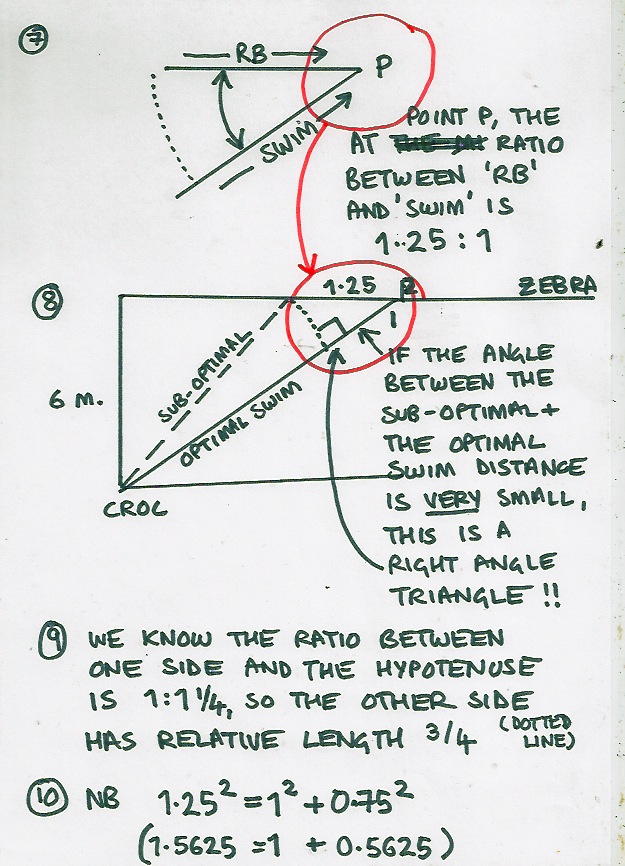
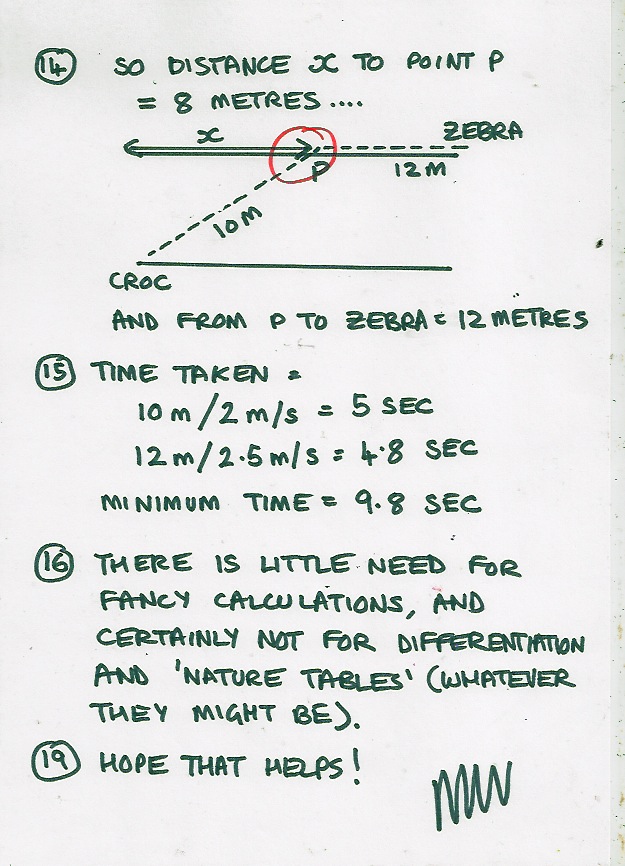
According to the BBC, this question was too hard:

No it wasn't. Here are my workings:


Crocodile, river, zebra, SQUA, differentiation, trigonometry, maths.
Posted by
Mark Wadsworth
at
19:32
22
comments
Saturday, 8 August 2015
How to avoid cow attacks, the movie...
Posted by
Steven_L
at
13:00
6
comments
Labels: Alex Salmond, Cows, movies, Scotland, videos
Tuesday, 14 July 2015
This is News?
From the Telegraph
Scotland's first home-grown wine has been described as “undrinkable” by experts.
Christopher Trotter, from Aberdeen, set up his own vineyard in Fife three years ago in a bid to defy the wet Scottish climate.
The chef and food writer installed 200 vines at his home near Upper Largo and the first bottle of Chateau Largo was eagerly awaited by experts.
But he admitted his first vintage tasted "horrible" as he had failed to chill the grapes quickly enough, which allowed oxidisation to occur.
“It’s not great,” he said. “We have produced a vintage of, shall we say, a certain quality, but I’m confident the next will be much better.
“We have proved we can grow grapes in the Scottish climate.”
Well, yes, you can grow grapes, I'm sure. My father manages to grow a vine in the midlands. The problem is that wine relies on grapes maturing, producing sugars, and one of the factors in that is photosynthesis, which means getting sunlight. It's why Champagne is grown where it is - it's not a particularly sweet wine, because it doesn't get the sort of sun that you get down in Burgundy or the Rhone.
"Climate change studies have suggested that areas like Scotland will become more like the Loire Valley in 20 to 30 years," he told the Scottish Daily Mail.
Uh, no. Even with the worst IPCC band, it's 100+ years. If you're betting on climate change making your wine good, think again.
'If you look back to the English wine-making industry 30 years ago, it was the laughing stock of the wine-drinking world. It was not very nice stuff. But they persevered and now they are making some of finest wines in the world.
"Nyetimber (in southern England) now make sparkling wines every bit as good as a £50 bottle of Champagne.
Most of it still isn't very nice stuff. And certainly isn't good value. I've drank some of it. I'd much rather spend the same money on German wine. The main problem is that it just doesn't get enough fruit, so it's pretty thin. I even drank some £30/bottle Nyetimber to see what the fuss was about and was pretty underwhelmed. I'm not even sure it's as good as £30/bottle champagne, let alone what I can get elsewhere.
Posted by
Tim Almond
at
13:55
2
comments
Thursday, 9 April 2015
I didn't realise that "in your face taxes" was a widely used term.
I pinged off my submission to The [Scottish] Commission on Local Tax Reform, which they have put online here.
Out of interest, I read the first submission by Kenneth McKay, which merrily demolishes The Poor Widow Bogey thusly:
14... Arguments against Domestic Rates and property-based taxation in general have included that tax liability should be based on income rather than the value of property occupied and the classic comparison between a widow living alone with 4 adults living next door which brought us the Poll Tax. There are in fact very few households consisting of 4 adults!
15. Although there is not a direct link between house values and income there is reasonable correlation...
But what cheered me up most was his description of Council Tax, Domestic Rates etc. as "in your face" tax in para 12.
I always assumed that we on this blog had coined this term, perhaps not after all.
Posted by
Mark Wadsworth
at
20:19
14
comments
Labels: Domestic Rates, Poor Widow Bogey, Scotland
Friday, 13 March 2015
"Scottish party leader admits never taking cannabis"
From the BBC:
Three of Scotland's four main political party leaders have said being fairly normal, they had taken cannabis when they were younger.
Nicola Sturgeon and Scottish Conservative leader Ruth Davidson both admitted that they had made the beginners' mistake of combining it with alcohol and it had made them feel sick. Lib Dem leader Willie Rennie said he had taken it "in his youthful days", adding that he still felt pretty youthful every now and then.
However Scottish Labour leader Jim Murphy told the Glasgow University debate between the party leaders that as a terminally dull and joyless person who had always had one eye on a political career, he had always politely declined the offer of toke.
Mr Murphy told the audience at the university's Queen Margaret Union that lecturing friends and family about the dangers of cannabis as a gateway drug was a "working class thing to do" in the Glasgow estate where he grew up.
Posted by
Mark Wadsworth
at
17:20
5
comments
Labels: Cannabis, Jim Murphy MP, Scotland
Sunday, 28 December 2014
The Laffer Curve, again.
Interesting linguistic point first, to lighten the mood: no European language has a proper word for "tax", because the concept of having to hand over X per cent of your earnings or output or wealth to the government every year is a relatively new and unnatural one. So each language just uses a word at random.
For example:
English "tax" actually means estimate and "duty" means what it means,
German "Steuer" is not actually derived from their word for steer (as in steering wheel), it is derived from an old word for support or prop,
French "impôt" and Italian "imposta" mean imposition,
Dutch "belasting" means burden,
Danish "skat" and Norwegian "skatt" mean treasure.
---------------------------
Right, down to business. The Scottish government can now, in theory, set its own income tax rates, i.e. abolish it by setting a rate of zero. Somebody who's campaigning for LVT in Scotland (to replace income tax) asked me whether I knew of any official or semi-official estimates of the deadweight cost of taxes.
He himself got a curt reply from HM Treasury years ago saying they thought is was about 30p for ever £1 (thirty per cent) of the amount raised in tax. To my mind, this is good start. The overall average marginal tax rate on income and output (taking income tax, National Insurance, VAT, corporation tax and working tax credit withdrawal into account) is around fifty per cent. Thirty per cent of fifty per cent is fifteen per cent, so that's the bare minimum amount by which the size of the economy is depressed (chances are it is much higher, especially if you factor in faster future growth). So if Scotland were to scrap income tax, that would reduce the overall average rate to about 35%.
The only official Treasury nod towards the existence of deadweight costs and the Laffer Curve was a couple of years ago, which I posted about at the time. The point being that the Laffer Curve looks specifically at tax revenues, but the fact there is a curve tells us that the economy is more depressed the higher tax rates are; obviously, with a 100% tax rate, revenues are nil and the size of the economy is zero.
We can turn their calculations into a chart and then work backwards. I shall assume that they are not completely stupid and that 50% is indeed the revenue maximising tax rate:

You can work out implied GDP by multiplying up tax rate by yield. Not all of the fall in implied GDP is down to the economy contracting, say HM Treasury, 60% of the apparent fall is down to evasion and tax planning and 40% is down to the economy contracting.
So at a tax rate of 50%, tax revenues are £31 and implied GDP is £62. At a tax rate of 35% (the lowest which Scotland can have), tax revenues are £28 and implied GDP is £80. The actual increase in GDP is not from £62 to £80 though, (a 30% increase) it is 'only' 40% of that i.e. 12%.
So there's your answer: if Scotland got rid of income tax, its economy would grow by twelve per cent. That's a significant amount. If it collects as much in (new) LVT as it would have done in (old) income tax, its citizens still end up 8% better off (35% of that 12% is lost in VAT and NIC).
Posted by
Mark Wadsworth
at
14:15
20
comments