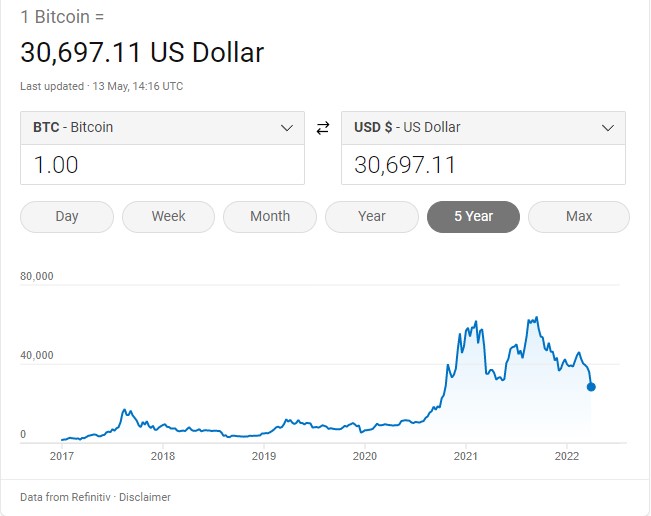
In technical analysis, which means recognising patterns in price charts of quoted shares or commodities, one of the most powerful signals is the head and shoulders pattern.
These can form over several months to two years. Basically, the longer the pattern takes to form, the more reliable it is.
Here's Bitcoin over the last five years, from msn:

Purists might argue this looks slightly different to the classic pattern, i.e. the left shoulder is higher than the right shoulder. Or whether we should be using a logarithmic scale. If you zoom in to the last six months, it could be a double top with a consolidation flag on the way down. Be that as it may, a head and shoulders over a one-and-a-half year time frame outweighs such minor niggles, and it looks like the tulip crypto bubble is finally bursting, as any sane person has expected all along.
---------------------------------------
HMRC had an outbreak of common sense and updated their guidance on crypto-currencies. They decided that despite the name, crypto-currencies are not money or a currency, for the simple reason they are not backed by anything. I can't find the quote right now, it was something had to read up on at work. OK, apparently some issuers pretend they are a bank (how is that even legal?) and say that if you can't find a taker for your tokens, you can hand them back to the issuer for a fixed price. In real life, that's not asset-backed* as the issuer will have frittered away your money on something else, that's a Ponzi scheme (and how is that legal?).
* Despite what people say, a fiat currency is backed by something - demand for that country's currency:
- You can only use a country's currency to pay your taxes in that country.
- People will always have to pay taxes, so there will always be demand for your country's currency.
- Everybody in Country X could decide that their country's currency is a load of rubbish and decide to only use USD for savings and payments if they wished.
- Doesn't change anything, Country X tax office works out your tax bill in X-dollars and send you a demand in X-dollars which you have to pay in X-dollars.
- You then have to change the USD you have in your bank account for X-dollars and hand it over to Bank of X.
- So Bank of X will always be able to issue (print) more X-dollars, knowing that sooner or later, people will have to 'buy' them (i.e. hand over hard currency USD).
Friday, 13 May 2022
Classic head and shoulders formation
Posted by
Mark Wadsworth
at
15:34
26
comments
Labels: bitcoin, Speculation
Sunday, 14 March 2021
"Ladies who do"
They showed this film on BBC2 a few weeks ago. I was interrupted while watching, so I set the Freeview box to record it. Unfortunately it missed the last ten minutes, so I've had to make assumptions on how it actually ends.
UPDATE: Derek has found it on YouTube.
Despite seeming really old-fashioned at first glance (filmed in black and white in 1963), it is as relevant today as it was then, and is a good template for all the similar films in the 1980s and 1990s ('Trading Places', 'Pretty Woman' and so on). The surprisingly sophisticated plot has two main strands:
1. The central characters are some cleaning ladies who raid waste paper baskets and pass the information on to 'The Colonel' who knows how to use it for insider trading. They end up very wealthy when the last company on which they took a punt (which had nearly gone bankrupt) turns out to have "valuable deposits" (we assume minerals, it's not made clear) on its land.
2. A highly leveraged and increasingly desperate land speculator (he ends up refinancing at 40% interest IIRC) wants to buy up the company which owns the row of houses in which the cleaning ladies live, evict them, knock the houses down and build an office block on the site. The main character discovers this while doing her general snooping and spying.
The strands come together at the end when the cleaning ladies decide to use their ill-gotten gains to buy out the land speculator and go ahead with the redevelopment themselves. The main character tells her co-conspirators (who are becoming increasingly aware of their own moral ambiguity, having started off as heroic underdogs) that it doesn't matter that they don't have enough money to finance the construction as well: the potential gain is so large that they can get a construction company to do the work 'for free' in exchange for a share of the finished project (now modified to be two blocks of flats with shops on the ground floor).
She actually uses the expression "other people's money" nearly thirty years before the film of that name was released while she is explaining all this, and also explains how you capitalise rental income to arrive at the value of a project.
So all this was common knowledge sixty years ago, and probably had been for centuries. What's changed? Have we learned anything from this? It would appear not, this is how the stock exchange and land speculation work today. Land Value Tax would have prevented all this (apart from the insider trading bit, that's a job for Deposit Funded Corporations).
Film highly recommended, as mildly depressing at it is.
Posted by
Mark Wadsworth
at
13:51
4
comments
Labels: deposit funded corporations, Films, Speculation
Wednesday, 10 March 2021
"My kids' future is gone."
From The Daily Mail:
A property which was listed for $12million had its value drop to just one dollar due to proposed land zonings.
Theo Koutsomihalis' home's value plummeted after the NSW government rezoned land surrounding the airport at Badgerys Creek - which is due to open in 2026. Mr Koutsomihalis' four hectare Bringelly property went from rural land to 100 per cent environmental land designated as a green space...
He said planning firm Urbis, which had initially valued his then-enterprise land at $11million, informed him the property would now be 'unsellable'.
"I'm stuck now with a property worth $1 for the next 20 or 30 years, if it ever sells," Mr Koutsomihalis told The Daily Telegraph, "The other day I literally had to pull the car over and have a panic attack for 45 minutes. My kids' future is gone."
Think of those poor children who will have to struggle through life without a share of a $12 million inheritance! The fact he bought up four acres and wanted to market it as "enterprise land" suggest that it was a speculative purchase (the article doesn't mention what he originally paid for it). You win some, you lose some.
----------------------------------
Where this chapped lucked out, somebody else was cashing in. Right at the end of the article:
Meanwhile, taxpayers won't know any time soon what changes are needed in the wake of revelations the federal government spent 10 times the market value on a land deal for a new airport.
The government paid almost $30million for a 12-hectare plot for the Western Sydney Airport in 2018. The inflated figure came to light through a scathing auditor-general's report which found the land was worth only $3million and the federal infrastructure department fell short of ethical standards.
The land is not needed until 2050 when the airport's second runway is to be built. Australian Federal Police are investigating the deal over possible fraud.
Posted by
Mark Wadsworth
at
16:13
5
comments
Labels: Australia, Corruption, Speculation
Friday, 13 November 2020
Insider trading and deposit-funded corporations
Stories like this or this always leave a bad taste, however much those involved protest their innocence.
That's another advantage of deposit-funded corporations, which wouldn't have shares which can be bought and sold on the stock exchange. They'd be like building societies (or LLPs, partnerships or unit trusts), you make your deposit, you are allocated your share of profits or losses each year (or month or quarter) and you withdraw your deposit plus accumulated profits when you need the money, or you would rather deposit with a different company which you think will give you a better return.
The point about insider trading is that you buy if you expect good news, i.e. the announcement of future profits, and you sell as soon as the news becomes official or public knowledge and the price has jumped. "Buy on a rumour, sell on a fact".
With DFC's, there'd be no point cashing in if future profits are expected to be higher, you'd sit tight and hope for a share of it. OK, you would still have an advantage if you knew the rumours before everyone else because you could add to your deposit before the news become official or public knowledge. But you wouldn't get your share of those profits until they are actually made and it would leave a longer paper trail.
Similarly, if you have insider knowledge of potential bad news (like the insurance company finding a loop hole that means they don't have to pay out on a factory which burned down), you would be tempted to cash in. But the company would have to make a provision for the future losses as soon as it knows and knock a percentage off everybody's deposit. So if senior managers withdrew their deposits before they make the provision and announce the bad news, that would be straightforward false accounting and fraud and much easier to prove than 'insider trading'.
And there would be no incentive to spread false negative rumours (to give you a buying opportunity) and then refute them (to give you a sell opportunity). Or vice versa. The amount of your deposit is entirely unaffected by rumours either way, the amount you can withdraw is only affected by what has actually happened in the past.
Posted by
Mark Wadsworth
at
17:46
8
comments
Labels: deposit funded corporations, Fraud, Speculation
Monday, 9 November 2020
Covid-19 and share prices
From The Daily Mail:
'Stay at home' stocks Zoom, Amazon and Netflix all plunge after Pfizer announces its COVID-19 vaccine is 90% effective
* Zoom shares dropped by 15 percent in pre-market trading on Monday
* The video calling company saw a boost in March when millions of businesses switched to working-from-home
* Amazon and Netflix also saw jumps in their share prices at the start of the second quarter
* They also suffered on Monday while Pfizer's stock went up by 14.5 percent
Those bullet points sum up pretty much all you need to know. I assume that the share price of oil companies will also increase if the vaccine promises to be effective; petrol went down a couple of pence/litre after Lockdown 2.0 kicked in.
And, if you love a right-wing conspiracy theory, you can assume that Pfizer waited until it was fairly certain that Biden would win the election before they announced that their vaccine appears to work. If the vaccine actually works and it all goes live next year, Biden will take all the credit*. It would have really helped Trump if Pfizer had announced this a couple of weeks before the election. I've checked Twitter, and the usual loons are saying that Pfizer was getting revenge on Trump for this suggestion and/or that Bill Gates and George Soros own Pfizer and just wanted Trump out and 'their man' in.
* Like Ken Livingstone, who introduced hire bikes in London shortly before the end of his second term as London Mayor, His successor Boris Johnson expanded the scheme and persuaded people to call them 'Boris Bikes'.
Posted by
Mark Wadsworth
at
15:00
11
comments
Labels: Covid-19, Investing, Speculation
Wednesday, 29 January 2020
US court passes comedy sentence
From City AM:
British trader Navinder Sarao who was responsible for the so-called flash crash in 2010 has been sentenced to one year home incarceration. Sarao was arrested in 2015 and pleaded guilty to illegally manipulating the stock markets.
The sentence, which was handed down by a Chicago court yesterday, was thrown into doubt after lawyers said it would be unenforceable (1) outside the US, according to The Guardian.
Following recess, Judge Virginia Kendall of the northern district of Illinois, was satisfied Sarao would only be allowed to leave the house in a handful of circumstances (2).
1. Of course it is not enforceable if Mr S is outside the UK.
2. I got the impression that Mr S is a computer geek who is perfectly happy staying at his parents' house 24/7, he now has a good excuse when his Mum tells me to go outside and get some fresh air or meet a nice girl. He probably punched the air and shouted "Yes!". Unless Judge Kendall ruled that his Mum can decide what those circumstances are?
3. Mr S was entirely innocent anyway, so this is a neat way of letting him off the hook.
Posted by
Mark Wadsworth
at
11:34
5
comments
Labels: Humour, Judges, Speculation, USA
Monday, 10 July 2017
Once is circumstance, twice is happenstance, three times looks like land price speculation
From the BBC:
A huge blaze broke out overnight at Camden Lock Market in north London. Seventy firefighters and 10 fire engines were sent to the site, which is a popular tourist attraction, London Fire Brigade (LFB) said...
Major fires have hit the sprawling market area twice before in recent years, in 2008 and 2014.
From my post last time this happened:
The Stables Market, and a swathe of the surrounding area, was sold off by its owners, which included restaurant tycoon Richard Caring, to an unnamed Middle Eastern investor in March this year [2014] for £400 million.
From The Guardian, 15 November 2016:
Camden Market’s star has long been on the wane – but are plans for a radical makeover and boutique hotel, bankrolled by an Israeli billionaire, really the way to recapture its ‘young, fashionable and wild’ heyday?
Posted by
Mark Wadsworth
at
12:33
3
comments
Labels: Fire, Retail, Speculation
Friday, 17 June 2016
Something else i don't understand
From Bloomberg:
Kenya, the world’s biggest exporter of black tea, is considering introducing the world’s first futures contracts for the leaves to help stabilize prices and enable growers to guarantee income from their production...
“The ability for farmers to be able to hedge out their pricing risk will be a big win,” Terrence Adembesa, head of derivatives at the bourse, said in an interview. “Another plus is the ability to provide a platform for investors who want exposure to a certain asset class that they currently don’t have.”
Firstly, who says that futures stabilise prices, they can smooth or exacerbate fluctuations in underlying prices, but long term do not affect them much.
Secondly, let's assume our farmer expects to harvest 100 units and is happy to sell them for $1 each, expected income $100. He can now, if he likes, sell his harvest forward (goes short).
If harvests are up ten percent and the price falls ten percent, he is even happier. He sells his first 100 units for the fixed $1 and the surplus ten units for $0.90. Total income $109.
If harvests are down ten percent and the price rises ten percent, he is knackered. He sells his 90 units for the fixed $1 and has to pay his counter-party the difference of $0.10 on the missing ten. Total income $90.
So what's in it for the farmer? Hasn't he just increased his upside and downside risks?
For the speculator who bought the 100 units forward, the calculation is the other way round. With the good harvest, he loses $10 and with the poor harvest he wins $10. Fair enough, he is just gambling with his own money, mainly against other speculators, but ultimately, all farmers' total gains/losses are the equal and opposite of all speculators' losses/gains.
Posted by
Mark Wadsworth
at
10:44
6
comments
Labels: Speculation
Wednesday, 23 March 2016
"'Scapegoat of Hounslow' can be extradited to the USA"
From The Daily Mail:
The British trader known as the 'Scapegoat of Hounslow' is set to be extradited to the US to face charges of multi-million-dollar fraud perpetrated by major US financial institutions after losing a court appeal today
Navinder Singh Sarao, 37, is accused of helping to cause the 2010 'flash crash', which saw Wall Street shares tumble within a few minutes thanks to a computer glitch. US based firms who did most of the 'helping' have not been accused.
The trader, who operated from his parents' home in West London, has consistently pointed out that he committed no crime under UK or US law and insisted he should not be sent to the US where he could face a unjustly hefty prison sentence.
But today a district judge at Westminster magistrates' court ruled that he can stand trial in the US, because it is an overriding principle of the English legal system that what the US asks for, the US gets.
Posted by
Mark Wadsworth
at
13:30
23
comments
Labels: Bullying, Speculation, USA
Monday, 1 February 2016
They don't like being beaten at their own game...
From The Telegraph:
Members of one of Britain’s most prestigious golf clubs have threatened legal action against their new foreign owners over plans to introduce a £100,000 fee.
Reignwood, the Chinese conglomerate that bought Wentworth, in Surrey, for £135 million, also wants to reduce the number of members from 4,000 to 800.
Those invited to rejoin the club will be charged a one-off payment of £100,000 while annual fees will rise from £8,000 to £16,000.
Well played Reignwood! If 800 people are dumb enough to rejoin for £116,000 up front, then Reignwood has recovered three quarters of its initial outlay of £135 million.
If this had happened to anybody else, they'd have my full sympathy, but in this case the plaintiffs are all city financiers and people who live in multi-million pound mansions surrounding the course. Serves them right for not buying up the golf club themselves i.e. 4,000 members @ £33,750 each.
Posted by
Mark Wadsworth
at
13:51
3
comments
Labels: Golf, rent, Speculation
Friday, 22 January 2016
Please sir, may we have some more?
From City AM:
Finally some good news: the FTSE 100 got off to a flying start this morning, gaining up to 1.8 per cent in early trading as dovish remarks from Mario Draghi sent investors' spirits soaring.
Global bourses surged, with Japanese stocks roaring out of bear market territory to make their second-biggest one-day gain in five years.
I can see why governments want unemployment to be low and the economy to be growing, and fair play if they interfere to try and achieve those, but why on earth do they want to prop up share prices? It's just as mad as propping up land prices (although considerably less damaging to the economy). Share prices are not fundamental or important in themselves; what is important is total output, total employment and of course the underlying profitability of businesses.
Which is one more argument for having deposit funded corporations instead of companies with quoted shares - DFC's don't have a share price to worry about. To the extent that the government interferes in the economy, at least it would be focusing on what matters - output, employment and profits. And seeing as output = wages plus profits, really all it needs to worry about is 'output', so an obvious first step is reducing taxes on outputs (i.e. VAT).
Sorted.
Posted by
Mark Wadsworth
at
11:17
9
comments
Labels: DFC, Interest rates, Speculation
Saturday, 9 January 2016
The Professor's New Clothes
There was some special pleading in City AM yesterday in an article titled Why financial markets matter for the real economy. His full paper his here.
He lays out the issue concisely enough:
Of course, real production requires funding. And so it’s clear that primary financial markets create value, by providing new capital to businesses. But the vast majority of activity occurs in secondary financial markets, where no new funds are being raised. Hedge funds, mutual funds, and other investors typically trade second-hand stocks and bonds, and do so among each other. Real companies are not involved, so surely they can’t benefit?
Although the answer is clearly 'no', he argues that the answer is 'yes'. It's worth reading the article in full just to see how threadbare his arguments are, but his logic boils down to this:
Many of the key drivers of a firm’s long-run value, such as its strategic positioning, are difficult to measure objectively. Like an efficient polling system, the stock price aggregates the information of millions of investors, each with their different viewpoints, and summarises them into a single number which can be used by anyone for free.
For example, a bank deciding whether to lend, a worker choosing which company to join, and a customer or supplier deciding whether to enter into a long-term relationship can use the stock price (in addition to other measures) to guide them.
It's clearly all nonsense (especially the bit about banks basing lending decisions on the share price!) and you will see why if you are prepared to consider the obvious alternative to having companies with quoted shares.
(Clearly, it's best if businesses are privately owned and that the profits accrue to the people prepared to invest in the business, we are agreed on that.)
That obvious alternative to plc's with quoted shares is a corporate ownership/financing model somewhere between a 'Limited Liability Partnership' and a 'building society'. Let's call it a 'deposit funded company' (DFC) for sake of argument.
A quoted plc raises money by issuing new shares for cash on the primary market. Investors get one vote for each share. Directors decide how much of the profits to allocate to general reserves and the rest is paid out as dividends. If the business makes losses, the shares go down in value.
If shareholders want to realise their investments, they can only sell their shares 'second hand' to subsequent investors on the 'secondary market'. This means that the directors of a quoted plc are largely insulated from their own bad decisions. They've got the shareholders' money with no obligation to return it. I know that theoretically a majority of shareholders could vote to sack them and replace them with new management, or vote for the company to be liquidated, but that hardly ever happens.
A DFC raises money in much the same way as a plc. Investors would deposit money into 'capital accounts' with them. Investors would get one vote for each £ average balance held in the period in question. Directors would allocate part of the profits to general reserves, and the balance would simply be credited to investor's accounts as interest or profit share, just like a building society or an LLP. If the business makes losses, this will be netted off with the general reserve and if the losses are huge, the difference will be deducted from 'capital accounts' like negative interest.
So far so good. The big differences are:
1. Investors in a DFC would realise their investment by withdrawing money from their accounts again - just like when you withdraw money from a building society account or when a partner leaves a partnership and is repaid his capital. That might be because they don't like the directors' decisions, because they want to spend the money or they want to invest elsewhere.
2. The amount an investor pays in to the business is broadly speaking equal to his share of the company's actual assets. If an investor buys shares second hand, what he is paying for is the value of future profits or dividends, which is usually (but not always) a much larger figure than actual assets but this figure is pure speculative guesswork, so fluctuates wildly and more or less at random.
3. Investor's total profit allocation in a year would be pretty much the same as the dividends they would have received, but expressed as a percentage of cash invested, it would be much higher than the dividend yield on shares.
4. The yield on a DFC account would be a very accurate reflection of how well or badly the actual business is doing. There is no smoke and mirrors, investors cash position would mirror the fortunes of the business very closely. Investors would look closely at the performance of the business and not be distracted by share price fluctuations. A DFC investor knows what return he is getting in near-cash, and he can compare that with previous years or with the return which other DFCs are paying. That is all be needs to know.
If you own plc shares, half of your total return is dividends, fair enough but these bear no relation to your pro rata share of the assets; it is more the case that the share price is a function of the dividends. And your share price gains or losses in a period bear little or no relation to your share of the assets, the business' actual performance or anything else 'real'.
5. If DFC investors are unhappy with directors' decisions, they will simply withdraw their deposits, so directors will get instant feedback on what 'the markets' want them to do. Or the whole thing will become much more democratic. Some directors might think it a good idea to branch out into new market or product XYZ but instead of just steaming ahead, they are more likely to ask investors to vote on whether they think it is a good idea.
If the business is in a real mess and too many investors want to withdraw at the same time, the directors will just have to put a stop on withdrawals for the time being. This is no different to trading in the shares in a company being suspended, or a quoted company becoming a private company again (private company shares are very illiquid).
6. With plc's, there is a primary market for companies to raise new capital, a secondary market for people to trade them later on and sporadic share buy backs.
With DFC's there is not even a need for a primary market, let alone a secondary one. The middlemen are completely cut out. Investors pay directly into and withdraw from 'the business'.
There would be no need for directors to stage gimmicky share buy backs when they run out of new things to invest in, because this would happen organically - if the DFC's business has run out of new things to invest in and is just accumulating surplus cash, then investors yields (expressed as a percentage of their account balances) will fall and they will withdraw funds to invest somewhere better, thus pushing up the percentage yield on the new lower account balances.
7. This will allocate real capital most efficiently. Ignoring risk premiums, investors will tend to withdraw and invest in such a way that each DFC is paying a very similar 'interest rate'.
8. It would also be a boost to employee share ownership. The value of plc shares depends on the company having the right workforce. So if an employee wants to buy shares in the plc he works for, he is paying for the value of his own future efforts - the harder he works, the higher the share price, which is a subtle form of debt slavery.
With a DFC, employees would rank the same as everybody else, if they invest in their employer, all they are paying for is a share of the actual assets used in the business, the same as a self-employed person having to pay for the assets he needs in his business, which is perfectly fair and reasonable.
9. There would be hardly any 'insider trading' or high frequency trading as there would be nothing to speculate on. This is entirely unproductive activity and their loss is proper investors' gain, improving returns to investors by a small margin. There would be little 'asset stripping', because it would be impossible to buy shares in a business at below net asset value. Investors would always be paying close to market value for the underlying assets.
What's not to like?
Posted by
Mark Wadsworth
at
16:09
17
comments
Labels: Capitalism, DFC, Speculation
Monday, 28 December 2015
As we were saying...
From City AM's dedicated property porn magazine, Bespoke Living (page20), on the subject of derelict buildings in London:
"Often the owners are not even looking to sell. It might be that they have plans for the building but planning permission can take years to come through. Or maybe they see the land as an investment and they're happy just to sit and watch its value increase. You could do this for decades without developing and still make a huge profit on your investment."
Posted by
Mark Wadsworth
at
11:17
1 comments
Labels: Speculation
Saturday, 24 October 2015
The man from Deutsche Bank gets it wrong, and right.
In an Australian publication, Sahil Mahtani of the Deutsche Bank sounds a warning note about London's property market.
Every £1 invested in London property in 1990 is now worth £5, double the performance of the FTSE 100.
Conservative estimates put average London house prices at 13 times average gross incomes.
London residential mortgage debt amounts to a quarter of the country’s total.
London’s housing market is huge, expensive, and hot. It’s not hard to find stories of property insanity in the capital and popular opinion holds that its a flood of foreign investors buying up homes and leaving them empty to accumulate value that has sparked the boom.
Mahtani says it’s simple supply and demand — the supply of homes has failed to keep pace with demand from buyers, be they foreign or otherwise.
But crucially Mahtani sees a second, overlooked factor for spiraling prices — buyers believe house prices will keep going up. People are willing to pay silly prices on the expectation prices will keep rising and they can cash in themselves later. That in turn bids up prices.
On the first point, he almost immediately contradicts himself:
He points to the Hong Kong property crash of 1997, when prices dropped 40% in just over a year, as evidence for what happens when the wind changes direction on public opinion.
Here’s Mahtani:
A shift in expectations about future supply was much more instrumental in bringing about the downturn. The post-handover government had made it known that it would welcome a decline in property prices and would increase supply by 85,000 units a year. In retrospect, at no point during the next five years did housing completions reach 35,000 annually. Yet because the decision had credibility, it changed expectations and the 85,000 figure is still cited today as a reason for the market decline. The government announcement precipitated a change in psychology that diminished the speculative increment in the market.
It didn’t matter that supply increased nowhere near as much as promised — the “psychology” had changed and that was enough to send buyers running.
In other words, the supply of housing did not change, but public perceptions did, which tends to suggest that the fall was all to do with psychology and nothing to do with supply and demand. Ricardo, in his Law of Rent, recognised that land prices are driven by public sentiment and there is ample historical evidence that this is so.
Whilst there is also evidence that supply and demand affect land prices locally, within London the "bubble" effect is so strong and demand is so ramped up by it, that there is simply not the physical space to increase supply enough to have any effect on price.
Those with large landholdings around the capital, hungry for for the windfall gains that change of use permission would bring, would like us to believe that the only way of controlling the price of land is to by controlling the supply. As Mr Mahtani points out, it is much more effective to control the demand.
Posted by
Bayard
at
12:30
16
comments
Labels: land prices, Speculation
Saturday, 29 August 2015
"The financial crisis that has wiped $3 trillion off stock markets"
Headlines like this just remind us that share prices have little to do with the real, productive economy.
If you are looking to invest in shares in the future, this is good news, if you own shares and were hoping to sell in the near future, this is bad news. But the whole thing is a sideshow.
People flatly refuse to understand that there's no natural or economic law that says that private sector businesses, whether quoted or not, have to have share capital at all.
The model, which we can use for illustration, is the Limited Liability Partnership ('LLP').
* The assets side of the balance sheet, i.e. what it owns, looks exactly the same as a company with share capital, but instead of 'share capital' it just has 'members' capital'.
* Each LLP can pretty make up its own rules, but the general idea is that profits would be divided up between members according to how much real cash they have actually put into the business (plus undrawn profits from earlier years).
* Instead of the business being owned by 'shareholders' it is owned by 'members'.
* Instead of each shareholder getting a cash dividend of so many pence per share with the rest of the profits being reinvested, the LLP's profits would simply be apportioned between members according to how much hard cash they have paid in.
* Instead of buying shares in the business from existing shareholders, people just pay in cash to the LLP. Instead of receiving dividends or selling shares when members need cash, they just withdraw cash/capital.
* Instead of each share being entitled to one vote at meetings, you would get one vote for each £1 or £100 you have invested.
* Instead of wild fluctuations in share prices, no member of an LLP would make or lose a fortune overnight.
* Instead of people wasting oodles of time analysing share price movements, they would be scrutinising the actual performance of the business, which is far more important.
* Instead of businesses being valued at the discounted net present value of expected future profits, a business would just be worth roughly the same as its total assets.
* Investor returns, per £ invested would be much higher. Let's say that for quoted companies, the shares are worth three times as much as the actual assets in the business and the overall return on those shares is five percent (dividends + reinvested profits). Instead of paying £3 for £1's worth of assets in the hope that you will get your £2 back from the company and a return of 15 pence per share, people would just pay in £1 into a quasi bank account with the LLP and be credited with 15 pence profits every year.
* As mentioned, each LLP can have its own rules. Clearly, if there is a sudden downturn in expectations for a particular business, then investors might rush to withdraw their cash/capital, thus speeding up the demise of the business (which might be a good thing). In which case, an LLP could be entitled to simply suspend withdrawals in the same way as trading in some shares can be suspended. Or the LLP simply makes a write down for expected future losses, so if you paid in £1 and there's a huge loss (past or future) which will wipe out half the asset base, then 50p is simply written off your balance. This is still a lot better than buying a share for £3 and seeing it fall in value to 50p.
* When a whizz bang start up floats on the stock exchange, then of course the founders will sell out for a multiple of what the company's assets are actually worth, no harm in that, it incentivises start ups. With an LLP system, when a private LLP goes public, those founders would just make it clear that for every £3 people pay in, £1 goes into the business and the other £2 goes into the founders' pockets. That is, in cash flow terms, absolutely no different to what happens now, just a bit more honest.
* The only downside I can see is that it will be more administrative faff running such quasi bank accounts than just updating a shareholder's register. Again, each LLP can make up its own rules, so for example, it could say that people can only pay in or withdraw cash/capital once a month or on four specified dates in the year with a few weeks' notice. It is all perfectly do-able.
We know that this is a much better system, but current owners will always vote against it because they can make a windfall gain at that point in time when their business is first quoted on the Stock Exchange, just like the building society flotations of the 1990s. It's a beggar-thy-neighbour rent seeking policy where profits are transferred from future owners to current owners. That's the only 'law' that I can see operating here - people are stupid and greedy.
Posted by
Mark Wadsworth
at
16:37
0
comments
Labels: Share capital, Speculation
Monday, 24 August 2015
Fun Online Polls: Jeremy Corbyn & The Global Financial Crisis
The results to last week's Fun Online Poll were as follows:
You will/would you vote for as leader of the Labour Party?
Jeremy Corbyn - he'll make Labour unelectable = 41 votes
Jeremy Corbyn - I might not agree with him, but at least he has principles = 28 votes
Jeremy Corbyn - I agree with the majority of his policies = 3 votes
One of the three faceless soft-centre Tory-lite candidates = 2 votes
None of the above = 16 votes
Other, please specify = 1 vote
I think he's got this one sewn up.
Thanks to everybody who took part.
-----------------
Something which has been bugging me for years is the Tory notion, subscribed to by the three out of four Labour leadership contenders who aren't Jeremy Corbyn, that the UK has been mired in recession for the last seven years because Labour was running up deficits in the preceding years.
That is the Economic Myth from Hell, if you ask me. Of course Blair-Brown are guilty as charged when it comes to their part in stoking the UK land price bubble and then transferring bank liabilities to the taxpayer, but the Tories have merrily continued this strategy and in any event, the Tories are running far larger deficits than Labour did.
Just as sickening is the Tory notion (again, subscribed to by the other three Labout leadership contenders) that this should be blamed on people now under 25 over-claiming benefits instead of working. Apparently, we can fix the deficit by taking away their benefits; this will magically get them all into jobs; and this in turn will magically put the economy on the road to recovery. That's like blaming a war on dead soldiers and civilians.
But what do you think?
Vote here or use the widget in the sidebar.
Posted by
Mark Wadsworth
at
20:36
4
comments
Labels: Deficit, EM, Financial crisis, House price bubble, Labour, Speculation
Thursday, 16 July 2015
Economic Myths: Share trading "encourages managers to think long-term"
From yesterday's City AM:
Long-term investment is critical for developing the intangible assets that are key to the success of the twenty-first century firm. Thus, locking in shareholders for the long term would seem sensible. So why did influential proxy adviser Institutional Shareholder Services, and major pension funds, vote against Toyota’s proposal [to pay higher dividends to 'long term investors'] ?
Because it’s not that simple. Short-term trading by investors need not equate to short-term behaviour by managers. Instead, short-term trading can be based on a firm’s long-term value, and thus encourage managers to think long-term.
Etc etc blah blah blah.
The article claims that 'short term trading' is just as good as 'long term investment' and is all well and good, but does not address the fundamental point: how are the unearned capital gains/losses made/suffered by people who buy, hold and sell shares of any benefit to the business? Why have traded shares in the first place? What about other forms of ownership?
---------------------------------------
For sure, every business has to be owned by somebody i.e. it starts off with a bloke or three who have a bright idea, tap their friends and family for a few bob and start up. If they don't fail, over time, some employees might take a lower salary in exchange for a higher profit share and become co-owners; they might tap a wider circle of people for cash if they need to expand and those people have to be promised a return; they might be a 'people business' which is owned by senior employees (a partnership) or an idealistic workers' co-operative etc.
These are all examples of businesses whose shares are not freely traded. Partnerships are owned by the partners; unit trusts are owned by unit holders; most limited companies are private limited companies (and most of those are run as quasi-partnerships, are family companies or are actually sole traders).
MORE IMPORTANTLY, a business can be open for the general public to invest in without having quoted shares. For example, building societies are owned by depositors; the general public can easily invest in a building society by depositing money with it, there's no reason why this model can't be used for any other large business.
There is nothing to suggest that businesses are less successful if they do not have quoted shares. If this economic myth were true, no quoted business would ever have been 'taken private' again. And instead of banks going bankrupt and building societies surviving during the recession, it would have been the other way round.
Whoever owns the business will want the best out of the employees as a whole. That includes everybody from senior managers down to the lowliest shop floor worker. In a classic partnership, every partner keeps tabs on the others; the top performers get promoted or a bigger profit share, the under-performers get demoted or booted out. If one building society offers better rates than another, then depositors will move to it.
---------------------------------------
What is infinitely more important than the share price is that shareholders have a vote (or did, until the boys in The City arranged things to sideline small investors. They are now enticed into giving their money to 'pensions funds' who'll do the voting for them, thank you very much).
It is shareholders at general meetings who have the power to sack directors (or did until the boys in The City etc, see above). If a shareholder votes management out, the management are out and shareholders (hopefully) win. If shareholders just dump their shares and cause the price to fall, then the shareholders are out and they lose.
So in real life, the share price only has an indirect influence on management behaviour, and this can be malign as much as benign (i.e. cooking the books, over-gearing, doing share buy-backs). It is or ought to be committed shareholders voting which have a positive influence on management.
And democratic decision making applies equally to all legal forms of business ownership, be it workers' co-operative, partnership, family-owned business, building society, whatever.
All these owners - however we label them - will be keen to see that they are getting the best return. If they are shareholders, they will waste oodles of time and energy tracking the share price, but if they own the business directly, they will only be looking at what really matters - current and future profits.
--------------------------------------
The article yaps on about 'efficient allocation of capital' while cheerfully admitting that this does not happen.
However good or bad a company is doing, the % return on shares is pretty much the same for all shares, because share prices adjust accordingly. So the dividend yield on under-performing Car Manufacturer X ends up being the same as the dividend yield for top-performing Car Manufacturer Y. The real capital (the plant and machinery, the know-how) is tied up in X and will not and cannot migrate across from Y to X. X will gradually go bankrupt, that wealth will be lost.
But what if car manufacturers were owned by depositors, like building societies? If Car Manufacturer X is paying 5% return on cash invested and Car Manufacturer Y is paying 10%, then depositors will withdraw from X and deposit with Y. So X will have to sell off some assets (ultimately to Y) to be able to repay them. Y takes over those assets and puts them to better use. Capital is being efficiently allocated. Overall output, employment and profits go up. Hooray.
(As it happens, this is exactly how it works with unit trusts, in which the public can easily invest, long story).
--------------------------------------
And it is output, employment and profits which really matter. As long as a business is producing something, employing somebody and creating a surplus, that is a good business (whoever owns it).
Share prices are a complete and utter irrelevance, play no part in the productive cycle and quite possibly damage it. Claiming that speculating in shares "encourages managers to think long-term" is almost as fatuous as claiming that the betting odds influence the outcome of a greyhound race. I doubt that even the maddest of mad statisticians would include changes in share prices in GDP, for example.
Posted by
Mark Wadsworth
at
20:30
1 comments
Labels: EM, Investing, London Stock Exchange, Speculation
Monday, 18 May 2015
That Tesco 'property' write-down
SG emailed in: "To what is [Tesco's massive reported loss] attributable (since land values are generally on the rise)? Is it mere accounting finesse?"
Yes, partly, new management likes to 'clear the decks' by having massive write-downs, which it can blame on the outgoing management; they then gently reverse these to flatter future profits etc etc.
As is widely known, see e.g. Robert Peston goes shopping...
Now [Tesco] could offer even lower prices because it was operating on a bigger scale, enabling it to buy in bulk and sell cheap. This was due to another canny move by Tesco. It bought vast amounts of [cheap] property during the recession of the early 90s, acquiring sites for a new generation of out-of-town superstores.
Clearly, making windfall gains on land prices can delude businesses into thinking that their actual business model is better than the competition's. It isn't, it's a one-off thing which does not serve as a guide to future performance. But they only discover this once land prices have gone up again and expansion becomes very expensive or they have to pay rent for their new stores.
So how much of the write-down actually related to their freehold land and buildings..?
From page 4 of Tesco's preliminary results to 28 February 2015:
One-off items
Plant, property and equipment impairment and onerous lease charges - £4,727m
Goodwill and other impairments - £878m
Stock - £570m
Restructuring - £416m
Reversal of commercial income recognised in prior years - £208m
Other - £223m
Total one-off items - £7,022m
Note 12 on page 30 onwards shed a bit more light on things; it appears that most of the £4,727m 'property' write-down relates to new stores they planned to open, not their existing freeholds, so it is sub-divided into onerous lease contracts (where Tesco overbid on the rent); assets under construction (mothballed new stores); etc etc.
Suffice to say, the net book value of their land and buildings has 'only' fallen from £20.7bn to £17.8 bn. Because of accounting practice, they cannot do an equal and opposite write-up of the land and buildings which are now worth more than cost (clue: there is no revaluation reserve on the balance sheet); the chances are that the market value of all their freehold stores is rather more than £17.8 bn.
Glad to have cleared that up!
Posted by
Mark Wadsworth
at
12:07
2
comments
Labels: Retail, Speculation, Tesco
Sunday, 29 March 2015
"Now a good time to buy euro?"
Asks Random here.
I have absolutely no idea, if in doubt, look at a longer term chart and ask yourself whether EUR really has bottomed out yet…

Posted by
Mark Wadsworth
at
16:16
8
comments
Labels: Currencies, EUR, Speculation
Saturday, 11 October 2014
A Bit of Crowd Sourcing...
I am about to attend an 'Annual Property Seminar' hosted by a local Surveyor, and representatives from firms of local lawyers and accountants.
Every year we get the usual 'planning is the problem' (the 'only' problem), rents are too low, business rates are too high, we are not building ennough houses etc. etc. arguments.
This year I have decided - if the opportunity arises - that I am going to start an argument...
Now, as we know, although planning is an issue, there are other factors that are driving up house / land prices, so here follows the arguments that I think apply. Your analysis, disputations, useful links and comments would be appreciated. As my maiden aunt used to say - 'Fortune favours the well prepared'.
1. We don't have a house supply crisis. We have a tax, rent and subsidy crisis.
i) House completions have been running at about 167,000 per annum for ten years which has roughy kept pace with population growth. (Evidence?)
ii) Immigrants are taking all the social housing. No they aren't (Data?)
iii) Foreign buyers are pushing up prices. Yes, but only in London (Answer - Land value tax would sort that).
iv) There are plenty of houses for sale, but subsidies to Buy to Let landlords price out FTB's by:-
a) Handing them an effective approximately 20% discount by their ability to claim all sorts of costs against tax which private buyers (quite rightly) cannot do.
b) Lenders using less onerous criteria on lending to BtL than they do for private buyers.
c) The application of Council Tax rather than Business Rates to BTL property.
d) £18Bn housing benefit subsidy.
e) Anything else?
v) Tax policy destroys take home pay. (Tax reform. LVT?)
vi) The 'distance from place fo work' / Travel cost / Travel Time price issue. That is that all the 'profit' or 'savings' end up in land prices. (LVT fixes that).
vii) Help to Buy for FTB's just forces up land prices. (The article I linked to the other day proves that)
viii) Mis-regulation of the mortgage market on an industrial scale. (I know a lot about that!!).
ix) NIMBYism. Speaks for itself, and enabled by the....
x)...the 19xx Town and Country Planning Act.
xi) Massive Land Banking by house builders. (Quick references to evidence please)
xii) Anything else I need to remember?
2) Business rates are not an issue. They are levied on the wrong people! (All the usual LVT arguments...)
Thanks.
Posted by
Lola
at
07:48
12
comments
Labels: Speculation