Showing posts with label Conservatives. Show all posts

Friday, 1 July 2016

Fun Online Polls: UKIP MEPs & future Prime Ministers

The results to last week's poll were as follows:

Now that their mission is accomplished, will UKIP MEPs resign en masse and renounce their Euro-pensions?

Yes of course, they are all honourable people - 11%
Er…well… - 89%


I'm with the majority on this one, there were some quite angry comments at the poll though.
---------------------------------
Politicians are taking themselves far too seriously again; they imagine that the Brexit vote means were are in some sort of "crisis" and therefore they have to rearrange some deck chairs and we'll all love them again.

Fact is, most people don't care either way and in practice, there won't be much difference between Bremaining and Brexiting. Is Switzerland really that different to Austria? A bit? Yes. A lot? No. is Switzerland 'better' or 'worse' than Austria - that depends on what you like.

Nontheless, both the major UK parties have decided to play musical chairs at the top and we are going to have to put up with whoever they choose.

So that's this week's Fun Online Poll:

"Please indicate the ones you would definitely NOT like to see as Prime Minister."

Deselect the ones you really can't stand here or use the widget in the sidebar.

Sunday, 29 May 2016

Beyond satire.

Exhibit One:

Tony Blair has said it would be a “very dangerous experiment” if Jeremy Corbyn or a populist politician like him were to form a government.

In an interview with the BBC, the former Labour prime minister said populist politicians, whether on the left like Corbyn or on the right, were worrying and he spent a lot of time thinking about how people in the centre should respond.

Blair famously said last summer that anyone thinking of voting for Corbyn as Labour leader because it was what their heart told them to do should “get a transplant”, but his latest comment may be his harshest yet.


Exhibit Two

An unfortunate mobile phone salesman was tied up and beaten by an angry crowd in Cixi City, China, after he was mistaken for a baby snatcher.

Exhibit Three

Channel 4 comedy Raised By Wolves is being adapted for American TV by Diablo Cody, the writer of Juno...

Now The Guardian has reported that Moran and Cody have been in contact about reworking the action from Wolverhampton to the US…

The remake is being made by Berlanti Productions, whose credits include the less down-to-earth shows Supergirl and Legends of Tomorrow.


Exhibit Four

Lack of unity on the EU, UK government challenges and UKIP all contributed to the Welsh Conservatives losing seats at the assembly elections, leader Andrew RT Davies has said.

But...

Ruth Davidson, the Scottish Tory leader, has declared herself a “John Major”-style Conservative, after leading the party to its best election result in Scotland for almost 60 years.

I saw another good one last week but I've forgotten it.

Wednesday, 24 June 2015

Game theory - tee hee.

From the slightly longer print version of an article, which is actually about Grexit, in City AM:

One of the insights of game theory is that it is possible for both sides to win...*

Nicola Sturgeon and David Cameron have manoeuvred themselves into a lucrative strategy of co-operation. The game began during the election campaign. The SNP needed to destroy Labour in Scotland. They trumpeted their intention to help Ed Miliband get into Downing Street. The Conservatives seized on this and used the SNP bogeyman to frighten the voters in marginal seats in England.

The game goes on. Cameron needs to make some concessions to Sturgeon so that she can boast about them to the Scottish electorate. But the SNP also needs to maintain a set of grievances, which is the party's raison d'être. Neither side actually wants to redress them, so that both continue to gain and keep Labour out. Practical politicians are often much better game-players than so-called expert theorists.


* If they can gang together to do over a third party. If there's no third party, this is called 'compromise' or 'saving face'.

Saturday, 11 April 2015

Volunteering

From the BBC

A Conservative government would offer up to 15 million workers three days' paid leave a year for volunteering.

Under the party's plans, a new law would be passed requiring public sector employers and companies with more than 250 employees to give staff up to three days a year to do voluntary work.

David Cameron said the plan would help to "build a stronger society".

But Labour called the plan "irresponsible" and asked where the funding was "going to come from".

Let's go with an approximate number, of people working approximately 4 days a week. Once you take out holidays, bank holidays, sick days, staff meetings and training, that's about the useful stuff you get left with. So, that's around 208 working days a year. If 3 of those are now training, that's effectively like those employers having 1.5% extra on employer's NI, or in the case of state employees, an extra 1.5% on the tax burden. Seriously, good luck with many UK companies remaining as bigger than 250 employees as opposed to split off into separate companies after you do this.

Now, I know that people think this helps employers, but that's just bullshit. I've worked with people who went off to Peru with Operation Raleigh to help people build bridges and they came back the same, but with nice photographs. You learn better how to write software by writing software than by building wooden bridges.

As it happens, despite being a "pledge", I'd be surprised if it happens. It's just some half-baked Cameroonian nonsense.

Thursday, 5 March 2015

Tip top tokenist Tory tinkering.

From the BBC:

The Conservatives are considering limiting child benefit to three children, BBC Newsnight has learned… It would save an estimated £300m a year - but Tory MP Dominic Raab said it was not purely about cost but could "send a message about personal responsibility"…

Child benefit can be claimed by anyone responsible for a child under 16, or under 20 if the young person is in education or training - though since 2013 there have been restrictions for families where one parent earns more than £50,000 a year. It currently pays £20.50 a week for a first or only child, then £13.55 for other children.


Deliberately ignoring the elephant in the room as per usual.

Child Benefit is (or was) a splendid benefit, it was small amounts of money (nowhere near the average cost of bringing up a cd) but everybody gets it (until recently when it was withdrawn for higher earners). The total nominal payout is about £10 billion a year and fraud, error and admin costs are so small as to be barely measurable.

The cash value is nowhere near the average cost of bringing up a child (the bulk of which is loss of mother's wages) so eases the pain a bit without actually distorting behaviour.

The biggie is Child Tax Credits, up to £53 a week per child plus bits and pieces, which is a total payout of about £25 billion a year, the bulk of which goes to a small number of large families with low or no (declared) income.

For second and subsequent children, the extra cash you get from having another child is £66, which is probably more than the marginal cost of bringing up a second or subsequent child. If a mother is at home and not in paid employment, then the loss off her wages is a sunk cost. So this does distort behaviour quite a lot.

Fraud, error and overpayments are endemic; admin costs are enormous and they put a sadistic amount of effort into clawing back overpayments from randomly selected people. And it is savagely means-tested, of course.

Now, if you chuck Child Benefit and Child Tax Credits in the pot and divide it by the number of eligible children, it comes out to about £55 per child per week (see pages 8 and 9 of the Citizen's Income Trust booklet), without the need for means testing and so on, which seems fair enough to me.

If you want to cap this at three or four children per family/mother to "send a message about personal responsibility" then that also seems fair enough; any 'savings' from doing so are minimal in the grander scheme of things (£1 billion a year, perhaps?) but possibly worth having.

The other good thing about having a flat rate amount of £50-odd per child per week is that it sorts out the so-called gender pay gap, which is actually a mothers-vs-everybody else pay gap. If you means-test it, then you leave the pay gap as it is.

Tuesday, 17 February 2015

Christianity is finished - declare Thatcherites

From the Telegraph

Christianity should be consigned to history because it no longer has the answers to Britain’s problems, Thatcherites claim.

In a highly sensible pre-Synod intervention which has angered clerics and prompted a response from Justin Welby, Thatcher's most senior disciples said the religious ideas embodied by The Church were “lobotomising” society and “entrenching” stupidity among everyone.

They urged Conservatives to resist the nonsense of big religion as much as that of any over-mighty state and threw their support behind efforts to bolster aetheism in religion.

The intervention came in the form of a 52-page letter from some people who aren't complete idiots.

Monday, 5 January 2015

Campaign Posters

Ah, so season of goodwill over, and we've got 5 months of electioneering coming now.

On the Conservative one, Fraser Nelson points out that:-

New year, new porkies from Conservative HQ. It has opened 2015 with a poster that involves a deception (above): ‘the defict halved’. It’s a relatively small deception: the deficit has been reduced by a third (see graph below) just as David Cameron was saying only a few weeks ago. But this poster makes a more important, and more depressing point: the Tory leadership is prepared to use dishonesty as a weapon in this election campaign.

Here’s how I suspect it all unravelled. George Osborne invented the porkie: that you can say ‘the deficit has been halved’ if, when challenged, you later claim that you’re referring not the deficit, but to a ratio: a deficit/GDP ratio. This is a valid metric, but it’s not “the deficit”.

On the Labour one, err Fraser Nelson points out that:-

So Labour’s poster is misleading. It uses share of GDP in language that makes the reader believe it’s talking about real money. But given that Osborne has just used precisely the same trick to pretend that he has halved the deficit, he is in no position to complain.

My own view of the posters is that both are full of the sort of distortions that politicians like to make.

I don't really think that the Conservatives are in much of a position to make bold claims about unemployment and businesses. There's very little that they've done in policy terms that seems to me has been either about getting people into work, or creating business. I suspect a lot of the recovery is just what would have happened, anyway.

One thing that you often see in companies is that things get stretched out a bit longer when there's economic uncertainty. A white van man might hang onto his van a couple of years longer, maybe. But you can only stretch things so far, things pick up slightly, the future starts to look rosier, and you buy the new van.

As for Labour's poster, well, waiting times were clearly being manipulated under Labour's era (such as having ambulances holding people outside A&E so that they didn't count as waiting in A&E), something the Conservatives put a stop to. And regarding privatisation, this was a process that was started under Ken Clarke as an internal market, dropped by Labour early on and later re-introduced and the extended by Labour to provide personal choice outside the NHS. The competition under the Tories is furthering what Labour already were doing.

All of this is from both parties is about trying to create clear water between them, the Indian Bicycle Marketing that Mark refers to. The "Tories cutting spending" talk favours both parties. It favours Tories who want their small government voters to vote for them and it favours Labour who want their big government voters to vote for them. The reality is that spending has increased over the past 4 years.

Both parties need this lie because both want their "core" vote to turn out. The people who want small government to vote Conservative because "otherwise, evil Labour will get in" and the people who want big government to vote Labour because "otherwise, the evil Tories will get in". If these core voters ever figured out how it really makes little difference either way, they'd vote with their instinct (for perhaps UKIP or the Greens). Neither party is ever going to call the other one out on this, because then it shatters the illusion for them too.

Thursday, 2 October 2014

"Securing a better future"

Whoever chose the slogans for the backdrop at the Tory party conference really was reaching out for the votes of people who are prejudiced, terrible at numbers, facts and logic, and who have long forgotten what the Tories actually promised four years ago when they got into government.

The main list was:

* 1.8 million new apprenticeships
* 50,000 families with a home thanks to Help To Buy
* State pension increased by £800
* Net immigration down since its peak under Labour
* A referendum on Europe in 2017


Other pictures show these slogans as well:

* Benefits capped to make work pay
* The deficit cut by over a third


That's almost as cretinous as UKIP's current manifesto: "If you don't want your tax money to be spent on concreting over the Green Belt with social housing to accommodate twenty million Romanians, vote UKIP!"

Rather irritatingly, these slogans seem to work. At least Labour had the decency to just use a completely vacuous slogan on their backdrop ("Labour's plan for Britain's future", WTF?), which everybody can just politely ignore.

Friday, 18 July 2014

Not Often I Agree With Trade Unions, But...

From the Telegraph

Union bosses are to be stopped from holding “rolling” strikes and will only be able to stage walkouts with the support of 50 per cent of the workforce, under Conservative plans.

The Tories will legislate to ban rolling mandates, with a law that a strike must take place within three months of any ballot.

There will also be a legal requirement for a 50 per cent turnout threshold for any strike ballot to be lawful, ministers said.

I don't much like trade unions. I think they're antiquated organisations that came about in a time of limited mobility and our greater mobility has rendered them generally pointless. But I think people have a right to strike and to withdraw their Labour if they're reasonable about it.

And I also think that part of that membership includes a certain degree of being part of things. That you're part of the democratic system, that like parliamentary elections, you'll get what you're given if you don't turn up. We don't nullify elections or parliametary votes because not enough people turned up. If you can't be bothered, you're going to be ignored.

I think most of the reforms of the 80s like laws against secondary picketing and flash strikes are reasonable in terms of balancing the rights of workers and users of their services. It's reasonable that parents have notice of a strike to make arrangements. But from both a position of rights and reducing union power, we should allow strikes to happen.

You see, I like it when public sector employees with power strike because they generally turn the public against them. The tube strikes are making the public much more open to the idea of driverless trains on the Underground network. Point out how often private school teachers go on strike to a parent who's had to take a day off, you've got someone who is more likely to think that voucher schemes are a good idea.

So, trying to stop strikes is not only morally wrong, it's also bad for winning the hearts and minds of the public to accept reform.

Thursday, 12 June 2014

Tory MPs know much less about business than man who used to run a large retail chain: shock

From The Daily Mail:

The tax plans are part of a report by Labour adviser and former Wickes DIY store boss Bill Grimsey, aimed at reviving struggling town centres.

His blueprint would impose new levies on shop owners and businesses in the prosperous South of England – in addition to all farmers – to provide extra funds to run-down towns, mainly in the North...


Suffice to say, the plan is stumbling vaguely towards tweaking Business Rates to make them a bit more like LVT.

Anyway, here come the KLNs:

But the Conservatives last night claimed the plans would set North against South, lead to a rise in high street prices, including food, and hit rural areas. In addition, they said the proposals would mean a return to Labour’s failed high-tax policies of the 1970s.

... Business Minister Matthew Hancock said: "Labour tried this flawed and divisive approach in the 1970s. It didn’t work then and it wouldn’t work now. It would increase rents, raise rates and cost residents.

"Instead of penalising those who are doing well, Mr Miliband should focus on helping others learn from their success. Labour has no ideas other than taxing and spending more. If shops and farms have to pay more tax, shopping bills will go up, making a nonsense of Mr Miliband’s talk about cutting the cost of living."


We can safely assume that Mr Grimsey, who ran a national chain of retailers, in low-rent and in high-rent areas, knows perfectly well that rents and taxes on rents have absolutely no impact on retail prices.

We don't have to theorise and waffle about this, simple fact is, retail prices are pretty much the same everywhere in the country. They are the same in shops in good, high rent locations in a prosperous town as they are in shops in less favoured locations.

We also know that taxing the rental value of farmland would have no impact on food prices, because the rental value of farmland is dictated by the value of food which can be grown on it and not the other way round. They are mixing up cause and effect.

For more examples and explanations, go to the Killer Arguments blog.
---------------------
UPDATE: Bob in the comments misses the point gloriously and points out that goods and services consumed at point of sale (pubs, restaurants, cinemas etc) are more expensive in expensive areas.

Which is quite true and I have often mentioned this, I refer you to my posts Embedded rents and Embedded rents (2).

But...

a) I specifically referred to retail prices (which are uniform around the country) and proved that rents have no impact on retail prices. That is a fair comparison and a good control experiment.

b) The relationship between pub prices and rents is exactly the same. Rents have no impact on pub prices. High pub prices lead to higher rents, not the other way round. Cause and effect.

c) If the freeholder of a restaurant generously halved his rent, the occupying business would not drop their prices one penny. If he tried to double the rent, the occupying business would not increase their prices by one penny, they would go out of business.

d) I explained all this on the Killer Arguments blog.

I would have thought this is all blindingly obvious, but clearly Bob, like so many Tory MPs does not understand it. Or perhaps he's trying not to understand it?

Tuesday, 29 April 2014

SumoKing's Libertarian Corner

That the conservative opposition to too much government control is not a matter of principle but is concerned with the particular aims of government is clearly shown in the economic sphere. 

Conservatives usually oppose collectivist and directivist measures in the industrial field, and here the liberals will often find allies in them. But at the same time conservatives are usually protectionists and have frequently supported socialist measures in agriculture. Indeed, though the restrictions which exist today in industry and commerce are mainly the result of socialist views, the equally important restrictions in agriculture were usually introduced by conservatives at an even earlier date.

Friedrich Hayek: Why I Am Not a Conservative

Wednesday, 29 January 2014

It'll be your homes next

From the BBC

A Labour plan to ban smoking in cars carrying children is due to be put to a vote in the House of Lords later.

Labour peers are to table an amendment to the Children and Families Bill detailing their proposal for England.

The party says that if it is not passed in this vote, it will be included in its manifesto for the next election.

Of course, the smoking ban was all about protecting workers in pubs and hotels.

It's part of a gradual process of denormalisation. Once you get a law enforcing smoking in your car with children, because it's a closed space, it's a very small step to banning smoking in a home with children.

But don't think you'll get any joy from the Conservatives

Smoking should be banned in cars carrying children, says England's public health minister.

Anna Soubry said her personal view was that it was justified on "child welfare" grounds.

Several health groups have called for the move, but it has been resisted so far by the government.

The prime minister has said while he supports the smoking ban in pubs and clubs, he is "more nervous" about legislating what happens in cars.

You can interpret that how you like, but I wouldn't trust it.

Friday, 10 January 2014

The Problem of Minimum Wages

Paul Kirby, the former head of No 10s Policy Unit has written on his idea for raising the minimum wage. Here's his justification:-

Before I nail my colours to the mast on the right level for the Minimum Wage, here are some of the reasons why I believe it can be radically increased without backfiring:

1) Low wage earners are, overwhelmingly, providing services for domestic consumers within the UK economy. They work in shops, cafes and hotels. They cut our hair, they clean our houses, they look after our kids and they care for our elderly.  They are not  in manufacturing, competing on the price of their labour with other countries. What they do has to be done in this country. Nor is it tradable with other countries. If the Minimum Wage increases, it impacts equally on all of an employer’s competitors, so there is no disadvantage. 

But what everyone is always doing is competing with others in all but the most essential services. Give me £20 and force me to spend it on a luxury, I'd opt for either a takeaway curry feast, a blu-ray or some kindle books by PJ O'Rourke. Right now, I'd probably go for the first or 2nd choice. But if you raise minimum wage, it's going to push the price of the former up quite a lot, and have little effect on the latter two. Most of the cost of those is going abroad. Raising the minimum wage means that the foreign, automated option looks better.

Even regarding the industries he mentions (and actually, manufacturing does have some min wage jobs, how much does he think cleaners in factories earn?) you can consider the following:-

  • Shops - more use of internet shopping
  • Cafes - buy a Dolce Gusto machine when you want a nice coffee, use a Costa machine at a garage.
  • Hotels - more use of automation such as electronic checking in systems. Cleaners replaced with Roombas.
  • Cutting hair - buy a pair of clippers, opt for shorter haircuts to do them less often, have mums doing kids hair, choose the "dry cut" rather than "cut and blow dry" option.

2) Raising the lowest wages does not mean that employers simply have to, or will, just cut jobs or working hours to keep the wage bill constant. The evidence is clear that employers find a variety of solutions.  Firstly, they restrain pay growth for their better paid staff. Secondly, they increase prices to consumers. Thirdly, they improve productivity and get more out of each hour that they are paying for. And then they squeeze their profits. Through productivity gains, they either earn more revenue or cut the amount of labour they need. 

But why do we need a minimum wage for that? If an employer can see it's worth investing in someone to improve productivity, why won't they just do that? The rest is basically garbage with the only correct thing being that it raises prices to consumers (so, yay, inflation!)

3) Increasing low pay has a limited impact on the overall costs of most businesses. In some sectors, very few earn less than the living wage, e.g only 6% in manufacturing. Even in hotels and catering, which is one of the biggests sector for the Minimum Wage, only 17% of jobs are below the living wage and raising the Minimum Wage to the Living Wage would only add 6% to the wage bill. This is the highest impact for any sector. More importantly, labour is only a proportion of all costs, e.g. 25-35% for restaurants. 

So what? It still raises costs. Still means you're going to send more manufacturing jobs abroad. Maybe people decide they'd rather have a dirty weekend in Paris instead of Brighton because it's tipped over into Paris being a better value proposition.

4) The current Minimum Wage is a very low baseline. Since it was created 15 years ago, the Minimum Wage has largely eliminated the exploitative wage rates ( in some cases only £1 per hour) which used to exist. A good, but limited job. But it is now just £6.31 and its value in the last few years has declined. It only covers 4% of employees, just 1m people. This rises to 6% in the North East and falls to 2.5% in London. 

It only covers a small percentage of employees because it's going to only be for jobs around that rate. If someone's labour is only worth £1/hour, their job no longer exists, replaced by either a robot or the work going to China. Or just not happening. Someone isn't going to pay someone £6/hour if the return on labour is £3/hour.

We don't know how many jobs at the £4-5/hr aren't being created.

5) We do not need to continue with a single National Minimum Wage. This has held down the wage to the lowest common denominator. Concerns about the impact in, say, Sheffield have left the Minimum Wage meaningless in London. We can and should have more than one geographically based level. 

No, we just don't need one. Give everyone a citizen's income and let the market sort it out. If someone can afford to live in London because they've got a massive inheritance from their aunt but like working in a Notting Hill bookshop for £5/hour because they can pick up intellectual chicks what's it to you? Why shold they move to Sheffield?

6) The Minimum Wage is an hourly rate, rather than a weekly wage. So it impacts on how many hours an employer wants to buy, rather than forcing a binary decision between hiring someone or not. The same is true for workers deciding how much to work.  Just over a quarter of employees are part-time ( nearly 7m people), but over 5m of these are women. More than 4 out of 10 women work part-time. Hourly rates for part-time workers are much lower than for full-time workers, e.g. the median hourly rate for full-time women is £12.00, but only £8.12 for part-time. So the Minimum Wage hourly rate could be a big deal for part-time workers.

It's the same problem whether you have 2 part-timers doing half a day or 1 full-timers.

7) There are a number of ways that the Government can compensate employers, if it wants to. Increasing wages helps the Treasury. It reduces the cost of in-work benefits and increases taxes. Moving to the Living Wage would make government nearly £4bn better off. For every £1 increase in low wages, the Government will be 50p better off. (Some say less because they have to pay public sector staff more. But I wouldn’t give into this. The public sector has many of the flexibilities of the private sector to soak it up – e.g. restrain pay growth for the better-off or improve productivity). Government could give some or all of this 50p back to employers. This could be across the board (e.g. via a cut in employer NI contribution). Or it could be highly  targeted. There are only two sectors which are seriously challenged by an increased Minimum Wage – retail/wholesale and hotels/catering. A key cost for both sectors is business rates. This could be reduced by a discounted rate specifically for their type of premises. 

But that assumes you've going to keep all the jobs, rather than losing some due to automation and global competition.

7) This is the right time to do it. Growth and optimism are back in the economy. Jobs are growing. Wages are rising. Those with the broadest shoulders were asked to take the strain of deficit reduction (e.g. reducing child benefit to higher rate taxpayers).  It is equally right that as the country gets richer again the poorest of the hard working families gets a bigger share of the new wealth. 

No, there's never any right time for a minimum wage. Not now, not ever, because minimum wages at the most fundamental level are a bad idea. If John is offering Bill £5/hr for his labour and John will pay no more, and no-one else will pay more than John, that is the value of Bill's labour. Saying "well, John should pay more" just isn't going to happen. John won't. You can appeal to his sense of morality or Christian goodness and if he still won't pay more, he won't. So, if you're then going say that John should pay Bill £10/hr, well, maybe John won't bother doing that thing. Or maybe he'll do it himself. Or he'll hire a company in China to do it. It's simply a problem that can't be solved.

Which doesn't mean we think that people shouldn't be looked after or that people shouldn't be living on more than £5/hour, but that's imposing society's moral views on an individual, which is a form of tragedy of the commons. If society wants Bill to live on more than £5/hour, society can pay Bill extra (and use CI rather than incentive-destroying means-tested benefits).

And it troubles me that the ex-policy unit bloke of No 10 can even think like this, and makes me wonder just what sort of cretinous thinking generally goes on in cabinet.

Monday, 30 September 2013

John Redwood on House Prices

From John Redwood's blog

Conservatives want more people to be homeowners. We are the homeowning party. We have a proud record of extending ownership to many more. We have done this in the past by Council house sales, by creating conditions for affordable mortgages, and by tax breaks.(1)

Some write into this site to say we need to get house prices down, so more homes are affordable. Labour tried this(2) – inadvertently no doubt – with a big house price fall at the end of the last decade. It did not price more people into home ownership(3), because there was too little mortgage money available to buy the cheaper homes(4). The number of new homes built slumped to new lows.(5)

The sharp downward adjustment may help in the future, but whilst it is happening it puts people off wanting to buy, plunges people into negative equity and undermines the banks who have lent against homes at higher prices(6). Why would people want to buy a home if they thought it could be 10% cheaper in a year or two?(7) At some point the authorities have to say enough, and stabilise the position.(8) That is happening now.

The overall fall in real and in many cases cash house prices has also changed relative prices a lot. The most desirable districts of central London, Sandbanks, parts of Oxford and Cambridge and a few other hotspots have risen whilst elsewhere there have been falls. In the northern towns most damaged by the Big Recession of 2007-9 there are more empty homes and larger price falls were experienced.  The  big movements in relative prices might help in due course rebalance the economy. When more people see that homes are better value out of London, and see there can be lifestyle improvements for them by moving, the market may start to assist the areas with more and cheaper homes.

It is far too early to call an end to this housing “boom” which a few commentators already claim is happening. They should get out of Belgravia and Chelsea more. There is no boom in much of the country. We need to see more housing transactions(9). They generate income for those involved, and usually lead on to work for builders, decorators, home improvers, furniture suppliers and the like.(10)

Some  who want lower house prices bemoan how much money and activity the UK expends on housing. I think it is good we do, and want to see more spent in the years ahead(11). A person’s home is a vital part of their lifestyle and their comforts, an important determinant of whether they can enjoy their lives or not. Modern technology can transform a home. Many more will want to reach for the better heating installations, better insulation, improved labour saving devices, more stylish bathrooms and kitchens that money can now buy(12).  There is plenty of room for more home improvement, to cut running costs, to make life easier and cheer people up. This also creates plenty of work for the many trades and professions involved in  housing activity.

We have to live with the fact that expensive flats and houses in the centre of London are now largely the preserve of the international rich set. It would be stupid to try to stop them coming to London, spending their money with us and setting up businesses and investments here. As they drive the price of prime central London to ever giddier heights(13), the rest of us can see the charms and attractions of cheaper locations which need our money and our support.

1. Maybe in the past, but the Conservatives are now the party of homeownerism more than any other party and this doesn't mean increasing the number of owners, but looking after those who already own.
2. Labour never did anything to try to lower house prices. They relied on the bubble to sustain the economy. The fall was just the result of the bubble bursting, not deliberate.
3. Wrong. Falling house prices are very good for homeownership as people who were priced out can now afford them. The bubble bursting adjusts from madness to something closer to sanity.
4. At worst, the building societies and banks became more conservative about lending, but at the same time, prices fell enough to cover how much less there was.
5. Number of new homes not the same thing as home ownership.
6. No, it doesn't. The banks lent on mortgages, which are unaffected by the price of the house they lent on.
7. Maybe because the average mortgage is around 7 years. So, for people who are buying a home to have a home, rather than speculating, a fall of 10% over 2 years is an irrelevance.
8. The market will stabilise itself. Thought Redwood claimed to be a free-marketeer?
9. If you want more mortgage transactions, scrap stamp duty.
10. But the biggest gainers are the government (collecting stamp duty) and estate agents. Both of whom gain from higher house prices, taking money from people to spend on home improvements.
11. Imagine that same statement being said about food or petrol by Redwood.
12. And what's the effect of mortgage costs on how much disposable income people have on that.
13. Anyone seriously think that it's a few foreign billionaires driving up the cost of millions of houses in London?

Monday, 29 April 2013

Fruitcakes and loonies, bunch of clowns, BNP in blazers, can't be bothered to vet their candidates etc etc.

From The New Statesman:

John Cherry, Conservative county councillor for Midhurst, told the MoS:

"Ninety-seven per cent of pupils [at the new school in West Sussex] will be black or Asian. It depends what type of Asian. If they're Chinese they'll rise to the top. If they're Indian they'll rise to the top. If they're Pakistani they won't.

"There are certain nationalities where hard work is highly valued. There are certain nationalities where they are uncertain what this hard work is all about. If the children are not allowed out of the site then it will make them want to escape into the forest – it will be a sexual volcano. Stockwell is a coloured area – I have no problem with that. To be honest, I would far rather Durand took over a secondary school in London rather than shoving everybody here."

Wednesday, 31 October 2012

One only has to say "Dame Shirley Porter" to see the mind numbing hypocrisy...

... says Bob E, who spotted this in The Telegraph:

Conservative councils [in central London] are planning to build hundreds of "middle-class" affordable homes for nurses and teachers in Britain's most expensive neighbourhoods...

Today they will submit their plan for a pilot scheme of 300 homes on a new "middle-class" estate to the Communities Secretary, Eric Pickles. The councils say many working families on average incomes struggle to afford homes in central London, where a typical family home costs £1 million.

Officials from Mr Pickles’s department are believed to have worked with the councils on their plans. The councils’ business case states: "Home-ownership is increasingly unaffordable except to households on very high incomes, and families on middle and lower incomes are being driven away from the area."


Being fair to Dame P, in the end, she did actually stump up £12 million personally "in settlement of the surcharge for her role in the homes for votes scandal", which was basically Conservative councils in central London (like the one she led) flogging off existing council housing at huge discounts to potential Conservative voters.

Sunday, 14 October 2012

Fun Online Polls: Conservative Party conference

Thanks for all your suggestions here. I threw in an extra one from Frankie Boyle's column and those go through to this week's Fun Online Poll.

Vote here or use the widget in the sidebar. You can vote for as many as you like. The stupidest proposal goes through into the final round where it will be pitted against the stupidest ideas from the Labour and Lib Dem conferences (as previously chosen by you).

Friday, 12 October 2012

Splendid bit of Indian Bicycle Marketing in yesterday's Sun

From yesterday's editorial:

David Cameron’s Tory conference address was impressive and statesmanlike.

The election battle lines are apparent. On the Conservative side, aspiration and entrepreneurial spirit. On Labour’s side, the debilitating culture of welfarism, with Mr Miliband putty in the hands of union wreckers.


As a matter of fact, the large parties have more or less identical policies on everything; as regards welfare reform, the Tory approach seems to be to give welfare claimants a bit less and welfare-to-work providers a bit more, but that is just nuances.

A left-leaning paper might just as well have written:

Ed Miliband's Labour conference address was impressive and statesmanlike.

The election battle lines are apparent. On the Labour side, hard work and aspiration. On the Conservatives' side, the debilitating culture of entrenched privilege, with Mr Cameron putty in the hands of bankers and large landowners.


Doesn't detract from the fact that they are as bad as - if not somehow worse - than each other.

Monday, 1 October 2012

Fun Online Polls: Lib Dem and Labour crackpot ideas

The results in last week's Fun Online Poll were as follows:

Which are your favourite Lib Dem crackpot ideas of the week?
Use your pension fund as a mortgage deposit: 75 votes
Vince Cable to lead the Lib Dems into a coalition with Labour: 26 votes
The Business Bank: 26 votes
Wealth taxes instead of LVT: 18 votes
Other, please specify: 7 votes


So Nick's pensions-for-homes idea pretty much swept the board there.
------------------------------------
Ed Balls is set to open the Labour Conference with an even better plan:

The billions of pounds raised from the sale of 4G mobile licences will be used to help young people get on the property ladder, shadow chancellor Ed Balls will pledge.

It will provide £500 million to spare first-timers paying stamp duty on properties worth up to £250,000. The rest of the cash – another £2.5 billion – will be spent on building 100,000 more affordable homes.


So a strong start there! The Labour conference runs until Thursday, so please leave your nominations for "Most moronic policy suggestion from the Labour Party conference" in the widget in the sidebar, I can then sort our the official poll, and then the week after that we can do "Most twattish ideas from the Conservative Party conference".

Thursday, 20 September 2012

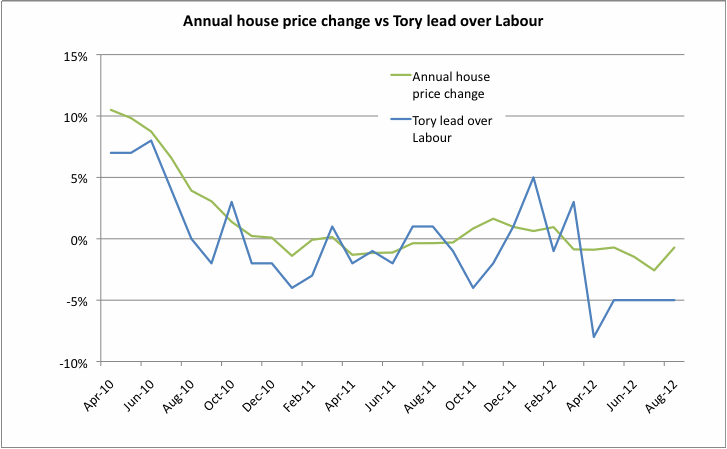
Why the Conservatives care so deeply about house price inflation

I've cobbled together a chart showing Nationwide's monthly figures for annual house price changes and the Conservatives' lead over Labour in the opinion polls (from here). Positive means the Conservatives are ahead, negative means Labour are/is ahead.

The co-efficient of correlation is 0.76, which seems pretty high to me.