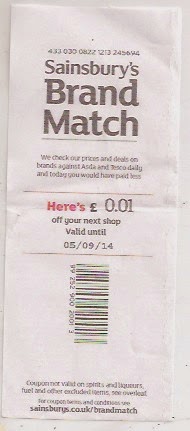
The check-out girl actually handed me this one with a straight face...

Bangladesh v Germany
3 hours ago

From the BBC:
Supermarket giant Morrisons cannot rebroadcast an advert for burgers after a watchdog ruled that it "condoned poor nutritional habits".
The TV commercial showed a mother preparing a burger for her daughter while they talk about school.
The girl then removes the salad, onion and tomato from the burger and leaves them on the side of her plate.
The Advertising Standards Authority ruled that this "suggested she was not going to eat the salad later".
It didn't "suggest" anything:
And Morrisons' defence...
Morrisons was represented at the hearing by industry body Clearcast, which approved the advertisement before it went on air.
It argued that "the daughter did not look disdainfully at the salad items or make a face that implied she did not like them or would not eat them in the future" and that "it was perfectly feasible that she would return to it later".
Pathetic.
From the BBC
A group of local councils in England is formally asking the government for new powers to tax large supermarkets.
BBC News has learned that Derby City Council has called for the right to bring in a levy as a "modest" effort to ensure supermarket spending "re-circulates" in local communities.
I don't understand this need for money to stay in the local community. Take 3 products: bacon, watercress and lamb. I happen to know that they're produced in large abundance in Wiltshire, Hampshire and Wales respectively. So, the stores in Swindon are giving money to Hampshire and Wales, the stores in Winchester are giving money to Wiltshire and Wales and the stores in Cardiff are giving money to Wiltshire and Hampshire. Everyone's buying stuff from everyone else, so not much spending stays locally, but arithmetically, each spending money on each other nets off.
From The Daily Mail:
A mother was left disgusted after her son bit into a Waitrose cupcake and nearly ate a dead wasp.
Sue Weightman, 52, bought the £1.99 pack of four treats for Alex's 22nd birthday. She was stunned when the civil servant apprentice took a bite out of the toffee and banana flavoured cupcake and found a wasp under the frosting.
Yes, that's a bloody outrage.
If you bite into a Waitrose cupcake and find an insect, you'd at least expect something nice and homely like a ladybird or maybe something more upmarket like an Old World Swallowtail butterfly.
Common or garden wasps are for people who shop at Tesco or Sainsbury's.
And Aldi shoppers would bite into something nice and crunchy like a dung beetle.
We went to see it this afternoon.
I normally steer clear of films which get good reviews, but in this case, the reviews which gave the film a tentative thumbs up (see "Alan Partridge: Alpha Papa is an uplifting feelgood smash") are pretty much spot on.
I giggled and snickered all the way through. There isn't really a one-off highlight comedy gold moment, but that's the point, it just simmers along nicely for an hour and a half and reaches no particular conclusion.
---------------------------------------------------
Actually, there was an unexpected highlight: we parked in the supermarket car park next to the cinema (for free), so honour bound, I popped in to buy something (i.e. lager) on the way home, they were doing 3 packs of 15 x 440 ml cans for £24. That's 53p a can.
Pocket money prices - back of the net!
From the BBC:
Calls to create a 24/7 "NHS Tesco" are ridiculous, according to the leader of the British Retail Consortium (BRC).
Mark Porter said it was simply not possible when the health service could "barely manage its current healthcare-only model".
Mr Porter spoke out at a BRC conference amid calls to provide the same choice of grocery and household items in hospitals at weekends and nights as is available at major supermarkets.
Fresh wounds for you
Delegates at the same meeting also passed a vote of no confidence in Health Secretary Jeremy Hunt.
The NHS has made 24/7 care one of its key priorities in its review of urgent and emergency care and is hoping to improve the patient experience with a broader retail range.
Mum's gone for a knee replacement
Data shows that mortality rates increase during out-of-hours provision. Last week NHS England highlighted figures that showed if the same standard of care could be provided seven days a week more than 4,400 lives could be saved each year, increasing the potential footfall at its in-house supermarkets by up to ten per cent.
There have also been suggestions everday value items - such as bread and milk - should be made available to people who drop in at three o'clock in the morning for a non-emergency operation such as a knee or hip replacements, for example.
Live less well
But Mr Porter told the BRC's annual conference in Edinburgh:
"Like many supermarket managers here, I feel personally offended by the terms in which this debate has been couched.
"Like many of you I work nights and weekends as well, at time when much of the private sector is fast asleep and GPs are tucked up soundly in their beds.
Every little hurts
"Let us be clear. We all want making impulse purchases at weekends and evenings to be as easy for in-patients as it is for everybody else on weekdays.
"But the calls we sometimes hear for an NHS Tesco, full service, 24/7, are just ridiculous when the health service can barely keep its vending machines stocked up properly."
Thanks to everybody who took part in last week's Fun Online Poll:
Is there a gay gene?
Probably yes - 41%
Probably no - 59%
So that puts me firmly in the minority. Clearly, we can't narrow anything down to a single gene, even simple stuff like eye colour requires the interaction of hundreds of different genes to come up with a result, but my thinking is, nobody (or hardly anybody) is actually brought up to be gay, and there are plenty of gays in countries where they are persecuted, executed etc, so there must be something innate in human nature to throw up a certain bare minimum number of gays (accepting that being straight or gay are merely two points on a vast spectrum, which also includes 'just not interested either way').
------------------------------------
This week's Fun Online Poll is to establish whether people are aware of just how f-witted and/or duplicitous politicians are.
Guess here or use the widget in the sidebar.
If you want to cheat, I will save the hassle of Googling it; the answer is here.
A hysterical commenter at Left Foot Forward, who is ostensibly a hard-core Socialist but may on closer inspection be a Poor Widower In A Mansion, asked...
"How will you handle agricultural land so as not to inflate food prices?" To which I replied "All easily solved if you apply common sense... The rent of farmland, and hence the LVT is dictated by food prices and not vice versa. In any event, the rental value of farmland is so low that the tax would be less than the income tax etc which farmers currently pay. This all stands to reason, or else tenant farmers would not be able to make a living.
Economics is not his strong point, and he made this bold assertion: "So basically, you're willing to accept a huge rise in food prices. The values I have seen proposed for farmland would cause, cause a 50-60% rise."
OK, simple economic logic is not good enough for him - the question can be answered by comparing the prices which three different farmers charge for their output; an owner-occupier; a tenant farmer who rents from a private landlord; and a tenant farmer who rents land owned by the government (Crown Estates is run by the government, not by or for the benefit of the royal family). Land rent and tax is the same thing, so to all intents and purposes, we could say that the government lets him have the land for free on the condition that he pays an annual tax equivalent to the rental value.
They all charge the same prices, obviously. Taxing the rental value of farm land, even at 100%, would put the first two farmers in the same position as the third farmer and there would be no change in prices.
----------------------------------------
But sod economic theory, let's look at actual numbers, they are dwindlingly small:
1. Going by Defra's figures for 2009 (the most recent available), total consumer spending on food in shops is £65 billion a year, and that income/turnover is shared as follows:
Agriculture and fishing - £7 bn
Food and drink manufacturing - £ 25 bn
Food and drink wholesaling - £9 bn
Food and drink retailing - £24 bn.
So out of £1 you spend in the shops, farmers only get about ten pence. Even if farm gate prices were to increase by half as a result of tax changes (which they wouldn't) and assuming competitive manufacturing, then that would merely mean that retailers' and wholesalers' share of total income would go down by a tenth (these sectors are the closest to being a monopoly, and so bear all costs and rake in all super-profits) and prices paid by consumers would stay constant.
Even if that extra £3.5 bn extra income for farmers were magically passed all the way up the chain to consumers, then shop prices would only go up by five per cent as a result. Seeing as we are constantly being told that we throw away at least a fifth of the food we buy, then maybe the result would be that we buy slightly less and throw away slightly less. Nothing terrible would happen.
2. A fair LVT system would mean that no productive business would pay more in tax than it does now, so how much tax does the farming sector pay? That £7 bn income is taxed at an average rate of say 30%, so that's £2.1 bn tax. There are about half a million farmers and farm workers who live in a quarter of a million houses paying £1,500 council tax, that's another £0.4 bn, with maybe as much again for Business Rates on agricultural buildings, let's call it £3 bn a year, all in.
3. That £3 billion is more or less equally offset by agricultural land subsidies, which were £2.3 bn a year in 2009.
So in net terms, farmers and farm owners paid net £0.7 billion in tax.
4. In the interests of fiscal neutrality, our starting point is thus that the current tax take (income tax, NIC, Council Tax, Business Rates) net of farm subsidies is only £0.7 bn a year.
a) To raise that much in LVT, all you'd need to do is put a flat tax of £2,800 a year on each farmhouse incl. outbuildings, or a flat tax of £16 per usable acre per year (or some combination of the two), and have done with it. Thus reinstating 'Agricultural rates' which we had for about three centuries without anything terrible happening.
b) The average annual market rent is £50/acre for arable land and £35/acre for pasture land, so £16/acre in 'Agricultural rates' looks perfectly reasonable. Income and gains from forestry is currently more or less tax free (although they still have to deduct PAYE from wages) and receives little in cash subsidies. The rental value of forestry land is practically nothing, £5 or £10 per acre per year perhaps, so that'd continue to be exempt.
c) Or, to save bickering over whether a particular house qualifies as a farmhouse or not, or carping over whether an outbuilding is used for 'farming' or for 'food processing and manufacturing', it's even easier just to exempt the bare land itself, charge tax on all the land used for farm buildings at full LVT rates and pay farmers and agricultural workers their normal Citizen's Income/Pension, which would net off to receipts of about £0.7 billion a year, which is exactly the same as what they are paying now (from 3. above).
5. To sum up, anybody who says that it would make a big difference if we scrapped farm subsidies and replaced existing taxes and collected the same amount in LVT instead is an idiot. Fact is, it wouldn't make much of a difference, and whether farmers' overall tax bills go up or down slightly is uncertain. In fact, they'd probably go down, or at least, it could be easily engineered to achieve that, by scaling down the figures I suggested in 7 a).
-------------------
Footnote re agricultural subsidies:
We are often told that supermarkets have such monopsony power that farm gate prices are pretty much cost-price. I suspect that farmers' costs include the value of their own labour, but farming itself is not particularly profitable. Therefore, we can assume that in the absence of farm subsidies, the rental value of farm land would be more or less nothing.
Actually, it's ever so slightly more than nothing, because most of the £2.3 billion in subsidies pushes up rents. If we multiply up land use statistics from here by average rental values from here, the total rental value of all UK farm and forestry land is about £1.7 bn a year.
We can also safely assume that the £1.7 bn rental value is merely the two-thirds of the agricultural subsidies which accrue to land owners (supermarkets get the other third by pushing farm gate prices down to below cost.
From City AM:
NEW RULES pushing up the price of alcohol will affect almost half of drinks sold at off-licences and hit moderate drinkers, a study by the Institute for Fiscal Studies claims... However, analysis of off-licence sales by the IFS shows 47 per cent of units of alcohol sold will be affected by the minimum price... The minimum price is also being implemented in an inefficient manner, the think-tank warns.
"The policy could also lead to substantial transfers of revenue to the alcohol industry. It would seem more sensible to establish a floor price through the tax system by treating different types of alcohol more consistently, and allow these revenues to flow to the exchequer instead."
However, the Home Office rejected that view, telling City A.M. "alcohol sold at a loss benefits the heaviest drinkers and costs the rest of us (1). Supermarkets can use any extra profits to lower the price of other goods and make the average shopping basket cheaper."(2)
1) No it doesn't. Even if sold at a loss (for which I have seen no evidence), the alcohol duty is still being paid, and that's what goes into the pot for "the rest of us". Admittedly VAT receipts from below-cost booze are lower, but VAT is an indescribably shit tax anyway.
2) Can anybody explain what would motivate supermarkets to do that?
Dearieme left a comment recently to say that ALDI's Passions were better than Tyrrell's, which is not actually saying much, as Tyrrell's came a distant fourth in the Fun Online Poll, so honour bound, I drove to my nearest ALDI this morning (which unfortunately is half an hour's drive away) to buy some.
We had people round for lunch today and I road tested their entry level flavour ('sea salt with crushed black pepper'). The five adults and three children present agreed they were very tasty indeed. If you ask me they are a lot better than Kettle's as well, but I don't really go for these 'hand cooked' crisps so maybe I'm not the best person to judge.
In the next few hours and days we will also sample the other two flavours available, 'sea salt and cider vinegar' and 'mature cheddar and onion'. I note to my horror that they only charged me for two packets of hand cooked crisps but I'm not going back now. ALDI's Cava was excellent as well, a snip at £3.99 a bottle. 
From Which?:
Waitrose has topped the Which? supermarket satisfaction table for the third year running with Aldi and Lidl edging ahead of Marks and Spencer for the first time.
Waitrose got a very impressive score of 83% with impressive customer ratings - it was the only store to get five stars for customer service. Aldi and Lidl came second and third - reflectling squeezed household budgets and the importance of pricing. They were the only supermarkets to really improve on last year’s scores with 72% and 68% respectively...
Which? asked more than 11,000 members of its Which? Connect online panel what they thought about supermarkets. The overall customer score for each retailer is a combination of customer satisfaction and likelihood to recommend to a friend.
My own Fun Online Poll, with a much smaller number of participants, gave us the same result:
... it is more instructive to divide vote share by market share to give what I will refer to as 'satisfaction' rating. We can see that they divide into three clusters:
Ahead of the pack
Waitrose 4.7 (i.e. vote share 19% divided by market share 4%)
Aldi - 3.9
Lidl - 1.4 (despite not being on the ballot paper)
The middle ground
J Sainsbury's - 1.1
Wm Morrison's - 1.1
Also rans
Iceland - 0.7
Tesco - 0.6
ASDA - 0.6
Co-operative - 0.5
For the past seventeen years, I have been faithfully/loyally/stupidly (delete according to taste) buying Walker's Crisps, even though they have been getting blander and blander and more and more expensive (relative to supermarket own brand crisps). I have occasionally strayed and bought supermarket own brand and usually been disappointed, up until now.
TESCO own brand crisps are a lot cheaper (standard price about £3.20 for a 20-pack multipack) than Walker's, and while they a) don't pack the full flavour explosion of crisps of yesteryear, and b) they copy Walker's blue/green colour switcheroo, they are certainly less bland than Walker's crisps have become: DISCLAIMER: I do not own and have never owned shares or had any other financial interest in TESCO plc or whoever it is who makes Walker's Crisps.
Today's article in City AM's Forum is about Big Food, well worth a read:
BIG Food is... the polar opposite of good food. Big food companies, we are told by campaigners and celebrity chefs, produce poor quality, waistline-busting, environment-wrecking, small-farmer-bankrupting products. The supermarkets... destroy communities to sell rubbish to zombified shoppers. Industrial agriculture gives us nutrient-lite, flavourless, chemical-soaked food produced in a shockingly wasteful manner. Fast-food restaurants produce bland, homogenised, artery-clogging, street-littering meals...
Thanks to everybody who took part in last week's Fun Online Poll (153 is a very good turnout). The results were, superficially, as follows:
Which is your favourite supermarket? (multiple votes allowed)
Tesco - 42 votes
Waitrose - 40 votes
J Sainsbury's - 37 votes
Wm Morrison's - 29 votes
Aldi - 25 votes
ASDA - 21 votes
Marks and Spencer -19 votes
Co-operative - 9 votes
Lidl - 6 votes
Iceland - 3 votes
Spar - 1 vote
I only shop at small local independent shops - 7 votes
Now, you might expect those results to be broadly in line with supermarkets' market shares, i.e. if there's no e.g. ASDA in your area, then you probably wouldn't vote for it. So I looked up their market shares on Wiki (my original source incorrectly excluded Lidl from the top ten), and maybe it is more instructive to divide vote share by market share to give what I will refer to as 'satisfaction' rating. We can see that they divide into three clusters:
Ahead of the pack
Waitrose 4.7 (i.e. vote share 19% divided by market share 4%)
Aldi - 3.9
Lidl - 1.4 (despite not being on the ballot paper)
The middle ground
J Sainsbury's - 1.1
Wm Morrison's - 1.1
Also rans
Iceland - 0.7
Tesco - 0.6
ASDA - 0.6
Co-operative - 0.5
M&S and Spar aren't on that list because Wiki didn't say what their market share is. And whether Waitrose really is that good, or whether the readers of this 'blog are just all frightfully posh, I do not know. PS, my nearest supermarket is a Waitrose and it seems perfectly good to me, not much to complain about except they don't sell liquorice cigarette papers.
It is also interesting to note that less than one-in-twenty people chose "I only shop at small local independent shops", which is completely at odds with all the public bleating that you hear.
--------------------------------------------
Having now read all the Harry Potter books right to the end, I establish that he ends up getting married to Ginny Weasley, a character who distinguishes herself by having no personality whatsoever, she's not even properly boring, for Heaven's sake. The only mildly interesting you can say about her is that she is a ginge (so bonus points for that).
Along the way, Harry brushes aside the attentions of all sorts of far more interesting and/or attractive females, so that's this week's Fun Online Poll: "If you were Harry Potter, with whom would you have liked to get hitched?" (or should that be "to whom.."?).
Vote here or use the widget in the sidebar.
On a high turnout (thanks to everybody who took part), last week's Fun Online Poll results were as follows:
Is the Bank of England owned and controlled by the UK Government?
No - 51%
Yes - 42%
Other, please specify - 7%
It's a conspiracy, maaaan! Some of the comments were things like "It's run with startling efficiency by and for a strata of self-serving, cretinous, ####wits", and I agree that the BoE is run largely for the benefit of the banks; but let's not forget that the UK government itself is in thrall to the bankers, which is why UK politicians are desperate to pursue Home-Owner-Ist policies, i.e. keeping house prices as high as possible, which enables banks to lend three times as much money on the same tired old houses, and thus make three times as much profit.
But, for the benefit of the nay-sayers, the Bank Of England is in fact part and parcel of the UK government (if you look at the legal position and the fact that the BoE dutifully pays any profits it makes to HM Treasury and so on); they are one and the same thing - the fact that the whole system is geared up to pandering to the Home-Owner-Ist alliance and not the interests of the wider population suggests to me that one is in control of the other.
And it's not some 'shadowy élite' we are talking about: the Home-Owner-Ist élite do this quite openly - paying themselves billions of pounds a year in bonuses without shame; MPs gaily flipping their 'second homes' for a nice tax-free profits; ex-Prime Ministers merrily accepting £500,000 a year jobs with merchant banks; whole countries (like Ireland) being held to ransom in order to repay wealthy international bond holders etc etc. We know exactly who they are.
------------------------------------------
Just for a bit of light relief, this week's Fun Online Poll is "Which is your favourite supermarket?"
Vote here or use the widget in the sidebar. You can vote for more than one if you want. If you wondering why I chose those ten (and not Lidl, Netto, Budgens) is because I chose the top ten supermarkets by market share according to this source.
From The Metro:
The cuddly puppy, which was bought by mum Leigh McPherson from Asda to help her daughter Mia learn to speak, sings songs when you squeeze its paw. However, Ms McPherson was left stunned when the creature turned the air blue with what sounded like barrack-room language.
It sang: ‘If you’re happy and you know it f*** with me.’
The 20-year-old single mum from Banbury, Oxfordshire, told The Sun: 'I couldn't believe it. I played it back three or four times. There is no mistaking what Violet is saying. The biggest problem I’ve got now is my friends, who all want to play with Violet because they think it’s hilarious.’
The manufacturer has claimed that the hound is actually saying ‘bark’ but has issued the toy with a new recording, just in case.
PS, the last time these toys were on sale was in May 2010.
From the BBC:
Plans for a minimum price for alcohol in England and Wales are to be announced by ministers. Shops and bars will be prevented from selling drinks for less than the tax they pay on them.
The minimum pricing would work out at 38p for a can of weak lager and £10.71 for a litre bottle of vodka. The aim is to prevent binge drinking, but campaigners say the proposed new rules do not go far enough...
The government is planning to ban the sale of alcohol below "cost price", which is defined as the tax drinkers pay - duty plus VAT...
How is that any different to the sort of shite that Labour came out with, year in year out? As a flourish, they are even proposing a measure that is nigh unenforceable on an administrative level, rather than something nice and simple like increasing alcohol duty (not that I'm recommending this, I'm just saying).
The BBC being the BBC, it has rent-a-quotes from the usual subjects, the BMA, Alcohol Concern, the National Institute for Health and Clinical Excellence and Drinkaware, and no doubt the major supermarkets are cheering to the rafters.
-----------
UPDATE: FormerTory in the comments links us to this vox pop:
Tom Logan, a trainee accountant from Peterborough, said: "So what you're saying is, they've fucked up the economy, forced the country to the point of bankruptcy and put my job and my home in jeopardy while at the same time paying themselves a hundred grand a year in expenses and are now telling me I shouldn't be allowed to buy a couple of cheap bottles of wine on a Friday night so I can forget my troubles for a few hours instead of hunting them down and roasting them on a spit like the shit-caked, trough-guzzling pigs that they are?
"Interesting."
Sobers dons his politician's hat and speaks thusly:
... when you have different land use types side by side (which happens a lot in towns and cities) you get the situation of a house paying the same rate of LVT as a business like a supermarket. One being a private residence with the only money coming in being the owners income, and the shop bringing in hundreds of thousands. [and by implication that the poor long suffering homeowner would be 'priced out']
That is the sort of fact-free polemic that voters in this country go for, I'm afraid, which is why we are in the mess we are in. So let's re-run that example with cold hard facts. Let's do a Real Life Example.
1. As it happens, where I used to live was a normal London suburb (part of Waltham Forest) - mainly houses, with a high street, a couple of small industrial areas and a sodding great supermarket/car park.
2. Using the Big Bath approach, we established that the LVT rate in Waltham Forest would be in the region of £44 per square yard per year, and using the "total value x 8%" approach we get a rate of £93, so let's split the difference and call it £68. This is the rate we'd require assuming we were to replace all other taxes.
3. Helpfully, we can look up the supermarket on the VOA website and establish that it the building (single storey) is 7,984 sq yards and the Business Rates bill is about £704,000. The car park is not listed on the VOA website (assume very low Business Rates, if any), but it is one-and-a-half times as big as the building, giving us a total area of 20,000 sq yards and an average Business Rates of £35 per square yard.
4. We know that the supermarket can easily afford the increase from £35 to £68 (it's TESCO, for crying out loud).
5. The next question is, would people in the mainly terraced houses surrounding the supermarket be able to afford to pay £68 per square yard? The gardens are very small, the average total plot size is 300 sq yards, let's say, so the typical tax bill would be £20,400 per annum.
Let's compare that with the current tax bill of somebody who'd like to buy a house in the area:
6. Houses round there are very expensive, say £350,000, so if you want to buy one with a £50,000 deposit and a mortgage of four times salary, you'd be earning £75,000 gross, or more realistically, a couple earning £37,500 each.
7. The Online PAYE Calculator tells us that the tax deducted from a salary of £37,500 is £9,700 each, plus the Employer's NIC of £4,000 each, plus VAT, which is about 7% of gross incomes = £5,200 (for the couple), plus Council Tax £2,000 = so the total publicly collected taxes borne by that couple are £34,600.
8. Under LVT/CI, they'd be paying £20,400 a year (from 5. above) and would be getting a Citizen's Income of £3,500 a year each, so their net tax bill would be £13,400, a lot less than £34,600, eh? The LVT rate would have to be £139 per square yard before this potential couple is worse off by buying a house there (in which case, they'd just offer a lower price).
Yes, I accept that there's a margin of error with these figures, and I haven't taken into account changes in house prices/land values, but as you can see, a reasonable rate for the supermarket is not an unreasonable rate for people who want to buy a house in the same postcode sector.
As I've said before, VAT is The Worst Tax of All.
The Chartered Institute of Personnel & Development have also come to the conclusion that increasing VAT from 17.5% to 20% will result in 250,000 private sector job losses, which gives us a nice easy rule of thumb: 1% VAT increase = 100,000 jobs lost.
Extrapolating is always a risky business, but it's also a not unreasonable assumption that 20% VAT adds two million to the unemployment statistics, plus a corresponding number of businesses which go under (or never got off the ground).
I shall have to wait until later in the year when the supermarkets* report their half year figures for a period when VAT was 20%, and then we can see what impact the changes from 17.5% to 15% to 17.5% to 20% have had on their gross profits. So far all the evidence says that the bulk of the tax is borne by the producer - if the old lie, that 'the consumer bears the tax' were true, then changes to the VAT rate would see overall business income change when the rate changes (consumers have limited budgets) but gross margins would stay the same.
* Taking them as a proxy for the economy as a whole.
Last night's programme was a fair insight into the waste and self-serving corruption that goes on in the EU, none of this was particularly new to me, but it's good to see it broadcast every now and then.
Of mild interest was the section on farming subsidies. From their own summary:
The programme also looks at the system of agricultural payments, which are supposed to help those British farmers struggling to earn a livelihood and continue producing food. Dispatches shows how millions of pounds in grants have ended up going to some of the best known - and richest - landowners in the country.
Well yes, we knew that as well, and we also knew that subsidies paid to tenant farmers end up pushing up the rents they pay; if the tenant farmer spends the money on improvements which then legally belong to the landowner, being part of the land, then clearly the rental value of the farm increases, of which the programme gave a few real life examples.
(Even if tenant takes the money as a straight subsidy, this either pushes up the rents and/or enables supermarkets, who are effectively large urban landowners with a retail division, to bid down the price they pay for agricultural produce, to the extent that a lot of farmers sell milk at a loss, comes to the same thing.)
Apparently some landlords (they singled out The National Trust, although I am sure they all do it), who actually write into the tenancy agreement that the rent is £x per acre, plus 50% of any farm subsidy payments.
But what was surprising is that anybody saw this as surprising, if you see what I mean. If all taxes come out of rent, then all subsidies accrue to rent as well.


