Follow up to this post to illustrate the contradictions.
Light going through a pane is easy enough. All colours are bent by the same amount on entering and on leaving, and what goes in = what goes out, which is parallel to the original ray. We also know that light takes the fastest route from source to image (like the "dog crossing a canal diagonally to chase prey some way from the canal bank" problem in maths):
Light going through a prism is easy enough as well. For some reason, longer wavelengths (red) are bent less than shorter ones (blue). You can read this one in either direction - either white light source on left being split into colours, or different colours coming in from the right to merge to white light on the way out (left):
If you add a second prism flipped upside down with a gap between them, the second prism reverses everything back into a single white beam on the way out - the two prisms act much like a single pane with an air gap in it.
But what if the two prisms are polished so perfectly that they are flat on a molecular level, and you move the two prisms closer and closer together until they are 100% touching (forming a single pane). We know what goes in, we know what comes out.
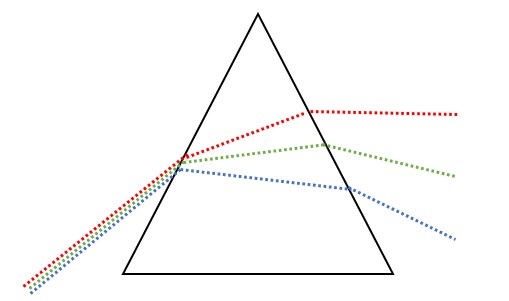
- Do the different colours take different paths (as shown in my rather badly drawn picture below), or do they "realise" that they are being tricked and "decide" that they are actually dealing with a single pane and then all follow the same path (as in the first picture)?
- They can't "know" what to do on entering until they leave again. Or does the fact that light, in its own reference frame, travels instantaneously (if something is travelling at the speed of light, then time slows to zero), play a part here?
- The assumption that they all take the fastest route (in our frame of reference) from source to image breaks down, as the red light (being least bent) must have travelled a shorter distance through the glass than green and blue.
- Or, as I asked last time, is there some mysterious quantum mechanics effect happening on the tiniest level incomprehensible to humans, which means that each photon takes every possible path, has a "think" when it's got there and then "chooses" the best one?
Monday, 11 July 2022
Light passing through a pane, a prism and two prisms
Posted by
Mark Wadsworth
at
15:37
8
comments
Thursday, 7 July 2022
"Refraction of Light through Rectangular Glass Slab and Glass Prism"
Here is a great explanation of how to work out what comes out of the other side of the slab/prism. I'm sure he'd get top marks in an exam, and on the basis of 'what goes in and what comes out' we know the result is correct.
But what nobody can explain - a proper physics prof. explains the head scratching in this video - are the striking differences, which appear to be down to weird quantum stuff and the wave/particle duality. And he's just talking about light travelling more slowly through a pane, he doesn't mention prisms (I don't think).
The different behaviour through a pane vs through a prism struck me a couple of days ago. The unanswered questions are:
1. UPDATE. Following Mark In Mayenne's comment, I rethought this one, there is no contradication here.
2. Why is light at all wavelengths bent in the same direction when it enters and leaves the pane (so barring reflections and imperfections in the glass, the image is the same on the other side), but is split by frequency when it enters and leaves the prism (so the image is quite different on the other side)?
3. What would an observer see if he were inside the pane/prism, looking towards the light source? At that stage, the light hasn't been bent again on leaving and the light doesn't 'know' if it's in a pane or in a prism? Would the light be split by frequency or not?
4. With a pane of glass, you can assume that the light behaves as a wave. When waves in water reach shallower or deeper water, they change direction in predictable fashion (regardless of frequency - all light travels at the same speed). Does light behave as particles in a prism? Does that go some way towards explaining the differences?
5. It's a like the 'dog running from A to B via swimming a canal diagonally' problem in maths. The actual calculation is heinously complicated (simplified version here, and even that one stumped a lot of people), but somehow dogs seem to be able to do this calculation by instinct and choose the fastest route.
With a pane of glass, the light (which travels more slowly through glass) takes the route from source to end point along the route that takes the shortest possible time, almost as if it 'knows', or as if takes every single possible route and then 'chooses' the fastest. So does the light somehow already 'know' whether it's entered a pane or a prism as soon as it enters?
The joy of all this is that nobody seems to know and probably never will, least of all me. I guess that's quantum mechanics for you. Light is inanimate, it surely can't 'know' anything, can it..?
Something to think about when you're at a boring event or you can't get to sleep.
Posted by
Mark Wadsworth
at
14:34
11
comments