From The Telegraph:
Home workers are likely to be driven back to the office en masse this winter, experts have suggested, because of the added cost. Ofgem, the energy regulator, confirmed on Friday its energy price cap would jump by 80 per cent to £3,549 per year in October.
As a result, average monthly energy bills will hit £789 in January for home workers compared with £580 for those going into work, according to price comparison site Uswitch. This equates to £209 a month and £2,508 a year. Remote working will still add £131 to energy bills each month from October, Uswitch found.
Sure, for a single person in an average home, which they could leave empty and unheated during the daytime, and whose extra commute costs would be materially less than £2,500 a year, this might tip the balance towards going to the office.
That is a small subset of all workers. What if there is another adult who would be at home most of the time (working from home or raising kids)? Or kids who come home early from school every day or are an school holiday? Or whose extra commute costs would be materially more than the vaunted £2,500 utility saving (if you include cash cost plus time wasted each day)? That's a lot of people.
Tuesday, 30 August 2022
Get back to the office, you plebs!
Posted by
Mark Wadsworth
at
11:46
4
comments
Labels: Commuting, Electricity, Gas
Thursday, 9 April 2015
I couldn't solve the 'challenging' Sudoku in this morning's Metro...
... because I didn't have a bloody pen with me.
D'oh!
Posted by
Mark Wadsworth
at
11:21
5
comments
Sunday, 7 December 2014
Von Thünen's Theory of Rent
Although Ricardo was quite correct, he explained his Theory of Rent in such a clunky fashion (using agricultural land to illustrate the point) that it's easy for the Faux Lib's and Homeys to attack (they are attacking the explanation, not the underlying observation, but there you go, some people easily confuse the two and have no grasp of analogies).
It turns out that the far more relevant explanation is Von Thünen's, as he factors in travel/transport costs, a model which applies much better to a modern, industrial society where the qualities of the land itself are nigh irrelevant and everybody faces the same two basic constraints - local average earnings and commuting times.
(Fraggle worked this out independently for himself, see here and here).
Caveat 1: The costs of transporting actual consumer goods are relatively low in the grander scheme of things, and the price of consumer goods are pretty much the same all across the country (higher rents in town centres are because a retailer can sell more goods per unit area; not because he can sell for higher prices).
Caveat/modification 2: What really matters is commuting times, and to a lesser degree 'getting the kids to school' and 'getting to the shops' times. Travel time is not the same as distance as the crow flies. Door-to-door is what counts. Hence why sensible retail areas give over at least half their space to car parks. They can't make the land any nearer to their potential visitors, but they can easily shave ten minutes from the door-to-door travel time by having plenty of parking spaces.
Caveat 3: There are lots of other things which explain local differences, such as being near a public park; in the catchment area of a good school and/or being nearer the school; having a nice view; being near the coast - but let's put those to one side for now, that's a simple plus/minus adjustment once we've done the basic workings.
-------------------------------------------
1. The first constraint is local average wages. If you look at average rental values (in terms of actual rents or selling prices) for whole conurbations/regions, they are closely related to average (net) wages, which is blindingly obvious. If average worker can earn £1,000 a year more by moving from A to B and doing the same job, then average rents in B will be £1,000 higher.
2. Commuting costs make up a huge share of GDP, if you express them in terms of hours x notional cost/value per hour. For example, average commute time 45 minutes and people value their own leisure time at £10 per hour, (or could earn £10 an hour by doing overtime, or they value their leisure time at £8 and commuting costs £2/hour etc), for one person the "cost" is 7.5 hrs/week x 48 weeks/year x £10 = £3,600. There are 30 million workers in the UK, 30 million x £3,600 = £108 billion a year, approaching ten per cent of GDP. Or, people spend one-fifth as much again commuting as working, in which case commuting is a hidden cost of one-fifth of of GDP.
3. So if everybody in the whole conurbation/region was on exactly the same wage, the gradient between the centre and somewhere half an hour (twenty miles?) further out would be £4,800 per hour, capitalised at 4% = £120,000 on the price of an identical sized home/garden. The rental gradient is £80/minute (being £4,800/hour divided by 60 minutes). The price gradient is that amount capitalised at (say) 4% = £2,000/minute.
But... Caveat 4: This assumes that all homes are of the same size.
Clearly this is not true; in the same way as people as people prefer short commute times to long commute times, they also prefer more space to less space. So the price gradient for "an average home" is much flatter. By and large, in a larger town or city, the price of a flat in the centre = the price of a terraced house in the inner suburbs = the price of a semi-detached house in the outer suburbs.
4. So build densities vary. If all homes cost the same but there are 50 flats per acre in the centre and 10 semi-detached houses per acre in the outer suburbs, then the rental value of one acre of the centre is worth five times as much as the rental value of one acre of outer-suburb.
And... Caveat 5: Not everybody earns the same, and each earner has his or her own price gradient. The larger the conurbation, the higher the average salary and the higher the difference between the highest and lowest earners. So in a very large conurbation/city state, the gradient is £80/minute for median earners, £160/minute for higher earners and £500/minute for top earners.
6. So there are three gradients (in fact there are infinite, but this is getting complicated enough), at the centre, the top earners create a gradient of £500/minute and price out the higher earners; the next concentric circle is the higher earners who create a gradient of £160/minute and price out the median earners; once the top earners and higher earners have their homes, the median earners make do with the rest with a price gradient of £80/minute.
7. Or you can start from the margin. Home rental values at the margin are zero, they and climb by £80/minute for a good long while (lots of median earners), then the price curve steepens to £160/minute for a shorter distance (fewer higher earners); then climb by £500/minute at the very centre.
8. Land values per acre are just one measure or all this. You can also look at population density or build density and it is always exactly the same gradient. Look at a long range photo of any major city and the skyscrapers are always in a cluster in the middle; then it's office blocks and blocks of flats, then terraced houses, then semi-detached houses, then industrial estates and then suddenly it's countryside.
Posted by
Mark Wadsworth
at
14:13
11
comments
Labels: Commuting, Ricardo's Law of Rent, Von Thunen
Sunday, 6 July 2014
The value people place on their free time.
Emailed in by Lola from The Telegraph:
Commuters who spend an hour-long train journey into London are saving around £380,000 on their average house price compared with the cost of living in the heart of the capital, research has found.
Lloyds Bank said that homes within a selection of commuter belt areas which are about a 60 minute commute by train, including Crawley, Windsor, Brighton, Rochester, Peterborough and Oxford, typically cost £260,000, which is £381,000 lower than the average price tag for a property within zones one and two in London, at £641,000.
With the average annual rail cost from these areas currently at just below £5,000, it would take someone 76 years of commuting to wipe out the difference in house prices, if property values and rail costs remained at the same levels.
OK, so a 25 year repayment mortgage @ 6% interest costs £5.92 per £1,000 per month.
380 x £5.92 x 12 = £27,000 mortgage saving
Deduct £5,000 for season ticket = £22,000.
Assuming that the additional commute time per person is 3 hours per day (half an hour to/from the station and one hour each way on the train), an average commuter loses 235 x 3 hours a year = 705 hours.
£22,000 divided by 705 hours = £31 an hour, which seems like a lot. If it's two commuters sharing a house and both commuting to London, the value they are placing on their own time is £16, which is more in line other calculations I've done on the basis of price v commute time comparisons pumped out by estate agents.
The other way of guesstimating it is to assume that Crawley or Windsor are the starting points and that if people work locally, they can earn £20,000 a year after tax for 2,000 hours a year commute-plus-work time = £10 net per hour. If they can earn £30,000 a year after tax in London for 2,350 commute-plus-work time, that's £12.80, so a slightly better deal (which is why so many people do it).
Personally, I'd rather have the extra 235 hours a year free time.
Posted by
Mark Wadsworth
at
13:38
8
comments
Labels: Commuting, House prices, London, Residential Land Values
Saturday, 16 November 2013
Lost in translation (lazy headline writers)
From the Evening Standard:
London’s men spend 42 days a year commuting
Men from [sic] London in their early 40s spend more time on jam-packed trains and roads than anyone in the UK - 42 days a year.
The shocking figure - more time than most people get in annual leave - is revealed in research published today. The study shows the average commute for a male Londoner in his early 40s takes 84 minutes every day.
It also showed that teens in the capital spend far more time travelling to and from work than other young people around the country.
The actual research they reference is all good stuff, and the TUC have produced a handy table showing typical commute times by age, gender and region.
That 84 minutes figure (42 minutes each way) looks about right to me, so I did a quick check: 1.4 hours times x 230 working days a year = 322 hours = 13.4 days. Which doesn't sound too terrible, actually.
Let's read on:
Frances O’Grady, General Secretary of the TUC which undertook the analysis, called for firms to help workers use time more productively.
She said: “Men from London in the early 40s spend a whopping 84 minutes on their daily commute.
"That’s 42 working days a year in cramped trains or traffic-choked roads.
“With the cost of commuting set to rise again in the new year as wage-busting rail fares come into effect, businesses must do more to help staff avoid rush-hour travelling time.”
Aha, she's dividing 322 hours by 7.66 hours to arrive at 42 working days per year, that's why. So at least she was accurate and precise.
(But this is still a fairly meaningless figure, it's like saying that in your lifetime you spend twenty years sleeping or ten months on the toilet or something. So what?)
Posted by
Mark Wadsworth
at
13:11
7
comments
Thursday, 20 October 2011
Minutes walking distance from the station (again)
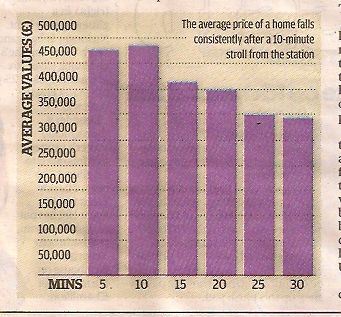
From yesterday's Evening Standard:
Comparing the 10- and 30- minute walk prices suggests about £3,000 per minute saved, which is much higher than £1,300 (here) or £1,667 (here) per minute extra for saving one minute's commute time on the train, but those two figures are reduced because taking the train costs money, so half the £3,000 raw saving is soaked up in ticket prices.
Assuming two commuters per household, one minute's extra each way five times a week, fifty weeks a year = 17 hours. £3,000 on your mortgage @ 6% interest and capital repayments is an extra £180 cost per year, so that suggests that people buying houses in London value their free time at about £10 an hour more than time spent commuting (understandable enough), and this is one of many factors which drive land values.
This is a real life illustration of what Fraggles explained on a more cerebral basis here: for every minute nearer the station, the rent is (say) £180 a year higher, so what the landlord is doing is
a) forcing a lot of people to live a little bit further away from the station (placing a burden on them and robbing each one of hundreds of people of a few seconds a day, for which he does not need to compensate them) and then
b) making his tenants pay £10 an hour for the value of their own time.
Posted by
Mark Wadsworth
at
20:49
11
comments
Labels: Commuting, Residential Land Values
Monday, 19 September 2011
The inverse correlation between commute times and house prices
There's a nice article in this morning's City AM on the topic, I've scanned in the accompanying map (click to enlarge):
The correlation is basically this: cutting 45 minutes from your commute time adds £75,000 to the price. If you estimate capital+interest repayments at 5% of the mortgage, knock off the £3,000 saving on your annual travel-card and divide that by the 350 hours not spent on the train, that all suggests that people value their own time at a paltry £2 per hour. Other estimates suggest more than, but let's work with the information we're given.
Posted by
Mark Wadsworth
at
21:48
31
comments
Labels: Commuting, House prices, London
Thursday, 2 June 2011
Daily Mail On Top Form
Mildly interesting statistics on commuting via the BBC:
Three-quarters of UK workers have journeys to work of less than 30 minutes, according to the Office for National Statistics... Those who earn more and work in management or professional positions tend to having longer journey times, the statistics suggest.
Which is what you'd expect: there are more low paid jobs and fewer high paid jobs, so on the whole you'll have to travel further from any given spot to get to where a high paid job is; people are less likely to want to commute a long distance for a low paid job; high paid jobs tend to be in town centres and the people who do them tend to live in the outer suburbs.
The Daily Mail turns this all deliciously on its head:
Long commute? Don't fret - you are likely to earn more than people who live round the corner from work.
Which is almost as daft as asking your boss for a pay rise on the grounds you have now moved to a different city.
Posted by
Mark Wadsworth
at
16:56
8
comments
Labels: BBC, Commuting, Daily Mail, Logic, statistics
Friday, 1 April 2011
Ha ha you landless peasants! That's the whole point! This is not an unintended consequence, this is how it was planned!
From The Evening Standard:
Thousands of long-distance commuters are having to pay more for their season tickets than their mortgage.
Research published today shows workers on packed rush-hour trains now need to put aside up to a third of take-home pay - compared with an average 28 per cent for the mortgage bill. Season ticket prices have soared in recent years as the Government seeks to force passengers to contribute more towards the cost of the railways...
For commuters from Swindon to Paddington, a £7,024 annual season ticket is 34.9 per cent of the £20,149 national average take-home pay*. This will rise to 36.9 per cent next year. In 2012, a Norwich-London season ticket will be worth 34.3 per cent of average pay; and one from Bournemouth to the capital will amount to 28.5 per cent.
The Campaign for Better Transport said it was did the research after getting a letter from a commuter saying: "My train fare is now more than my mortgage. I have absolutely no money left for food, clothes, necessities of life."
Why, we wonder, would anybody live in Swindon and commute to London, which costs him or her £7,024 a year? I can only assume that it's because houses are about £200,000 cheaper in Swindon, so our Swindonian saves £10,000 a year on his mortgage (or rent), spends £7,024 on his season ticket and treats the balance as compensation for the extra time he spends commuting.
Sure, the government could tell the wicked, exploitative railway companies that henceforth all train travel is to be free. So what happens then? Existing homeowners in Swindon would be delighted (assuming that 'somebody else' is prepared to pay to subsidise the railway and that service quality does not deteriorate, it would get a bit more crowded for a start). But rents and house prices in Swindon would just go up commensurately, so the next generation would find that they are still no better off living in Swindon than in London.
This is the whole point of Home-Owner-Ism - all existing generations do their best to keep the next generation just above the breadline, and to take as much of their wages off them as possible, whether that's in income tax etc; in rents/mortgage repayments; or in the cost of a season ticket prices.
Why younger generations put up with this is a mystery to me, but hey.
* The comparison with net national average wage is misleading. If they are looking at the cost of a season ticket for Swindon-Paddington, we can safely assume that the commuter lives in Swindon and works in London, so it would be better to compare the cost with the net average wage in London, but hey.
Posted by
Mark Wadsworth
at
19:49
28
comments
Labels: Commuting, Home-Owner-Ism, London, Swindon
Wednesday, 30 March 2011
No wonder it seems crowded.
From the BBC:
The assessment by UN-Habitat said that the world's cities were responsible for about 70% of emissions, yet only occupied 2% of the planet's land cover... "We are seeing how urbanisation is growing - we have passed the threshold of 50% (of the world's population living in urban areas),"
That sounds a bit doom-laden, doesn't it, but it puts me in mind of this, from City AM:
HUMANITY recently reached something of a milestone: for the first time, more than half of the global population is now living in towns and cities, rather than in the countryside where we all started off as hunter-gatherers. The global urban population is growing by 65m a year.
Cities are great for economic growth and wealth-creation: thanks to economies of scale, network effects and cluster effects, urban centres are more productive and wages invariably higher. They attract the best, most skilled and motivated people from around the world. Their size allows extreme specialisation, cultural as well as commercial...
That's more how I see things. In any event, in Western countries, people who live in cities tend to cause less pollution that people who live in the countryside because of shorter journey times etc.
Posted by
Mark Wadsworth
at
07:33
9
comments
Labels: BBC, Commuting, Town planning
Monday, 14 March 2011
Fun Online Polls: Traffic Lights and Investing
Thanks to everybody who took part in last week's Fun Online Poll, results as follows:
How many minutes do you spend waiting at traffic lights on a normal week day?
0 minmutes - 27%
0 to 5 minutes - 33%
5 to 10 minutes - 18%
10 to 15 minutes - 8%
15 or more minutes - 10%
Other, please specify - 3%
The weighted average of all those is about six minutes, which is (happily) the number I first thought of, so we can pencil in an economic loss of £12 billion a year*.
* 40 million adults x 6 minutes x 5 days per week = 1,000 million hours per year. 1,000 million hours @ £12/hour = £12 billion per annum (or 1% of GDP). The £12 is an arbitrary figure, being half the value of output per hour worked in the UK economy (it's difficult to put a value on leisure time lost).
-----------------------------------------
Inspired by Tim W, this week's Fun Online Poll asks which is the better investment: paying off your mortgage as quick as possible/saving up a deposit to buy a house; or investing spare cash in stocks and shares?
Vote here or use the widget in the sidebar. There's no 'other' option this week as the possibilities are endless.
Posted by
Mark Wadsworth
at
14:14
12
comments
Labels: Cars, Commuting, FOP, Traffic lights
Monday, 7 March 2011
Fun Online Polls: Irish bail out and traffic lights
On a good turnout (thanks to everybody who took part) of 136 people, the results to last week's Fun Online Poll (multiple votes allowed) were as follows:
What sort of success will the new Irish government have in renegotiating the terms of the EU-IMF bail out?
None whatsoever - 54 votes
Some minor window dressing - 63 votes
The repayment period will be extended - 11 votes
The interest rate will be reduced - 6 votes
Bond holders will bear more of the losses - 8 votes
Other, please specify - 4 votes
Ooh you bunch of cynics! I reckoned that the EU-IMF would at least extend the repayment period, which reduces the annual instalments but increases the overall amount to be repaid, in which case they might even reduce the nominal interest rate a bit to even things out. But we'll see fairly shortly.
--------------------------------
This week's poll is nice and simple. I am trying to work out how much traffic lights cost the economy. The largest single item on the list is the value of the time wasted while stuck in the queue at traffic lights, so I'd be grateful if everybody could give me an estimate of how many minutes they waste in total on a normal week day.
Vote here or use the widget in the sidebar.
Posted by
Mark Wadsworth
at
07:38
6
comments
Labels: Banking, Commuting, EU, FOP, IMF, Ireland, Traffic lights
Tuesday, 26 October 2010
Misleading headline of the day
From The Metro Morning commutes 'take longer than in 1906'.
I'm interested in the topic of how long people are prepared to spend travelling to work each day, and (while different people have different pain thresholds) had always assumed that the overall average remained the same and had done for centuries. In other words, with faster travel speeds, people commute longer distances, but spend the same amount of time travelling.
So if people are spending more time commuting now than a hundred years ago, that's that theory out of the window. Actually the article explains that the speed of an average bus is slower than it was a hundred years ago, which is almost certainly true, but entirely irrelevant. For a start, in percentage terms far fewer people travel by bus nowadays. And so on.
Posted by
Mark Wadsworth
at
08:00
7
comments
Labels: Commuting, Public transport
Monday, 27 September 2010
Fun Online Polls: Commuting & Eyebrows
There was a very good turnout in last week's Fun Online Poll (133 took part, multiple choice, thanks to all who took part), results as follows:
Which is the least stressful way for you to get to your current place of work?
Driving by car - 56 votes
Walking or cycling - 25 votes
Taking the train - 16 votes
Taking the 'bus - 6 votes
Other, please specify - 4 votes ('jogging' and 'motorbike')
I work from home, am retired or currently unemployed - 37 votes
So stick that in your pipe and smoke it, Greener Journeys! The twattish thing is that I might just as well have asked "How do you get to work?" and the answers would have been much the same; so really I could have asked "Do you choose to the least stressful mode of transport to get to work?", a question which is barely worth asking...
--------------------------------------------
Fiona Bruce was back on telly again yesterday (I've not noticed her for a while) and has inspired this week's Fun Online Poll: "Who has the sharpest eyebrows?"
Vote here or use the widget in the sidebar.
Posted by
Mark Wadsworth
at
13:21
14
comments
Labels: BBC, Cars, Commuting, FOP, Global cooling, Kate Winslett, Lobbyists, Public transport, Television
Monday, 20 September 2010
Fun Online Polls: Baroness Warsi & Commuting
On a good turnout (thanks to everybody who took part) in the four days that the Fun Online Poll was running, the results were:
Do you want church leaders to play a greater role in "local communities"?
No thanks - 72%
Not bothered - 19%
Yes please - 10%
So stick that in your pipe and smoke it, Baroness Warsi, along with your 'Big Brother Society'. That's not how we do things round here. If a local church group wants to organise something, then great, I can take it or leave it, but there's no need for you lot to come steaming in offering selected groups additional power/money, that'll just ruin everything.
-----------------------------------
Man Widdecombe spotted some complete and utter bollocks press release being re-hashed in The Telegraph under the headline Driving a car is more stressful than going by bus, says new research. The Telegraph's original input is this, right at the end:
The Greener Journeys campaign is largely funded by major bus companies and so there are no studies on the stress levels of driving compared with travelling by train.
So that's this week's Fun Online Poll: "Which is the least stressful way for you to get to your current place of work?"
Vote here or use the widget in the sidebar, I'm allowing multiple choice because a lot of people can get to work in more than one way. It's a pretty dumb-ass question, really, because surely most people will choose whichever method is least stressful (taking into account cost, journey time, reliability etc), but hey.
The result from an earlier poll on average commute times are here, in case you're interested in the topic.
Posted by
Mark Wadsworth
at
09:15
0
comments
Labels: Cars, Commuting, FOP, liars, Lobbyists, Public transport, Religion, Tories
Wednesday, 12 May 2010
Bad Tempered Woman who takes the same Tube as I do*
Posted by
Mark Wadsworth
at
21:04
3
comments
Labels: Caricature, Commuting, Trains
Monday, 22 March 2010
Fun Online Polls: Commute times & British Airways
Thanks to everybody who took part in last week's Fun Online Poll. The responses to the question "How long does your journey to work take in the morning?" were as follows:
less than 15 minutes - 32%
15 to 30 minutes - 22%
30 to 60 minutes - 29%
60 to 120 minutes - 15%
more than 120 minutes - 3%
I foolishly forgot to include the option "I work from home", which (judging by the comments) would be about a third of the 32% who reported a journey time of less than 15 minutes.
There is no particular back story to this poll - I was just genuinely interested whether my assumption that the majority of people are prepared to tolerate a commute of 'about half an hour' was correct and what the spread about the mean (37 minutes) is.
--------------------------------------
Staying with the travel theme, the British Airways versus Unite (the trade union) industrial dispute seems to me like one of those cases where you want both sides to lose.
As a privatised former public entity, BA was given enormously valuable landing slots at UK airports for free but inherited a hefty final salary pension scheme which it never bothered to fund properly. Even though it was privatised a quarter of a century ago, it never really shook off the public sector mentality - even now, salaries for BA staff are nearly twice what they are at other airlines (if they had taken lower salaries then the difference would have gone into the pension fund and all would be sweet and dandy).
The trade union is being completely daft - in economic terms (if you consolidate the airline and its pension fund into one entity), the employees already own about ninety per cent of their employer (or at least older members of the final salary pension scheme do). I am surprised that the union doesn't have an economist to quietly point this out.
Luckily, there is a way in which both sides can lose. All it needs is for passengers to stop booking with BA for a few weeks and the whole thing will simply collapse. All their slots can be auctioned off properly by the government (preferably on a leasehold rather than a freehold basis) and smaller competitors and new entrants can snap up the aircraft, infrastructure and most of the employees.
So that's this week's Fun Online Poll: "Would you be bothered if British Airways goes bankrupt and is split up between smaller competitors?"
Vote here or use the widget in the sidebar.
Posted by
Mark Wadsworth
at
09:15
9
comments
Labels: British Airways, Commuting, FOP, Slots, Strike, Trade Unions, Twats
Tuesday, 16 March 2010
Fun Online Polls: Multiplier Effect & commuting times
Thanks to everybody who took part in last week's Fun Online Poll, results as follows:
A foul justification for ever more deficit spending - 66%
Some government spending creates value and some destroys value - 29%
An increase in government spending is good for the economy - 4%
Other (please specify) - 1%
IMHO, both of the first two answers are correct. It's a bit disappointing that all the major parties are waffling on about "not withdrawing the fiscal stimulus too quickly" when it appears that the vast majority don't agree with having it in the first place.
I chose the second, as I think you have to look at each item of spending separately, some are worth while, some aren't. The answer "An increase in government spending is good for the economy" is almost certainly wrong (unless you attach a million caveats) and whoever chose the last answer didn't specify what he or she thought, so that's not much help.
--------------------------------
As an interlude, I did a Fun Online Poll on nationalities within the UK recently, and it appears (as James D pointed out) that the English are more likely to choose 'British' than 'English', but the Celts are more likely to choose 'Scottish', 'Welsh' or 'Irish' than 'British'.
The BBC report on a survey in Northern Ireland that says the same thing: "A total of 42% of those surveyed told the pollsters they were Irish while 39% identified themselves as British. 18% saw themselves as Northern Irish."
--------------------------------
OK, this week's Fun Online Poll is just out of interest, as I've never really found a satisfactory 'official' statistic (and the variation around the mean is as important as the average): "How long does your journey to work take in the morning?"
Vote here or use the widget in the sidebar.
Posted by
Mark Wadsworth
at
07:10
2
comments
Labels: Commuting, FOP, Northern Ireland
Friday, 25 April 2008
Friday night gear changes
I mainly listen to Ye Olde i-Pod on the daily commute and scribble down truck driver's gear changes on the back of an old ticket receipt as I go along. Here's this week's crop:
Dead Kennedys "Too drunk to fuck"
Bangles "In your room"
Shania Twain "Come on over"
Posted by
Mark Wadsworth
at
20:08
1 comments
Labels: Commuting, Gearchange, Humour, Music