Showing posts with label Agglomeration. Show all posts

Wednesday, 18 July 2018

"Agglomeration effects (might) change the YIMBY calculus"

A splendid article by Devon Zuegel, the first half of which I wish I'd written myself.

Worth reading in full, but the upshot is this:

There's a distinction within the YIMBY cause that's mostly unspoken, but it's important. Two* of the key goals the movement aims to address are (1) to lower housing prices and (2) to unlock economic, cultural, and social potential. These are often described in similar ways and are in many cases complementary, but they are not the same.

On one hand, there's a lot of talk about how building more will decrease prices because of the models of basic supply and demand curves from Econ 101. We'll call this goal the affordability objective: let's make housing affordable in key metro areas, both for residents who are already there and for those who'd like to come.

Another related but different goal is about how much is lost as a result of locking people out of opportunities in the most productive regions. We'll call this the opportunity objective: let's make it possible for people to to participate in the economic and cultural dynamism in places that they're locked out of right now...


So far, so good. Here's what most YIMBYs resolutely fail to take into account (and refuse to do so, if challenged):

The issue with the conventional supply-demand model is that it assumes that supply and demand are functions of price and price only. At a first approximation, and maybe at the margins, this is basically true. However, it does not account for the fact that the population is also a critical factor in determining the shape of the demand curve for a particular place... the value of living in a particular place is greatly determined by how many people live around it. As the number of people living in a place increases, so does the value of being there. This is often labeled the "agglomeration effect".

She concludes that additional supply probably depresses prices by more than the agglomeration effects push them up, while admitting she has little hard info to support this.

This is clearly not true, we know for a fact that the largest and best connected cities in any country or region always have the highest prices in that country or region (assuming no rent controls or similar measures). But hey, at least she has broken down the issue into manageable chunks and explained what the YIMBYs are missing.
---------------------
The analysis I would disagree with is this:

A lot of laws exist to effectively cut out the bottom part of the market. (The mechanism here is similar to the argument for how the minimum wage is in fact bad for the very low-wage workers it aims to protect.)

Laws like minimum lot sizes, setbacks, amenity provision, max numbers of occupants, etc effectively make it illegal to build affordable housing.


I wish it were as simple as that, but it clearly isn't.

Imposing large lot sizes is by and large a waste of space etc, but this reduces agglomeration benefits, so cancels out.

Remember - while allowing higher densities and smaller homes reduces the amount which people have to pay for entry-level bricks and mortar, it means more people and more efficiency, and more people and more efficiency means more agglomeration benefits, and that means higher total prices (the savings on the bricks and mortar cost are outweighed by the higher location rent). Think Manhattan vs Houston.

We know that in large, well-connected cities, even the modest/dense housing originally built for lower income people is now insanely expensive and only higher income people can afford it. Think an ex-council flat in London.

I rest my case.
--------------------
* On a personal note, I have been a lifelong YIMBY on the basis of "not being a total fucking hypocrite".

Vegans and vegetarians can rightly rail against the meat industry and meat eaters in general, that's intellectually coherent. But NIMBYs are like motorists who complain about all the cars on the road. I have always lived in a flat or house wherever it was I wanted to live, and who am I do deny others the right to live in a flat or house wherever it is they want to live? And if there aren't enough, build some more.

More subtly, I have been an owner-occupier for most of my life and it dawned on me decades ago that if they build more stuff near me, that must, however marginally, increase the value of my home (which I later found out was called "agglomeration benefits"). So as a laisser faire kind of chap who likes unearned gains, YIMBYism was always part of my belief system; as a Georgist, YIMBYism sits just as comfortably.

Monday, 30 April 2018

World cities - rents vs metropolitan area population

The BBC ran a good article pointing out that it will soon be rent-freedom day, which is analogous to the Adam Smith Institute's tax-freedom day.

So one-half of their earnings go in tax (stealth or otherwise) and one-third goes in rent. That means the average working tenant's disposable income after tax and housing costs is one-sixth of their earnings!

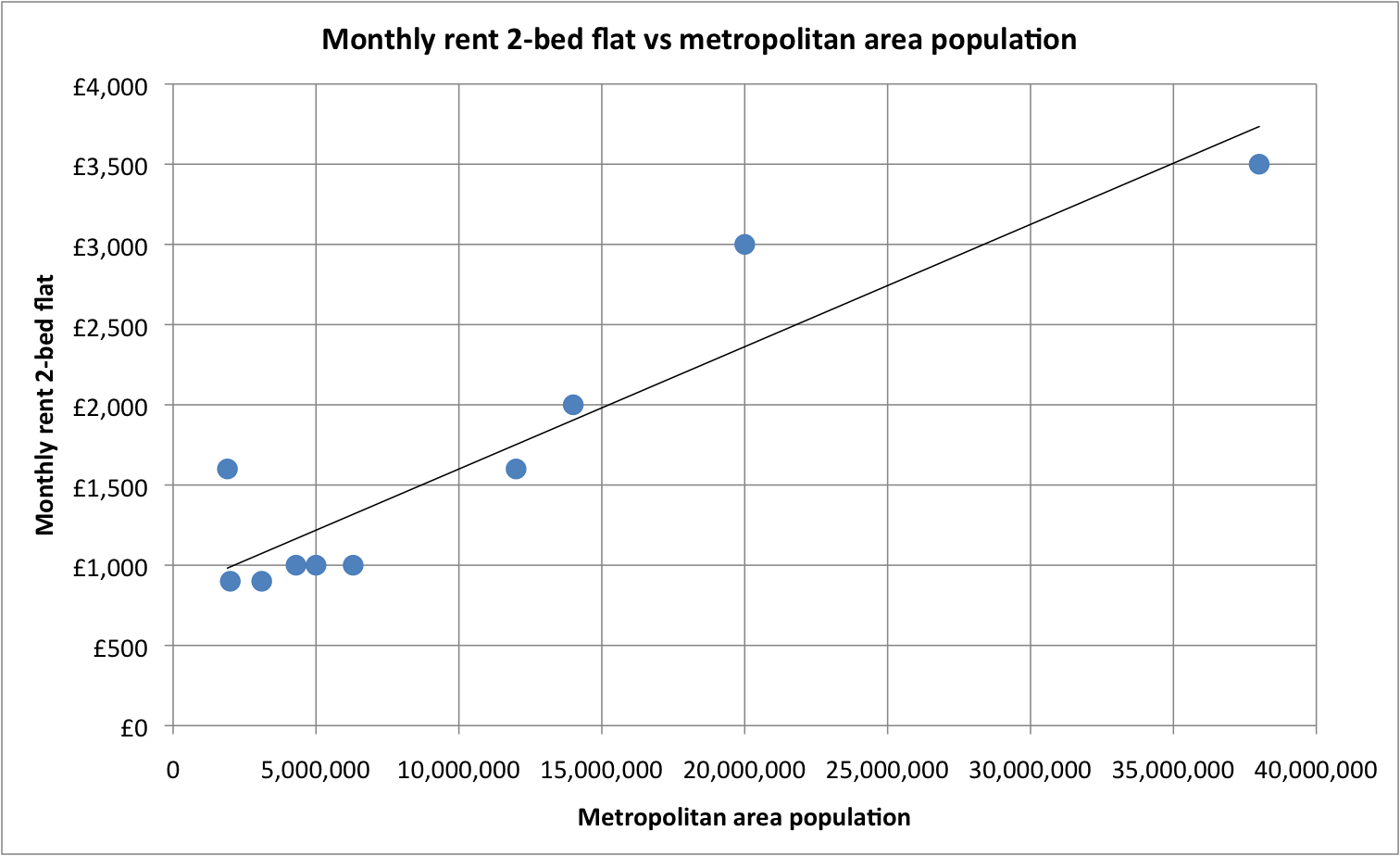
What caught my eye was this graphic further down the article:


Those rents are fairly proportional to the size of the population of those cities and their metropolitan/surrounding areas, co-efficient of correlation 0.93 (says Excel):


What's the relevance of this, you may ask (except for BenJamin' who put me onto this in the first place).

The point is that larger populations push up rents (agglomeration effects). If you build more homes in large cities, the simplistic supply-demand assumption is quite simply incorrect (unless you prevent any immigration into the city, which is impossible). Build more homes = more people = even higher rents. Rinse and repeat.

Sources:
https://en.wikipedia.org/wiki/Tokyo
https://en.wikipedia.org/wiki/New_York_metropolitan_area
https://en.wikipedia.org/wiki/London
https://en.wikipedia.org/wiki/Paris_metropolitan_area
https://en.wikipedia.org/wiki/Greater_Dublin_Area
https://en.wikipedia.org/wiki/Demographics_of_Berlin
https://en.wikipedia.org/wiki/Rome
https://en.wikipedia.org/wiki/Madrid_metropolitan_area
http://worldpopulationreview.com/world-cities/brussels-population/
https://en.wikipedia.org/wiki/Warsaw_metropolitan_area

Friday, 23 March 2018

"Peter Thiel gripes about San Francisco rents"

The man is brutal, but brutally honest:

Outspoken venture capitalist Peter Thiel has trouble finding many people who agree with him in the Bay Area these days, but at a speech Thursday at the Economic Club of New York, Thiel may finally have found common ground with the average San Franciscan by railing against skyrocketing rents.

When asked about the future of the tech industry, Thiel speculated that the lure of Silicon Valley may no longer be enough to overcome the pain of punishing housing costs.

“At what point is this a feature and what point is this a bug?” asked Thiel, admitting that “it’s a feature if [...] everyone has to be where everyone is, where all the ideas are, where the capital is” and thus creating an enormous network.

Thiel also asked, “At some point does it just get so expensive that it doesn’t quite work, that you have to very quickly make money just to pay the rents?”

The venture capitalist complained that most of the money he invests in new companies these days goes not into product development but instead “to landlords, to commercial real estate.” He even referred to Silicon Valley landlords as “urban slumlords.”


Correct, that's called "agglomeration effects" which is what drives rental values.

His options are:

1. Relocate somewhere cheaper. Rents will be lower in the middle of nowhere, but he will find it more difficult to do business there. Over time, the economy and population in his chosen middle of nowhere should grow and mature, making it easier to do business but the rents will go up to match. So that doesn't solve his problem.

2. If you can't beat 'em, join 'em. If he first buys up the land on which to build Peter Thiel City, he wins on both sides of the equation.

3. Fight the system and campaign to shift taxes from output, employment and profits (and in his case, capital gains) onto land values.
--------------------
In reply to Lola's comment/question, see here Peter Thiel on Henry George, I think he has mentioned Henry George favourably on a few occasions, but usually as an aside or when prompted.

Monday, 1 January 2018

Paul Krugman on "Economic Geography"

From The New York Times, the conclusion is this:

Take the (fairly celebrated) example of Rochester, New York. It started as a flour milling center, benefitting from the Erie Canal, then as a center for nurseries and seeds. So it was a resource-based center. Then, in 1853, John Jacob Bausch, a German immigrant, started a company making monocles, which became a major producer of glasses, microscopes, and all things lens related.

So Rochester became a place where people knew about optics, presumably creating the preconditions for the rise of Eastman Kodak, and much later Xerox. This was typical of small industrial cities: even if what a city was doing in, say, 1970 seemed very different from what it was doing in 1880, there was usually a sort of chain of external economies creating the conditions that allowed the city to take advantage of particular new technological and market opportunities when they arose.

Obviously, this was a chancy process. Some localized industries created fertile ground for new industries to replace them; others presumably became dead ends. And while a big, diversified city can afford a lot of dead ends, a smaller city can’t. Some small cities got lucky repeatedly, and grew big. Others didn’t; and when a city starts out fairly small and specialized, over a long period there will be a substantial chance that it will lose enough coin flips that it effectively loses any reason to exist.


That seems to be a fair description/explanation of how things are developing.

The article in turn links to lots of other articles, the one that triggered his article was one by Emily Badger, which describes/explains how agglomeration effects benefit the largest global cities but smaller regional cities are losing out; also the links between global cities appear to be stronger than the links between any global city and its own hinterland/host country.

UPDATE: Now I've thought about it, there's a similar phenomenon with car manufacturing nowadays, which I wrote about here, it's just that large car factories are not concentrated near global cities, they are wherever they are for historical reasons. Most of the hundreds of small factories there used to be have closed down and a few have swollen enormously.

While this is all good stuff, what puzzles me is why anybody thinks these are blinding new insights? They aren't. I'm a land value taxer because I look at the real world and draw real conclusions. I know which factors drive (or depress) land values, and those factors are pretty much the same as those which encourage the growth of global cities and cause the gradual decline of smaller regional cities, in a word, 'agglomeration'.

Replacing taxes on earnings and output with Land Value Tax would ameliorate the effects of all this; it would drive growth in the largest cities; reduce the drag of taxation on smaller cities and 'the regions' (where land values are lowest); and act to redistribute the benefits of economic growth more evenly across the country - an overall levelling upwards.

Thursday, 23 February 2017

None so blind as those who think we can't see the wood for the trees etc.

The director of a London landlord writes in City AM:

Ultimately, business rates are a property tax rather than a corporate one, and for some companies this means that there is a relatively straightforward solution: move location. Businesses currently located in areas from Victoria to King’s Cross will be considering their options. Most worryingly for the locations worst hit by rates rises, the most desirable and influential businesses are also often the most mobile.

East London has undergone fundamental change over the last 10 years. In 2008 the Crossrail Bill received Royal Assent and construction started on Europe’s largest infrastructure project that would shift London’s economy East. That same year, the first iPhone was launched, a watershed moment in the fourth industrial revolution which would firmly take hold in East London with the “launch” of Tech City in 2010. All this before the Olympic Games put East London at the centre of the world for a month in 2012.

Shoreditch, Old Street and Clerkenwell are unrecognisable from 2008. Tech and creative businesses arrived in the area due to its affordability and stayed because of the community of businesses, cafés, shops and the nightlife that sprung up around them. Rents increased incrementally, but a tech and creative cluster endured as businesses recognised the value of collaboration with their peers.

However, from 1 April 2017, rates will increase overnight to reflect seven years of economic development in East London. When added to the associated rental increases, this will be too much for many businesses to bear. Smaller, entrepreneurial firms in particular may decide their growth prospects are better in a cheaper location...

Successful regeneration projects such as King’s Cross and Victoria take years to deliver, and the painstaking process of creating new spaces, attracting businesses and growing rental values will be undermined by the sudden sharp increase in business rates.

Sunday, 4 September 2016

Economic Myths: Additional supply in the housing market.

In the comments to this post, L Fairfax put up a spirited rebuttal of my statement that:

Observation tells us that in the medium term, additional supply in high demand/high wage areas creates its additional own demand and the overall effect is to push up rents and prices, but his point stands.

The evidence he gave was as follows (I hope I have summarised correctly):
- The Spanish seem to have proved that if you build enough new flats on the outskirts of towns they become cheap
- my family in Spain live in a city of 228,000 people and mass house building has caused prices to go from EUR 100,000 to EUR 35,000 for starter flats
- £120pcm for the mortgage on a flat in parts of Spain.
- wages have fallen not that much


To which my reply is:

1. Perhaps I should have focussed on rental values rather than prices in my original statement. The agglomeration effect I referred to apply only if the population of the town increases in response to the additional supply; in which case added supply and added demand cancel each other out and we would expect no downward movement.

2. Golden rule: rents are the Maypole around which house prices dance. Rental values are a far better reflection of the absolute "location, location, location" value (average local wages minus time cost of travel to place of work etc) and, unless something in the real economy changes, are fairly stable.

3. House prices are rental values divided by the prevailing interest rate, plus or minus expectations of future price changes, so booms and busts are self-fulfilling. People who paid EUR 100,000 for a home which only has a rental value of EUR 2,000 a year must have been gambling on massive rent or price increases, this is completely irrational short term behaviour which is difficult to factor into economic models.

4. Rational people will buy if the initial repayments on a mortgage are roughly the same as the rent, plus or minus a bit.

5. Flats cost EUR 35,000, so you'd expect the annual repayments on a mortgage to be around 5% of that = EUR 1,750 = EUR 150 cpm = £120 = looks about right.

6. So I would assume that local rents for a starter flat are about EUR 150 pcm, give or take a bit. It's not going to be much higher or else nobody would rent, they'd all buy instead.

7. So the missing bits of information here are:
- what has happened to rental values since the building boom started? If they have fallen by two-thirds, then that puts a hole in my theory, if they have remained stable (or merely fallen in line with GDP), that supports my theory.
- what has happened to the population of that town since the building boom started? If it has increased by less than new supply, that puts a downward pressure on (average) rents and prices (supply exceeds demand and no agglomeration benefit).

Saturday, 6 February 2016

Economies of Scale: The most valuable Land there is.

Here (part 1 of 3) Prof Geoffrey West explains that all biological entities from DNA to cities have evolved from the exploitation of economies of scale (agglomeration effects).

This scaling effect is a Universal Law, hence Land. It gives us aggregate demand, the ability to produce capital, and gives natural resources their value.

Under a system whereby the State gets the majority of its revenue directly from land rents, they would have two explicit priorities. To increase the efficient exploitation of agglomeration effects,  and to compete against privately produced goods and services by providing(regulating) high locational amenity.

Another reason why LVT is as hardcore as Capitalism gets.

Friday, 29 January 2016

Clever scientist understands and explains agglomeration...

… but fails to draw the obvious conclusion.

From the NY Times, h/t Pablo:

In essence, they arrive at the sensible conclusion that cities are valuable because they facilitate human interactions, as people crammed into a few square miles exchange ideas and start collaborations.

“If you ask people why they move to the city, they always give the same reasons,” West says. “They’ve come to get a job or follow their friends or to be at the center of a scene. That’s why we pay the high rent. Cities are all about the people, not the infrastructure.”


Having established what creates rental value, why not ask whom it belongs to? To say it belongs to landowners is like saying that fireplaces give off heat. They don't. It's the burning fuel that gives off heat.

As an aside, this further undermines the view that particularly high rents and prices in London are caused by shortage of supply. They are not. They are caused by the presence of large numbers of people and businesses (and the appropriate infrastructure to support it).

If you build more buildings, will you get more people and businesses or fewer..? Continuing the fireplace analogy, you can't cool down a fire by throwing more dry twigs on it.

Wednesday, 27 January 2016

Agglomeration

Via @thomasforth, from Centre for Cities:

When it comes to productivity, size isn’t everything – at least not in the UK. Unlike the US and Germany, there is no clear relationship between city size (as measured by the number of residents) and productivity (as measured by the wage premium of each city once workforce characteristics are taken into account).

The three charts in the article plot relative productivity against major cities ranked by population in the UK, USA and Germany. The difference is huge in the USA (the trend line is steep), quite big in Germany and smaller in the UK (the trend line is nearly flat), if you ignore London which is well above the line.

Well duh. We could have guessed that...

1. The population of a city is just one indicator or factor. Just as important are links to other cities or indeed the rest of the world. The more other places you can get to, and the quicker/cheaper you can get there, then better. So the smaller the country and the quicker/cheaper the journeys, the lower the differential between smaller and larger cities. Or consider two similar sized cities, but one has an airport with flights to other business centres - the one with the airport will be more productive.

2. How do you define a city? Are Birmingham and Coventry separate cities for these purposes? No of course not. Bracknell and Wokingham, smallish towns in themselves, are well above the line (i.e. very productive). But they are just part of the M4 corridor, which is everything from Reading to Slough to Heathrow. Once you are on the M4, all these towns and the airport are within easy reach, in economic terms, they are one city.

3. Similarly, London and the M4 corridor and large chunks of the south east reinforce each other; good transport links, close together and three major airports etc. London is shown as having a population of 12.5 million on that chart, which is probably accurate if you include the whole hinterland and commuter belt.

4. This is why Berlin is so far below the line. It's the largest city in Germany with 3.4 million people, but it's stuck in the middle of nowhere (surrounded by ex-DDR). A couple of my cousins live and work there and they confirm that it is no great shakes, there are just lots of small businesses with negligible agglomeration effects.

5. The charts do not show absolute productivity, they show relative productivity between small and large cities. So the charts do not necessarily indicate that large UK cities fail to tap in to agglomeration benefits; they could just as easily be taken to indicate that small cities in the USA (or Germany) do particularly badly (especially if they are miles from anywhere).

6. If you look closely, they have messed with the horizontal axis. The horizontal axis on the UK chart is from 50,000 to 12.8 million. The one for Germany is from 50,000 to 3.2 million. This means that the trend line for the UK is actually even flatter than it appears, and if you removed London, probably would be completely horizontal.

And so on and so forth.

Wednesday, 2 December 2015

"Why are so many British homes empty?"

A mildly interesting article at the BBC on the subject.

But really this is about agglomeration benefits.

At one extreme, there are the multi-£-million buy-to-leave flats in London standing empty. The only thing which gives them value is the fact that they are in London i.e. agglomeration benefits (actual or potential).

At the other end, the abandoned streets in seaside towns, the reverse applies. If one house is standing empty in a road, it makes the area a bit less attractive and so depresses the value of the other houses a bit. If two are empty, that depresses the values by more than twice as much. The effect is geometric and reaches a tipping point, so once a third or half the homes on a street are empty, the others are now virtually unsaleable.

In which case, Liverpool was doing the right thing selling off a whole street for £1 each, that gets people back into the houses and kick starts the process again.

(In either case, LVT would have sorted it out, but that's by the by).

Tuesday, 3 November 2015

"That's partly down to ... the way property developers work."

On the subject of new towns, the BBC states the obvious:

In a revealing article [page 72 onwards of this] published last year, Francis Salway, former chief executive of the largest listed property company in the UK, Land Securities, explained that developers don't relish huge empty sites like the former quarries at Ebbsfleet.

They like "established demand" and "existing communities", he wrote, which prove people really do want to live there. The developers like to "limit the forthcoming supply" - that is, to ration how many homes come on to the market at one time so that the market is not flooded.*


Exactly. Apart from providing shelter, when you buy a house, you are paying for access to an "established community" i.e. jobs, shops, schools, neighbours good or bad, transport links to other towns etc.

The developers - i.e. the bricklayers, roofers, architects and the material suppliers - have to be paid for their inputs to the finished house, of course. But who is 'providing' the "established community"? The developers? The landowners? Methinks not. So why do they get paid for its existence? And if you buy an existing home from somebody who is moving away, what contribution is he going to make to the "established community" in future? Precisely nothing, of course. So why should he get paid for it?

Ho hum.

* Which puts the developer in a tricky position, on the one hand they like to drip feed new homes onto the market, but on the other hand, the more homes already exist, the easier the new ones are to sell. Prisoners' dilemma with one prisoner.

Monday, 8 June 2015

"Building new properties doesn't drive down house prices"

From City AM:

Building new properties doesn't drive down house prices, according to a study by the London School of Economics.

By looking at the price impacts of a series of Barrat Homes developments in suburbs and villages over the past five years, the researchers found no evidence of a price depreciation.

In fact, in some cases the opposite was true – the report, seen by the FT, says: “Developments of the size and scale studied, even in areas where originally objections were significant, can lead to more rapid rises in local house prices.”

Eight developments were looked at in total, each containing 300 new homes. All were based in the Midlands and South of England.

The results are contrary to the opinion held by many economists that more houses are needed to keep future house prices in check. The consensus is that between 200,000 and 300,000 new homes are needed each year, but in 2013-2014 the UK fell short of this with 141,000.


Which is what observant people have been saying for years. I only cottoned on to this a few years ago, thanks to their valiant efforts.

Monday, 16 March 2015

Location, location and, er, condition

In some cities oop north, houses are being sold for as little as £1, on condition that the buyers repair them and then lives in them for five years. In Stoke on Trent the local authority is even giving interest free loans to the buyers and it now turns out that the renovated houses are worth £60,000.

So where has all this value come from?

The building's location hasn't changed. Some of it has obviously come from the repairs made to the building, but it seems unlikely that the entire value came from that source, after all, the council only lent them £30,000 to begin with. Perhaps the council sold at undervalue, but if you have a house which needs a large amount of money spending on it and no-one wants to rent anyway, what is it worth? Up in Durham, landlords have just abandoned houses as not worth repairing.

There's a clue a bit further down the article: "We're looking forward to it becoming a family area again where we can bring up children and people know their neighbours" says one of the new homeowners.

That suggests the rise in value has been partly due to "gentrification", i.e. the aggregate effect of. many properties being repaired in a given area is much greater per property than the cost of repair. Not only that, however, but the aggregate effect in reducing location value of many properties being in need of repair can be so great as to wipe out the location value entirely.

Saturday, 14 February 2015

Agglomeration.

From the BBC:

Tesco is capable of provoking strong emotions. There were riots when the chain opened an Express branch in the bohemian Stokes Croft district of Bristol. Although the store survives, a mural urging shoppers to "Think Local" and reject the chain is still proudly displayed in the area.

Conversely, when it was announced that the Tesco superstore in Kirkcaldy, Fife, would close, it was standing room only at a public meeting called to try and save it. The event was addressed by no less a figure than the local MP, former Prime Minister Gordon Brown.

Kirkcaldy's Tesco, situated in the middle of the town, houses a post office and is the focal point for the main taxi rank. It's on a bus route, which makes it the easiest store to access for many pensioners. Local traders told the meeting they feared a decline in town centre footfall if it shut.

Wednesday, 21 January 2015

OK, let me try to explain it again.

Last week, City AM carried the usual blah blah saying that high house prices are the result of a lack of supply:

The UK, and particularly London, is in the midst of what should be seen as a housing crisis. According to LSE professor Paul Cheshire, new build houses are about 40 per cent bigger in the Netherlands and 38 per cent bigger in Germany than they are in England. And yet housing goes for 45 per cent less per square metre in the Netherlands and, in Germany, prices did not rise throughout the entire 1971 to 2002 period.

A new paper from the Adam Smith Institute lays the blame at the door of the Green Belt. Despite the fact that 90 per cent of the UK is undeveloped, with half of the remainder gardens, Britain is hamstrung by rules hindering development in the places where people most want to live – around successful cities, particularly in the South East.


A reader's letter a couple of days ago referred to an "iron law of economics: if you increase the supply of something, the price goes down".

It's kindergarten Faux Lib economics though. An article in the same paper a couple of days ago looked at actual hard facts. Always start with facts and work backwards to the conclusion. Or establish that there isn't a conclusion, they are just random facts:

London’s population is forecast to hit its highest-ever level this year, surpassing its pre-war peak of approximately 8.6m. Yet it remains one of the least densely populated major cities in the world, according to research by LSE Cities, based at the London School of Economics...

By Burdett’s calculations, London is 30 per cent bigger than it was when its population last peaked in 1939. Even if London’s population density grew, it would bring with it a raft of benefits. If everything is nearby, cars are used less, for example.

LSE Cities’ research finds that holding family income and size constant, petrol consumption per family per year declines by 106 gallons (401 litres) as the number of residents per square mile doubles.

A higher population density can also facilitate a more diverse range of businesses and services than lesser ones can – such as hospitals, airports, theatres, and museums.


So that is the reason why housing in London is so expensive.

It has five time the population of other conurbations in the UK, as well as having most airports and relatively easy rail or car travel to the continent. So there is "a more diverse range of businesses and services etc".

So, glossing over the debate whether we should build outwards at a low density or increase density in the middle (they have much the same effect), what happens if we build more housing in London?

1. People who are currently 'priced out' will move there.

2. So the supply of housing goes up, but the number of people and hence demand for housing goes up pro rata and the effect cancels out.

3. There will be an even more diverse range of businesses and services.

4. So the cost of renting housing and commercial premises will go up even more.

If this were all not true, then the highest house prices would be in the Scottish Highlands and Islands and houses in London would cost tuppence ha'penny.

Whether this is all A Good Thing or A Bad Thing, and if so, what we ought to do about it (liberalise construction and introduce Land Value Tax, please!), or whether it is all irrelevant is an entirely separate debate.
---------------
@ Jim in the comments, strictly speaking, the best kind of LVT is based on "site premium" (as explained on KAALVTN) i.e. that part of the total rental value of a home or office or anything else which relates purely to the location.

But most people are unfamiliar with this concept, and simply taking a small percentage of current house prices is a good enough approximation, i.e. for most homes, the site-only rental value is around 3.5% of its current selling price.

It is not a straight line, unfortunately, it's clearly zero % at the very bottom (homes selling for £50,000 and under), rising to about 4% in the upper middle (homes selling for £400,000 - £600,000), then falling again to 2% or lower for multi-million pound homes at the very top. But hey.

Wednesday, 25 June 2014

Agglomeration benefits in the movies

Rich Tee mentioned No Batteries Included in the comments at The Stigler's post about films where the general theme is Noble Small Landowners battling with Evil Developers.

The plot twists are right at the beginning and at the end:

Frank and Faye Riley (Hume Cronyn and Jessica Tandy), an elderly couple who run an apartment building and café in the run-down East Village neighborhood, come under threat by a nearby property development. The development manager sends a hoodlum named Carlos and his gang of thugs to bribe the couple and their tenants to move out…

OK, so Frank and Faye are just small rent collectors competing with a larger rent collector; this is not good-v-evil, it is slightly evil-v-very evil, and being fair to the Evil Developer, at least he starts off by offering them a ransom payment...

Fast forward through the shenanigans where the counter parties commit various criminal offences to frighten each other off…

The story then rolls on to an undisclosed period some years later in the future, revealing that skyscraper developments have eventually been built, but this time flanking either side of the tiny apartment building, with Frank's café now doing a roaring trade as a result of the new employment brought into the area.

So in the end, the small rent collector ends up getting his ransom payment ten times over by reaping the agglomeration benefits; which is exactly what the hero in Once Upon Time In The West was gambling on but gets killed for.

Wednesday, 5 March 2014

Business Rates

From Sky (h/t tip Bayard for pointing me to this):

The Committee urges ministers to give a six-month business rates amnesty for firms occupying empty properties and there should be an examination of whether retail taxes should be based on sales rather than the rateable value of a property.

The MPs also suggested that retail needed its own system of business taxation, adding that a six-month amnesty would encourage new businesses to the high street.


No, you cretins, no. If you base it on sales then owners are more likely to leave shops empty. No sales, no tax.

Retail is at its most successful with a full town centre/shopping centre/retail park of varied shops . If you encourage people more to leave shops empty, they're more likely to do so. But it doesn't just affect that shop - it makes all the others less valuable too.

Mark's covered this in posts about agglomeration, but in a nutshell, someone looking for a pair of spectacles, a new coat and some shoes for the kids would much rather go to one place with a number of providers so they can do it all in one trip. If you lose the kids shoe shops from your town, the shopper might decide to go to the next town because they don't want to do the specs and coat in one and then go to the next town for the rest.

It's also why the death of bricks and mortar retail hasn't been uniform. What we've seen is some places are still doing fine and others are struggling. As bricks and mortar reduced and travel got easier, it agglomerated in fewer, better places. A woman looking for a coat would much rather travel half an hour to have a huge range of coat shops than waste their time with a small number of shops.

This then has a snowball effect that the losing towns/cities lose shops and go downhill. That's why Bath has a thriving shopping centre and Swindon and Chippenham don't. Bath was always a better but it's now a lot better.

Tuesday, 25 February 2014

The Flagship Tenant

Continuing the general theme of "The Death Of The Traditional High Street" and "Retail Mix Control", as well as the related topic of "how land ownership smashes The Invisible Hand to pieces", let us consider the issue of "The Flagship Tenant".

NB, this is not to be confused with the concept of the flagship store.

The concept is of general application and has to do with kick starting the process of agglomeration. Here's an example from Free Office Search:

The Maxim Industrial Park provided a significant amount of new office space in Glasgow when it opened this year but the development has yet to find a "flagship tenant".

Speaking to the Hamilton Advertiser, Andrew Lapping, non-executive director of Tal Land Developments - the company behind the office scheme - explained that more space in the office park will be rented out once a large tenant is in place.

"Once we have a flagship (tenant) in place then we are sure the office space will fill up soon. This was indeed the case with our development in England and we firmly believe it will be the same with Maxim," he stated.


An old example of this is the original Canary Wharf building, now referred to as Number One, Canada Square.

From The Independent, 1993 (I didn't know we had the internet back then!):

MIRROR Group Newspapers, publisher of the Daily and Sunday Mirror, People and Sporting Life, is to move into Canary Wharf Tower, in Isle of Dogs, in a five-year, rent-free deal that allows it to back out if the Jubilee Line extension is not built...

You always get this with new office blocks or shopping centres. The landlord knows that he is not just tapping into the general rental stream that arises from the general location, but that this can be enhanced if he can tap into the more specific benefits of agglomeration.

Larger well-known retailers with their own 'brand' will attract shoppers of their own accord, and once they are there, you will get the smaller, less known more niche retailers as well to broaden the general shopping epxerience.

So it makes sense for the landlord to offer a flagship retailer a low rent or rent free initial period (relative bargaining power and all that), and once he is in place, the smaller retailers will be happy to open up nearby and pay a higher rent than otherwise. Sooner or later, the process becomes self-perpetuating, and the original flagship retailer has to start paying rent, because he benefits from the presence of all the other outlets which have opened up in his wake as much as they originally benefitted from his presence (the landlord ends up collecting the lot).

But more or less the opposite happens on The Traditional High Street, because all the units are owned by individual landlords or proprietors who have no interest in the overall rental value of the whole street.

All a landlord cares about is squeezing out as much rent as possible from his one or two units, if he can't get what he imagines his units are worth, he will either give up the battle and leave the shop empty and gradually deteriorating or he will hand it over to a charity shop. Both of these strategies are encouraged by Business Rates exemptions and both can lead a high street into decline, this is the opposite of the process of agglomeration explained above.

An owner-occupier business often keeps slogging on long after it has stopped making sense (they don't realise they could make more money by renting the shop out to a new more profitable business). This is also encouraged by the fact that actual business profits are taxed heavily (something they notice) and the rental value is taxed relatively lightly (which they just put up with).

If all the little land owners on a failing high street acted for their own common and collective benefit, then a few of them would knock down their buildings and replace them with a car park or put up a larger building and offer it to a 'flagship' retailer for low or no rent, but clearly this doesn't happen because all the other land owners would have to agree to pool the total rental value/extra business (enhanced by the presence of the car park or the flagship retailer) and share it with the people who've agreed to knock their buildings down.

Here endeth.

Friday, 30 August 2013

Privately collected taxes

From City AM:

RETAILERS at the Shepherd's Bush branch of London mall Westfield are facing rent rises, after [retailers] posted strong sales growth for the first six months of 2013.

Sales at Westfield London rose 1.9 per cent in the six months to the end of June, while sales at Westfield Stratford City – its east London cousin – grew 7.3 per cent.

"The retailers at Westfield London have had five years of trading now, they've been doing very well, and now it's time for the rents to catch up to the sales revenue," Peter Lowy, co-chief executive of the Sydney-based parent company, told Bloomberg yesterday.


Your business does well (whether through your own efforts or pure good fortune), so the government takes more publicly collected tax and the landowner takes more privately collected tax.

The only real differences are that taxes on income have no real justification and depress economic activity but rents are a rationing device for scarce resources. If there was unlimited land at each location then landowners would not be able to charge much rent, if any - a retailer would not be able to steal a march on his competitors by occupying the best spot.

The other difference is that the bulk of the taxes which the government collects are spent for the benefit of the people as a whole. The members of the government sadly nick a large chunk for their own private benefit, but the landlord takes the lot (minus a bit of tax) for his own private benefit.

Tuesday, 27 August 2013

Agglomeration

There's a fascinating article in The Daily Mail about a massive open market in Ukraine somewhere which consists of thousands of old shipping containers which were bought for a song. There appears to be electricity laid on, the containers are laid out in neat rows ("streets"), there are bus services from the nearest towns... and that's about it.

The rents the traders pay seem to be sky-high, but what are they paying for? They are paying for the passing trade, the 150,000 people who turn up every day looking to buy (or sell) stuff. And what attracts those people? All the other traders.

So each trader is contributing in some small way towards making this an attractive place to go shopping (benefitting the other traders) and is equally benefitting from the presence of all the other traders. Overall, there is a gain to be made by trading from there - you lose a few roubles hryvnii to your competitors (or have to price very keenly) but you gain many more by being near them. This is "agglomeration" in its purest form.

So what moral justification is there for the traders between them to be paying a million dollars every month to somebody who basically owns a few big fields? Apparently government tax collectors and inspectors are unwelcome there, which makes the place even more attractive, but if the Ukraine government wants to collect tax from the market, the easiest thing to do is just take it from the land owner who appears to do little but collect the rents.

If he refuses to cough up, the government can just set up its own market a few miles down the road, shut down the existing one and change the bus routes. The government then declares the new market to be a "tax free zone" and charges rents (the least-bad form of taxation) accordingly.

From the look of it, it won't be too difficult to make the new market more attractive than the old one (wider "streets", public toilets, better layout, chuck in a kids' playground or something etc).