Thursday, 30 May 2019

Killer Arguments Against Citizen's Income, Not (21)

This one keeps rearing its ugly head:

"If we pay out a universal Citizen's Income at a flat rate to all adults, this will go straight into higher rents so landlords will be the only beneficiaries"

Clearly not true as it ignores the basic rent setting process (and it ignores the real world, in which UBI would be a straight swap for many existing welfare payments and tax reliefs, a few winners and losers, most households break even to within £10 or £20 a week).

(Clearly, a UBI, like nearly any type of government spending, good or bad, ist best funded out of LVT but that is a side issue.)
--------------------------------------------------------
1. The main driver of rents is the extra income you can earn for a similar amount of effort by moving to a higher wage area. If you do not understand or accept this, go to jail, do not pass Go, do not collect $200. This is easily observable in the real world, what it boils down to is that the net disposable income, after paying rent, is pretty much the same all over the country.

This must be true, or else what's stopping everybody from moving to higher wage areas? Answer: the equal and opposite force of higher rents!

2. In the lowest wage area, the location rent is always nil.* There are vast swathes of land/housing, even in developed countries where the location rent/site premium is £nil i.e. where you can buy a house or flat for less than it would cost to build, or where some homes/shops have been abandoned. This is easily observable in real life.

That is our fixed point, call it Town A, where average wages are £10,000 (or those in work earn £15,000 but one-third of adults are unemployed, for example).

People in Town B have average wages £11,000 (could be higher wages or lower unemployment/more jobs, doesn't matter).

People in Town A would like to earn that extra £1,000, so they are willing to move to Town B, provided the extra rent is no more than £1,000.

People in Town B would like to save rent by moving to Town A, but they know that wages are £1,000 lower, so they expect rents to be at least £1,000 lower in Town A (and at least £1,000 higher in Town B).

So the equilibrium point is where the rent in Town B is £1,000 more than in Town A, the same as the difference in average wages between the two.

This applies to all areas up to Town Z, with the highest average wages in the whole country.
---------------------------------------------------------
OK, so let's imagine the government pays the UBI out of thin air, like some new royalty income (oil, 3G 4G 5G licences etc), so requires no change to taxation which would confuse the discussion.

Town A is still the least desirable area, so location rent is still nil. That is a fixed point.

Average wages (even including UBI) and rents in Town B are still £1,000 higher than in Town A, i.e. unaffected.

The incentive to move from Town A to Town B (higher wages) and to move from Town B to Town A (lower rents) are unchanged and still in the same equilibrium as before.

This applies all the way up the chain to Town Z, the highest wage area in the whole country.
--------------------------------------------------------
* Imagine an outdoor concert with so many rows of seats that there are more seats available than the number of people with even the slightest interest in seeing the show.

The front row seats will go for £100, the second row for £95, the price/value will drop slightly for each row further back, and so on until the seats are so far back that people aren't willing to pay anything for them (not even the price of the bus ticket to the venue) and the promoter can't even give them away.

The marginal location is the last row where people want to sit, even for free. Their location value is £nil. Any further in, and you'd have to pay at least £1. Any further out and there are no takers at all, as the last few people with an interest in the show have already taken a free seat in the back row.

Wednesday, 29 May 2019

Tax haven bleating

From The Mirror:

Big companies are avoiding an estimated £100billion a year in tax thanks to Britain’s “spider’s web” of offshore tax havens.

A damning report says the UK and its network of overseas territories is “by far the world’s greatest enabler of corporate tax avoidance”. Four of the top 10 places branded tax havens by campaign group Tax Justice Network have strong UK links...

The TJN previously estimated that multinationals avoid around £400 billion a year in corporation tax. While it did not put a figure on how much of it was due to UK tax havens, it may be over £100billion annually.

There are growing calls to clamp down on firms that, through clever accounting, deprive countries of tax.


There are two sides to this - the tax havens, and the countries out of which profits are siphoned. Any country out of which profits are siphoned only has itself to blame and is complicit in the whole scam.

A non-tax haven merely has to tweak its tax rules to ensure that a company cannot claim a tax deduction for money paid to a company in a tax haven, in other words, treat such payments as dividend payments, which are paid out of after tax income.

With the really big corporations, the sensible thing to do is to find out (or estimate) their global profits, find out (or estimate) what share of those profits are derived from customers in your own country and then charge them to tax on that element of their global profits derived from your own country.

This is standard practice in countries which have different rates of corporation tax in different regions/states, for example Germany, Switzerland, USA etc. It's not reinventing the wheel.

The EU has a cruder - but equally effective - way of taxing the big corporations, especially American ones. The EU knows perfectly well that they will wriggle out of any tightly defined rules, so it just "fines" them a few hundred million Euros on some trumped-up offence every few years (market rigging, anti-competitive practices, banking fraud, tax evasion, whatever), the big corporations haggle a bit and then pay half or two-thirds of the original sum demanded, it's just a 'market access fee', like an ice cream seller paying for a pitch.

And while £400 billion is clearly a lot of money, it's probably an over-estimate, so let's call it £200 billion. What share of that ought really to have been paid in the UK? Ballpark, the UK is 5% of the global economy, so maybe our tax receipts are down by £10 billion a year, which is barely one per cent of the UK's annual government budget. So nice to have, but not fatal.

Oh the irony...

Emailed in by Lola, a video on how Amazon is buying up vacant shopping centres, the ones that went out of business partly because of online shopping ( or 'glorified mail order' as I call it, to put it in context), and using them as warehouses/distribution centres, and presumably collection centres for people in a hurry.
-----------
Also emailed in by Lola, from The Telegraph:

The perilous state of Sir Philip Green’s retail empire has been laid bare in a 312-page tome sent to landlords as the former “king of the high street” pleads with them to help save Arcadia from going bust.

The document reveals that Arcadia’s earnings have crashed from £215m to just £30m in the last five years – a fraction of the £100m of extra costs, including pension contributions and debt interest, it is on the hook for...


Landlords' response: “We are not minded to support Philip Green ­because he took a perfectly good business and extracted money rather than investing.”

Pots, kettles.
-----------
From the BBC, this morning:

Meanwhile another leadership hopeful, Home Secretary Sajid Javid, has vowed to recruit 20,000 new police officers.

Writing in the Sun, Mr Javid says: "More police on the beat means less crime on our streets. Not exactly rocket science is it?"

BBC Reality Check says, under the Conservative and coalition governments, the number of police offices has fallen by somewhere between 19,000 and 22,000.


I'm not sure why the BBC even bothered to link to the source of the figures for the reduction, this is more or less common knowledge.

Tuesday, 28 May 2019

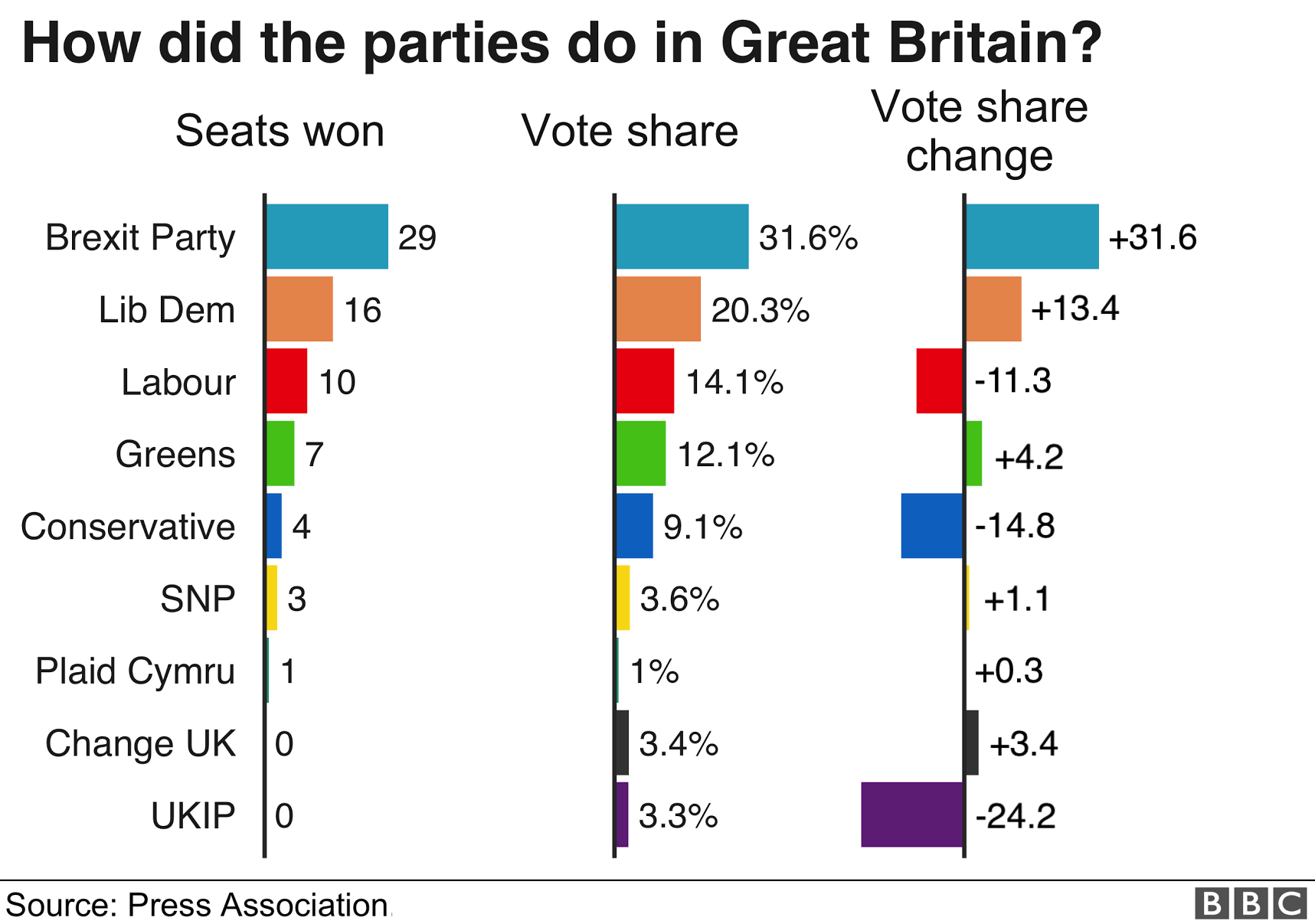
The European Election results - you can spin them any way you like...

From the BBC:


Leavers: Brexit Party got far and away the most votes and seats, so we won.

Remainers: Ah, but if you add the votes of the hard remain parties (Lib Dems, Greens, SNP, Plaid Cymru and Change UK), we won.

[Let's skip the debate about whether votes for the Conservatives or Labour are proxy votes for Leave and Remain respectively, Lord Ashcroft's polls say that the number one reason that people voted for those parties was 'Because I always do.'

Leavers: Ah, but lots of people would have voted Lib Dem, Green etc anyway, regardless of their EU policies.

Remainers: So let's look at the swing. Total Hard Leave (Brexit Party/UKIP) only up 7.4% compared to the 2014 elections, and the total vote share of Hard Remain parties (list as above) up by 22.4%. The net shift from Conservative/Labour to Hard Leave was 7.4% and from those two to Hard Remain was 22.4%. [Yes, those shifts add up to 29.8% and BBC give combined losses for Lab/Con as 26.1%, not sure where the other 3.7% came from]. That's a significant swing to Hard Remain.

Leavers: Hang on, weren't you moaning after the Referendum that with a 52%/48% result on a 72% turnout, strictly speaking only 37% voted to Leave and 63% didn't. This this time Hard Remain got 40% on a laughably low turnout of 37%, that means only 15% voted to Remain, which is a lot less than 37%.

Remainers: So why are you lauding Brexit Party's votes; they got 32% of 37%, that's only 14$%, hardly a mandate for a No Deal Brexit. Of 17.4 million people who voted Leave back in 2016, only 5.2 million voted Brexit Party, clearly 12 million of them have lost interest.

[And so on, ad infinitum].

Friday, 24 May 2019

I was surprised to see this in The Telegraph

I just stumbled across this, from three years ago:

Business rates are the closest thing we have in the UK to a land value tax (LVT). They're favoured by economists for their property of being "non-distortionary". They don't mess around with incentives, unlike many other forms of taxation.

A higher income tax may be a deterrent to earning more money in the UK, as are corporation tax hikes, but the supply of land is fairly fixed - people aren't going to change their production of it in response to higher taxes...

Business rates have existed for a lot longer than we’ve had evidence in support of them. They were first introduced in their current form in 1990. Their heritage can be traced back further, to the Poor Law of 1572, and later the Poor Law of 1601. They’ve had more than a few facelifts since.

Are they popular? Other than with economists? Not really. Business rates have become the business lobby’s bogeyman. The British Retail Consortium (BRC) is particularly opposed.

“Business rates bills have continued to rise when property values have fallen,” Sir Charlie Mayfield, the BRC’s president has said. “Reforming the rates system would be a welcome boost for retailers and help drive investment in training and technology.”

The opposition from businesses on the grounds of their cost is rather strange, because it's not occupiers that end up taking the financial hit. Rather, it's land owners. This is the so called "incidence" of a tax, who ends up shouldering it. 


If business rates rise or fall by a small amount businesses aren't likely to face different costs, just correspondingly higher or lower rents over time. So there would be no more money for investment [as a result of reductions in Business Rates] after all.

It's the landlords who lose out as a result of business rates. Over a period of two to three years, three quarters of the change in business rates is capitalised into rents, according to a report from Regeneris, the consultancy. This has been backed up by work from the London School of Economics which examined properties in London, and a more recent paper using data from enterprise zones, which also came to the conclusion that it is landlords who end up taking the hit.

Wednesday, 22 May 2019

Surely a ten-year old can see that this is complete and utter nonsense?

From one of my favourite Warmenist Porn sites:

Climate Myth:

Water vapour is the most important greenhouse gas. This is part of the difficulty with the public and the media in understanding that 95% of greenhouse gases are water vapour.

The public understand it, in that if you get a fall evening or spring evening and the sky is clear the heat will escape and the temperature will drop and you get frost.

If there is a cloud cover, the heat is trapped by water vapour as a greenhouse gas and the temperature stays quite warm. If you go to In Salah in southern Algeria, they recorded at one point a daytime or noon high of 52 degrees Celsius – by midnight that night it was -3.6 degree Celsius.

That was caused because there is no, or very little, water vapour in the atmosphere and it is a demonstration of water vapour as the most important greenhouse gas. (Tim Ball)

Basic rebuttal written by James Frank:

When skeptics use this argument, they are trying to imply that an increase in CO2 isn't a major problem. If CO2 isn't as powerful as water vapor, which there's already a lot of, adding a little more CO2 couldn't be that bad, right?

What this argument misses is the fact that water vapor creates what scientists call a 'positive feedback loop' in the atmosphere — making any temperature changes larger than they would be otherwise.

How does this work? The amount of water vapor in the atmosphere exists in direct relation to the temperature. If you increase the temperature, more water evaporates and becomes vapor, and vice versa.

So when something else causes a temperature increase (such as extra CO2 from fossil fuels), more water evaporates. Then, since water vapor is a greenhouse gas, this additional water vapor causes the temperature to go up even further—a positive feedback.

How much does water vapor amplify CO2 warming? Studies show that water vapor feedback roughly doubles the amount of warming caused by CO2. So if there is a 1°C change caused by CO2, the water vapor will cause the temperature to go up another 1°C. When other feedback loops are included, the total warming from a potential 1°C change caused by CO2 is, in reality, as much as 3°C.


Has he not heard of the concept of an equilibrium?

There are two ways of interpreting the rebuttal:

1. There is no equilibrium. So a CO2 induced increase of 1C leads to an overall 3C increase. Which in turn would lead to another 9C increase. Which would lead to a further 27C increase. And then we'd all be boiled alive. Clearly not true.

2. There is an equilibrium, and 3C warmer is the 'new normal'. OK. But the Warmenists insist, with calculations, that the entire 1C increase since the Little Ice Age is down to increases in CO2, with water playing little or no role.

In which case, why isn't it already 3C warmer? That's clearly not true.

If they insisted that of the 1C increase, 0.3C was due directly to CO2 (this is in fact just about plausible) and the rest was due to water vapour "and other feedback loops" (as yet unspecified), well fine, but none of them has ever said that.
--------------
Finally, he does not give a starting point for the CO2 level at which such positive water/CO2 feedback kicks in.

Let's change his wording slightly: "So when something else causes a temperature increase (such as extra CO2 from fossil fuels bright sunlight or atmospheric pressure), more water evaporates. Then, since water vapor is a greenhouse gas, this additional water vapor causes the temperature to go up even further—a positive feedback."

That's clearly nonsense.

Should we assume that up to 'pre-industrial levels' of 280 ppm of CO2, there is no positive feedback, and it starts at 281 ppm? Or current levels of 420 ppm (and rising)? Or does the positive feedback start at 1 ppm?

Classic bit of BBC spitefulness

In their article headed European elections 2019: Where the parties stand on Brexit, the BBC lists parties alphabetically, so first is Change UK, then Conservatives, then Green Party and so on.

"But wait!" shouts the crowd, "Haven't they forgotten The Brexit Party?"

Nope, they are listed second to last, as their name officially begins with the letter "T".

A classic beginner's mistake by whoever registered The Brexit Party with El Comm. Sort of serves them right.
------------------------------------------------------
Funny story: UKIP's official name used to be "UK Independence Party UK I P" with spaces between "UK" and "I" and "P", to get within El Comm's six-word limit. That was my fine work (he said proudly). El Comm didn't follow their own stupid rules and used to write to us without the spaces, which I took great glee in correcting each time. Twats.

Tuesday, 21 May 2019

I am now a Climate Science Believer!

I haven't been posting much over the last few days because I was busy reading lots of articles about Climate Science and watching YouTube videos, most were from Warmenists and a few from Deniers, for balance. No links, for the time being as I have dozens.

The Warmenist articles/videos look to be about 90% correct, but they all contain a couple of logical/mathematical errors, inherent contradictions or  over-simplifications, not to mention that they contradict each other. Most of the Denier articles and videos have similar inconsistencies.

What their explanation boils down to, having stripped away the errors and taking the rest at face value, is this:

1. The two main Greenhouse Gases are:
a) water vapour (not to be confused with condensed water droplets, which cool the atmosphere) at an average of 20,000 parts per million (within a wide range between zero and 40,000, that's the assumed average).
b) Carbon dioxide at an average of 420 ppm, up from 280 ppm in pre-industrial era.

Molecule-for-molecule, these have a very similar effect (AFAIAA). Water is self-regulating, as once it hits saturation point, it condenses and falls as rain or snow, removing itself from the atmosphere and cooling things down.

Carbon dioxide is not self-regulating, rain washes some of it out of the atmosphere, but it then most of it re-evaporates and only some goes into the oceans (which is where limestone cliffs come from) or into plants (which eventually die and rot again).

(The Warmenists shift the goal posts here a bit. Up to current CO2 levels, they accept that H20 is self-regulating and can be ignored (most of them do), but magically, if C02 increases, then H20 and C02 will interact and temperature increases due to the H20 element will somehow become self-reinforcing. This seems highly unlikely to me.)

2. The entire additional 33C average temperature of the earth's surface compared to what you'd expect from sunlight alone is down to greenhouses gases.

Apparently nitrogen and oxygen would have no such effect, we'd still get the steady fall in temperature with decreasing pressure/increasing altitude. This is the 'adiabatic lapse rate'. This gradient is much the same for all planets in the solar system, regardless of what kind of gas makes up their atmosphere.

3. If you increase greenhouse gas concentrations from average 20,280 ppm (average H20 plus pre-industrial C02) to 20,420 ppm (average H20 plus current CO2), that's a 0.7% increase in Watts being reflected back to each square metre of the earth's surface. Existing greenhouse effect is 33C, increase that by 0.7% = 33.23 = an extra 0.2C* compared to what it would be at 280 ppm C02, everything else being equal.

* The increase in surface temperature relative to increases in Watts/m2 is logarithmic not linear = 0.1C, so let's round that 0.23C down to 0.2C for sake of argument.

4. It appears to be accepted by both sides that global average temperatures go in lots of overlapping and fairly regular cycles. The most relevant one as at today is a roughly thousand-year cycle i.e. Roman Warm Period, Mediaeval Warm Period and Modern Warm Period.

That explains the rest of any increase since a randomly chosen starting point. Let's not  bicker about what a sensible starting point is.

Looking at the increase since the pre-industrial era means you are looking at the increase since the Little Ice Age, however defined, when temperatures were 1 or 2C lower than the very long run average, so of course we're 1C warmer than then.

Monday, 20 May 2019

Cargo Cult Improvement

From The Guardian

Just over a decade ago, Mulhouse, a town of 110,000 people near the German and Swiss borders, was a symbol of the death of the European high street. One of the poorest towns of its size in France, this former hub of the textile industry had long ago been clobbered by factory closures and industrial decline.
...
Today, Mulhouse is known for the staggering transformation of its thriving centre, bucking the national trend for high street closures.

The article goes into all the normal Guardian favourites like independent shops and god help me, f**king trams. These people think that gentrification is all about putting the independent shops there and that makes everyone richer and they spend money. In reality this is a by-product. You get the fancy, overpriced shops when you get the richer people.

What's really happened in the past decade is that a new shiny high speed LGV line was built linking Mulhouse to Dijon, cutting the time from something like 2:30 to more like 1:00, and onwards, Mulhouse to Lyon is down from 4:30 to 3:00. There's also a plan to have a branch going around Dijon to join up with a TGV to Paris, and to extend the line down to Lyon.

Friday, 17 May 2019

Voices in my head

TV advert: "Adopt a snow leopard to save the species from extinction."

Voice: "What's the point? It's going to know straight away I'm not it's real Dad."