
Most "Two Black Holes to merge" stories go like this, from Space.com:
The two black holes dance around each other at the center of the galaxy NGC 7727, located some 89 million light-years away from Earth in the constellation Aquarius. Scientists say they have never seen such a pair so close to our planet, but also so close to each other.
The black hole couple, which will merge into one giant black hole 250 million years from now...
That's not exactly a testable prediction, is it?
Imagine my surprise when I stumbled across this article on Inverse:
ASTRONOMERS ARE WATCHING THE SKIES, waiting for two cosmic giants to collide. In a galaxy located 1.2 billion light years from Earth, a pair of black holes could potentially be engaged in a gravitational tango, pulling closer to one another until they merge as one supermassive black hole.
This could occur as soon as 100 days, or up to three years from now*.
The chaps at LIGO/Virgo have got a lot riding on this. So far they have been marking their own homework, although their output has the ring of truth to me. Equally, they could be pulling a massive scam like all the scientists wasting billions on Dark Matter detectors.
So, let's hope that Huang Nang and Ning Jiyang (who arrived at their conclusion independently of LIGO/Virgo "using data from a survey telescope in California called the Zwicky Transient Facility) are in the right ball park and that the merger can be detected by LIGO/Virgo. That's both parties vindicated and we'll learn something new, or have some existing theory corroborated. Or possibly red faces all round, but we've still learned something.
* Of course, either this event happened - or didn't happen - 1.2 billion years ago, but from our point of view, it hasn't happened yet.
Thursday, 10 February 2022
Exciting Black Hole news!

Thursday, 4 November 2021
Calculating the speed of a falling object etc. using the physics approach.
I like doing a bit of mental arithmetic, when I'm in a boring meeting or lying awake at night. A typical challenge is calculating the speed of falling objects; how long it takes them to fall etc. There's one constant, acceleration due to gravity (hereafter abbreviated to 'gravity' for brevity) = 9.8 m/s2 and then you have to work out how to work it out; then remember how to work it out while you actually work it out.
It's surprisingly fiddly, tedious and not much fun. Here's a link to an explanation with an embedded calculator.
It occurred to me this morning that taking the maths approach is a load of bollocks, it's quicker, easier and simply more fun taking the physics approach. You just have to remember a bit of GSCE level physics:
1. Initial potential energy of an object = kinetic energy of the object just as it hits the ground.
2. Potential energy = mass x height x gravity.
3. Kinetic energy = half x mass x velocity squared.
For simplicity, mass is always 1kg so does not appear in the answers (it would cancel out anyway), we're using SI units and we're ignoring air resistance.
Q1: Object is doing 60 m/s when it hits the ground. From what height was it dropped?
A: Closing KE = 1/2 x 60 x 60 = 1,800
∴ Starting PE = 1,800
∴ Starting height = 1,800/9.8 = 183 metres
Q2: An object is dropped from a height of 500 metres,
a) at what speed does it hit the ground
b) how long before it hits the ground?
A: Starting PE = 9.8 x 500 = 4,900
∴ Closing KE = 1/2 x 9,800
∴ Closing velocity squared = 9,800
∴ a) Closing velocity = 99 metres/second
(Calculating square roots made easy here)
∴ b) Time taken to fall (constant acceleration at 9.8 m/s2) = 99/9.8 = 10.1 seconds.
----------------------------------------------------------------------
The old fashioned maths approach is probably better (simpler calculation and more intuitive) if you are told time taken to fall:
Q3: An object falls for five seconds before it hits the ground. From what height was it dropped?
A: Closing velocity = 5 x 9.8 = 49
∴ Average velocity = 1/2 x 49 = 24.5
∴ Height = 5 seconds x 24.5 = 122.5 metres
The physics approach would be:
A: Closing kinetic energy = 1/2 x (5 x *9.8) x (5 x 9.8) (no need to calculate the actual number)
Starting potential energy = closing kinetic energy
Height = starting potential energy ÷ *9.8
∴ Height = 1/2 x 5 x 5 x 9.8 = 122.5 (the *9.8s cancel out)
Both approaches boil down to:
Height = 1/2 x time in seconds squared x gravity, but you'd have to remember this extra equation, so this approach is not advised.
Wednesday, 26 May 2021
"pV = nRT"
Alarmists and Physics Deniers don't actually know what this equation signifies and make themselves look silly by trotting it out as if it somehow supports Alarmist Theory and/or debunks the Gravito-Thermal Effect.
Nothing of the sort. There's a full explanation and worked example at ChemGuide.co.uk. This is basic first year level GCSE Physics and nothing controversial.
-------------------------------------
Let's apply it to typical temp, pressure, density at sea level:
Pressure = 101,325 Pa
Volume = 1 m3
Mass of air in 1 m3 at 'standard temperature and pressure' = 1.227 kg
n = number of moles of gas in 1 m3 = mass/m3 divided by molecular mass of 'air', which is 29g/mole
R = universal gas constant* = 8.31441 J/K/mol
Temp = 288K
Stick in the numbers on the right hand side, 1,227/29 x 8.31441 x 288 = 101,314. Close enough to 101,325!
------------------------------------
Now we've got the hang of it, what's the likely temperature at 10 km altitude?
Wiki tells us that pressure up there is 26,300 Pa, density is 416 g/m3.
The left hand side is 26,300 x 1 = 26,300
The right hand side is 416/29 x 8.31441 x T = 119.3 x T
So 119.3 T = 26,300; and T = 26,300/119.3 = 220K
Which is exactly what the blue line on Wiki's chart - and real life measurement - show. Wiki's chart is what you get if you just start by assuming ever increasing density in a gravitational/acclerating field and working from there (see diagram 5).
In fact, you can assume constant density, desnity which increases linearly or geometrically as you go down, there would still be a similar profile with increasing pressure and hence temperature towards the surface. Basic maths. Any other outcome is mathematically impossible unless you assume that density increases with height at an implausible rate (in which case, what happens at the top?).
------------------------------------
* Keen-eyed readers will know that this is Avogadro's number x Boltzmann's constant.
Sunday, 25 April 2021
Acceleration ≈ gravity
The effects of acceleration and gravity aren't exactly the same of course, but we can generate 'artificial gravity' by spinning things round, like swinging a bucket of water in a horizontal plane - the water stays in, the same as it would if you just put the bucket down. As a reality check, I put some marbles in the centre of a smooth, flat plate on a record player turntable. When I lifted the needle to get it turning, all the marbles hit the edge of the plate within a second or so.
For all the 'Physics Deniers' out there, let's work out what would happen if you had a large, well-insulated tube of air (the larger and longer the better) being spun around an axis at one end (the faster the better).
1. While standing still, the density, pressure and temperature are constant along the whole length (I haven't bothered with units or numbers on the axes, this is about basic principles):
 2. When it is spinning around the axis, the gas will be pushed towards the outer end (the same as the marbles on a plate). So density goes up at the outer end and down at the axis end. I've assumed that the increase is linear for now:
 3. The pressure at any point along the tube is the mass of all the gas to the left of it pressing 'down' on it, which is the area of the 'density' shape to the left of that point (multiplied by the strength of the artificial gravity). The length and height of the upper triangle both increase by the same multiple with each step to the right, so the area increases by that multiple to the power of 2. So pressure increases geometrically from left to right:
 4. Temperature is proportional to pressure divided by density. There are no physical barriers along the tube, it's all in equilibrium, so you can use the Gas Laws to calculate T if you know D and P (or indeed, calculate any variable if you know the other two). The ratio of P/D increases from left to right. So temperature goes up from left to right in a straight line (crudely speaking, T ∝ P/D and P ∝ D^2, so T ∝ D^2/D => T ∝ D):
 This is the bit the Physics Deniers can't or won't understand. The gas can't become isothermal again, because the density and pressure at each point in the tube are dictated by the amount of gas, the length of the tube, how fast it is spinning etc, and temperature is the result of all that, temperature can't just make up its own mind what to do. So the inner surface at the outer end becomes warmer than when it was standing still, and the inner surface at the axis end becomes cooler. No thermal energy has been added to the gas - it is just distributed differently.
A real life application of a similar effect is the vortex tube, which uses centrifgual forces to split air at a certain starting temperature into a stream of much colder air and a stream of much warmer air.
5. What relevance does this have to the gravito-thermal effect? Simple, you just rotate Diagram 4 clockwise by 90 degrees and relabel the axes. This now resembles the measured profile of the troposphere. You can multiply T and D at any altitude, divide that by P at that altitude and you get the same answer.
 The other and even easier to understand explanation for the temperature profile in the atmosphere is that when air rises, it converts thermal energy to potential energy (cools); when air falls (or presses down on air beneath it), it converts potential energy to thermal energy (warms). Actually it is gravity and the Gas Laws that says there must be a lapse rate and the formula g/Cp just tells us how much the lapse rate is.
So the other way of modelling the whole thing is by just knowing the effective/average temperature and the lapse rate. We know that Earth receives enough sunshine to warm the atmosphere to an average of ~255 degrees (effective temperature), which is (by definition) the temperature half-way up the troposphere (the same as the temperature half-way along the spinning tube = the starting temperature). So you subtract ~5.5 x lapse rate ~6.5 degrees to find temperature at tropopause and add the same amount to find the temperature at sea level. You can work backwards to find pressure and density at different altitudes (for example by using the Barometric Formula or trial and error).
The equilibrium and actual observed profile is that for every 100m fall, density increases by ~1.115%; pressure increases by ~1.373%; and the ratio pressure-to-density increases to give a lapse rate of ~6.5 degrees/km. These three variables are inter-dependent, one does not 'cause' the others, they are in balance, like two playing cards balanced in an inverted 'V'. Each card is holding the other one up.
And if we have two different approaches which both give you the correct answer, you can be fairly confident that the approaches themselves are correct.
But whatever the explanation, it reminds us that the effects of gravity and artificial gravity/acceleration are very similar; and acceleration due to gravity is a lot, it is slightly more than the acceleration of a car that can do 0 to 60 mph in three seconds*. The laws of physics that apply to a bucket of water also apply to a spinning tube also apply to the troposphere.
---------------------------------------
6. "But what about radiation and greenhouse gases?" shout the Physics Deniers. Well, what about them? You can explain what happens in the spinning tube or the vortex tube without mentioning them and they are irrelevant when you rotate the diagram and have real gravity instead of artificial gravity. In the spinning tube, there was a fixed amount of thermal energy to start off with, which was recycled towards the outer end. Earth gets enough sunshine to keep the whole system at a steady average ~255K (fixed - see 7.) and the laws of physics ensure that the thermal energy is recycled downwards to cool the air at higher altitudes to ~220K and warm the surface to ~288K.
7. For sure, land and the ocean surface are emitting more radiation than actually gets to space (which must be approx. equal to the amount received from the Sun each day) but there's no point subtracting one from the other, it's not comparing like with like. We calculate the effective temperature ~255K by treating clouds as part of the 'surface', so the 288K at the hard surface/ocean surface is a red herring; the effective temperature should be compared with the overall average temperature of the top surface of clouds (two-thirds) and land and ocean surface (one-third), which is a lot closer to ~255K than ~288K.
The surface is as warm as it is, and emits the corresponding amount of radiation, it simply doesn't care what happens higher up. Somehow or other, the whole system will ensure that incoming and outgoing radiation balance, whether we point the finger at greenhouse gases trapping radiation or the low emissivity of clouds. Nature finds a way**.
* People picture the atmosphere (or anything else) resting on the Earth's surface as a static situation. In some ways, you can imagine the surface accelerating upwards at 9.8 m/s (a car doing 0 to 60 mph in three seconds) and pushing everything up accordingly. Imagine a ship moored in a river flowing at 10 knots, there's a bow wave in front of it. Or the same ship travelling up a canal at 10 knots, there's the same bow wave. If you lean over the bow and look straight down, you can't tell whether the ship is moored or moving. So it's like the Earth's surface is a giant piston pushing and compressing (hence warming) a ten-ton 'bow wave' of air in front of it.
** The top 1m of the ocean surface only radiates away about 1.4% of its total (thermal) energy overnight, sufficient to cool it by ~4K, which matches up with the typical diurnal temperature range for the surface of a fairly still ocean and the air immediately above it. Losing energy by radiation is a slow and inefficient process - blacksmiths quench red hot steel by plunging it into water; how much longer would it take if they held the red hot steel just above the surface of the cold water and allowed radiation to do its thing?
Here endeth today's lesson. I'd rather be a Climate Denier than a Physics Denier.
Saturday, 12 December 2020
"The Alternative to Dark Matter May be General Relativity Itself"
From Astrobites. Here are the highlights:
For most astronomers, it is just common sense that dark matter accounts for approximately 85% of the matter in the universe. However, as long as the constituents of dark matter remain a mystery, some astronomers remain skeptical about our conventional understanding of dark matter. Recently, astronomer Alexandre Deur suggested that the theory of relativity itself may explain a phenomenon widely regarded as evidence for dark matter...
Modified Newtonian Dynamics, or MOND, for example, is the most discussed out of all the gravitation corrections to explain the missing mass problem (see this astrobite for further discussion of MOND vs. dark matter). It modifies the Newtonian gravitation law at low accelerations to enhance the effective gravitational attraction. Similarly, most of the other corrections require new descriptions of gravitation. But recently, as Deur proposes in this work, the effect of general relativity may account for the missing mass, without introducing any new corrections.
Yes, MOND is a bit of a fudge and an approximation, but the general approach is correct. It's a lot less of a fudge than inventing Dark Matter.
Generally, the predicted rotation of galaxies, as shown in Figure 1, is modelled by Newtonian dynamics. The rotation velocity is much smaller than the speed of light, especially at the outer part of the galaxy (typically v/c ≈ 0.1 % , where v is the velocity and c is the speed of light). Therefore, it is believed that a non-relativistic treatment is reasonable. However, this assumption could be challenged due to the effect of field self-interaction in general relativity. This effect depends on the mass only, and is independent of the rotation velocity, thus making a difference regardless of how fast the stars move in the galaxy. Deur shows that field self-interaction, which reveals the non-linear nature of general relativity, is in fact not negligible in the missing mass problem.
To demonstrate this, Deur uses the gravitational lensing formalism. While light travels in straight lines in flat space, it can be deflected in the presence of a gravitational field. In exactly the same way, the gravitational field lines connecting two parts of the galaxy are distorted by the background field. That is to say, the gravitational field is deformed by the total galactic mass. With the field lines distorted, the strength of the gravitation consequently changes.
Yup, gravity lenses itself, i.e. it focuses itself on the mass that created the gravity in the first place. You can guess this for yourself. Once they have worked out how and to what degree, they'll hopefully show that there was no need to invent Dark Matter, and the concept will be quietly shelved.
Sunday, 18 August 2019
Common sense tells us that effect of gravity moves at the speed of light
This appears to be an open question; it wasn't until 2002 that they were fairly sure and very recently (2017) that they established that, "assuming a delay of zero to ten seconds, the difference between the speeds of gravitational and electromagnetic waves, vGW − vEM, is constrained to between −3×10⁻¹⁵ and +7×10⁻¹⁶ times the speed of light."
I would have thought it was easier to apply common sense.
The light we see from the sun arrives from where the sun was 8 minutes 20 seconds ago (assuming for simplicity the earth is stationary and the sun moves round it).
If you measure the direction in which the earth is being pulled by the sun, you'd establish that it is being pulled towards where the sun was 8 minutes 20 seconds ago.
The light meter and gravity meter will be pointing in exactly the same direction; if not, there'd be all sorts of apparent weird wobbles (which would make measuring distances and so on a lot easier, as it happens).
And well done to these chaps, while we're on the topic. Instead of chasing non-existent Dark Matter, they are actually measuring and observing exciting stuff that actually happens.
Sunday, 23 December 2018
Expected and observed galactic rotation curves
Interesting article from Forbes ("Rotating Galaxies Could Prove Dark Matter Wrong") which includes the following graphic:
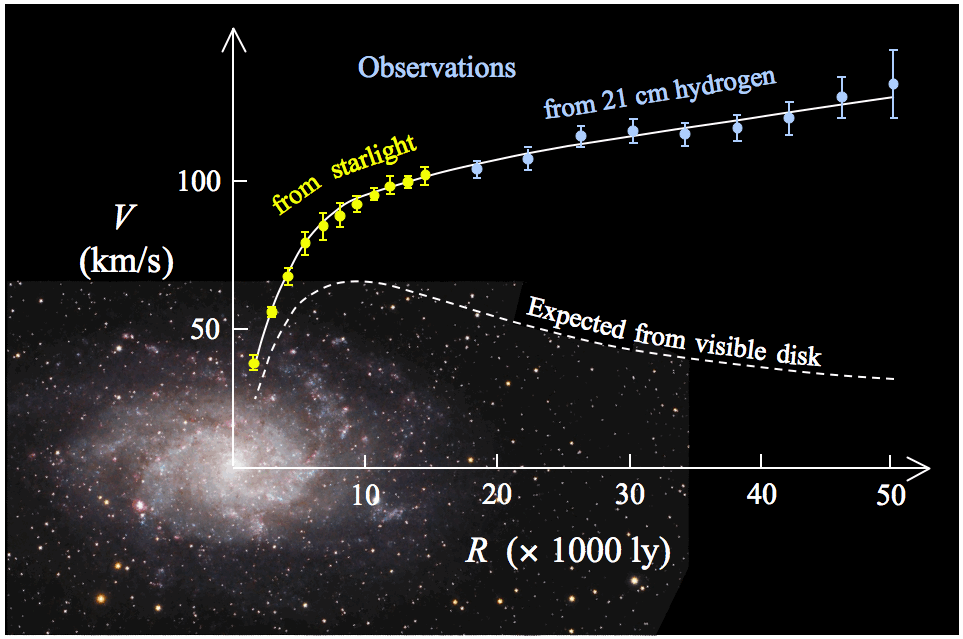
You can't argue with facts. The observed speeds are the observed speeds. The big mistake appears to be the other line for "Expected from visible disk".
What I don't get is why anybody would expect that in the first place. While the centres of galaxies are a lot denser than the outer bits, overall the matter is pretty evenly spread out (let's assume that the concentration of non-light emitting clouds of gas and dust are distributed in the same way as the visible stars).
Remember that a star at the outer edge of a galaxy only feels the pull of gravity inwards, but for a star further in, some of the inwards pull is cancelled out by the outwards pull of the stars further out.
Similarly, gravity from mass 'ahead' of the star, pulling it forwards is also cancelled out by gravity from mass 'behind' the star pulling it backwards. It is only the net inwards pull that matters.
In our Solar System, the Sun is 99.9% of the mass and thus causes 99.9% of the gravity and explains 99.9% of the orbits and speeds of the planets, but at a local level, the mass of a planet dictates the orbits of its moons. Earth is tiny compared to the sun, but a lot closer to the Moon. If you are calculating the orbit of the Moon, you first consider its orbit round Earth and then adjust that a bit for the influence of the Sun.
In the same way, the outer stars are orbiting round/in between/past each other as much as round the centre.
I did a spreadsheet for an idealised galaxy with
a) 11% of total matter in a circle with a radius of 2 "units" (multiples of 5,000 light years, let's say) from the centre and
b) the rest evenly spread out,
and calculated the relative net inward pull of gravity on a star orbiting 1, 2, 3 etc "units" from the centre.
The speed required to stay in a particular orbit is proportional to the force of gravity acting on it; there is no need to ponder whether a star's orbit dictates its speed; or whether its speed dictates its orbit; or a bit of both.
My spreadsheet produces a chart which shows that having made these assumptions, the relative force of gravity on a star travelling perpendicular to the centre at various distances along the radius matches up pretty well with the observations (the vertical axis units are not any absolute value, it's just relative to each other):

Sunday, 16 December 2018
An alternative explanation for the shape of spiral arm galaxies (part 2)
And lo, the second and final part in my mini-series on why the planets revolving a sun follow Newton's rules/General Relativity (the larger the orbit, the slower the planet) but stars revolving a galaxy do not. Beyond a certain radius, their speeds remain constant, so they can maintain the spiral arm shape.
This is a slightly different explanation to Part 1, the conclusion of which might well be completely wrong (theses are just thought experiments, because I like thinking about stuff), but if it's correct, then the two explanations complement each other.
In words: taking gravity as a given, the orbit of a planet around the sun (or of a star round a galaxy) does not determine its final speed; it is its initial arrival speed which determines its orbit. If its arrival speed is not right for its initial orbit, it will either spiral in to the centre or fly straight on and end up in another solar system (or galaxy).
So you have to skip back to how solar systems or galaxies were formed in the first place, and there's your answer, no Dark Matter required. (The fact that nobody really knows what gravity really 'is' or how gravity actually 'works' is irrelevant if we are only thinking about its effects. I don't know how computers or the Internet work, but I can still use them.)
There was basically loads of stuff whizzing round, it formed the only patterns it could possibly have formed. If you just look at finished solar systems or galaxies, you ignore all the stuff that passed a system or galaxy with which its direction and speed were not compatible and so ended up in another system or galaxy, or floating through space on its own; for a bit of a stuff to end up particular system or galaxy is the exception not the rule.
A solar system or a galaxy is the result of a series of happy coincidences. It's like evolution. To invoke Dark Matter is like invoking Intelligent Design.
With pictures:
1. A simple solar system.
Planets are formed from dust and rocks which were spewed out by dying stars and whizz through space until they are caught by the gravity of a sun. They don't arrive fully formed, but to be caught, their constituent rocks have to be travelling at the right speed and distance from the sun.
For a given distance from the sun, if Rock B is travelling too slow, it will fall into the sun, if too fast, it will change path slightly but then whizz off into space again. Its speed has to be 'just right' for it to end up in a fairly stable orbit. It then merges with other rocks travelling on a similar orbit at a similar speed form a planet. Cruithne is travelling round the Sun on a similar orbit to Earth at a similar speed, but is more or less opposite Earth so the two won't collide and merge any time soon.
Rocks and planets have no memory, when a planet reaches the place illustrated with a small white circle, travelling perpendicular to the sun (pink), all they 'know' is that they want to continue travelling in the direction of the solid arrow. It doesn't matter whether they just arrived fully formed along the solid arrow or were already in that orbit at that speed.

2. The right speed is different, depending on what their (initial) trajectory is
Imagine rock A and rock C, which happen to pass into the sun's gravity (the dotted circle), travelling at the same speed, and let's imagine that this is the optimum speed for rock A. Rock A feels a strong gravitational force as it passes quite close to the sun. So I have coloured the sun orange to denote 'strong' gravity'.
Rock C, travelling at the same speed, only feels weak gravity from the sun (coloured yellow to denote 'weak' gravity), so for that particular orbit, it was travelling too fast, so is deflected slightly but flies off into space again.

3. The optimum speed is slower, the further from the sun the rock was initially travelling.
Stands to reason. If Mercury (or the rocks which formed it) had been travelling slower, they would have spiralled in the sun. If the gas in Neptune had been travelling faster, it would have passed straight on.

4. Mass is much more evenly distributed in a galaxy than in a solar system
Newton/GR is easy with a solar system, as the sun makes up over 99% of the overall mass. You can more or less ignore the pull between the Earth and Mars when studying their orbits.
But how are galaxies formed? It's a bit more complicated than solar systems. Consensus seems to be that you start with a large gas cloud, which contracts under gravity to form the first few stars, with strong gravity, then other nearby or passing gas clouds, which might or might not have already formed stars, are caught up in it.
Picture 4 is analogous to picture 2. Whether or not stars arrive fully formed does not matter, they have no memory. When they have reached the point marked with a star and are travelling perpendicular to the centre of the galaxy they might as well have just arrived from outside (where they only experience medium gravity, coloured yellow) and in the absence of gravity 'want' to continue to travel in a straight line. So let's imagine two stars A and C which are travelling at the same speed, just different distances from the centre.
There are stars to the left and right of A's line of travel. The ones to its right cancel out the pull of gravity from some of the stars to its left. It only feels the net pull of the stars in the region coloured orange (strong gravity), yellow (medium gravity) or green (weak gravity), which adds up to a certain total gravity. Let's assume that it is travelling at the optimum speed for that distance from the centre, so falls into a stable orbit.
Now look at it from the point of view of star C, which arrives at the same speed, parallel and at the edge of the galaxy. There are no stars to its right, it only feels a pull to the left. The regions which pull it are given the same colours (strong = orange etc), and as you can clearly see, it would be reasonable to assume that it actually feels a stronger pull to the left than star A. I adapted this idea from a Dark Matter Sceptic on YouTube called Jeremy Kenny, who is probably as well qualified as I am, in other words, not at all.
So if star C is travelling at the same speed as star A, it is 'too slow' to stay in that orbit and will spiral in to the centre.

5. The 'optimum speeds' for stars in a galaxy is the other way round to planets in a solar system
Picture 5 is analogous to picture 3, which told us why inner planets have to travel faster than outer ones.
Picture 5 shows why with stars, it is the other way round - apart from the inner stars orbiting the very centre (massively heavy, loads of Black Holes and stars etc) which follow normal rules, for outer stars (more than 5,000 light years out, or whatever the cut off point is) the optimum speed to stay in orbit is the same (or faster) the further out you are.
For star A, closer to the centre, most of the galaxy's gravity cancels out, it only feels gravity from stars in the areas coloured yellow (medium gravity) or green (weak gravity). To stay in that orbit, it must be travelling slowly. Fewer stars cancel out for star B, it is pulled more strongly to the left, so it is has to be travelling as fast as or faster than star A to remain in a stable orbit; and so on for star C right at the edge.

Hope that settles matters!
----------------------------------------------
A lot of people go for the 'dark matter' explanation, for which there is only indirect evidence and absolutely no direct evidence. I am a 'dark matter sceptic' if you will, which is why the True Believers in Dark Matter (a phrase coined by Prof. Stacy McGaugh, who used to be one until he discovered MOND, his lectures are highly recommended) would deride me as a 'Gravity Denier' if they knew I existed. (Please note, Dark Matter is not to be confused with Dark Energy, something else entirely, which might be negative mass for all we know)
Wednesday, 12 December 2018
An alternative explanation for the shape of spiral arm galaxies (part 1)
We are familiar with spiral arm galaxies. The 'problem' is that to maintain their shape, the rotational speed of the outer stars must be the same as inner stars.
That is in stark contrast to smaller systems like the solar system where the innermost planet Mercury goes round the Sun every 88 days, the rotation period gets progressively longer the further a planet is from the Sun, so the outermost planet Neptune (sorry, Pluto!) goes round every 165 years. This follows the inverse square law - see 2. below.
The still-fashionable explanation - Dark Matter - has been debunked endless times, most recently in the last few days.
Density wave theory is a contender, but the real front runner must be Modified Newtonian Dynamics (MOND), which just says that people get Newtonian Gravity slightly wrong.
In such cases, I find it helpful to write down everything you know and then draw the obvious conclusions.
1. The surprising similarities between behaviour of light and gravity
Yes of course, gravity doesn't really exist as an independent force, but for simplicity we might as well assume it does. The behaviour of light is well studied and understood, so let's use it as an analogy:
* The speed of light = the speed of gravity waves (I remember vividly reading about some fairly conclusive experiment/measurement in 2002 or so and thinking "Well, yes, obviously...")
* Photons = gravitons
* Light waves = gravity waves
* Ripples in electromagnetic field = ripples in space time
2. The inverse square law
The brightness of light is inversely proportional to the square of the distance. This stands to reason. The source is emitting the same number of photons every second and they travel in straight lines, so the surface ares of a hypothetical sphere with radius one light second (with its centre at the source) contains as many photons as the surface area of a sphere with radius two light seconds.
But the surface area of the two-light-second-radius sphere is four times as large (surface area of a sphere = 4 Pi r^2) as the one-light-second-radius sphere, so the light (number of photons) is only one-quarter as bright. Real life example: because of perspective, a light a certain distance away also only looks one-quarter as big as one half as far away, so if you look at a row of street lights stretching into the distance, they all appear to have similar brightness.
The same thing happens with gravity - the force of gravity you feel is also inversely proportional to the square of the distance. To continue the analogy, there are a quarter as many gravitons per unit area of the second sphere.
3. Gravity bends light waves, and...
That light waves appear to bend when they pass near massive objects is also undisputed (I hope); gravity bends light waves. Although photons have no mass so shouldn't respond to gravity. General relativity explains this.
The massive object bends light and so it changes the shape of the hypothetical sphere considered in 2. If the observer is at A, the massive object at B and the light source (star) at C, the light sphere emitted by C is stretched a bit. It is more like a boiled egg shape, with the star at the centre of the yolk and the observer at the pointy end. The observer sees brighter light than they 'should'; the star appears larger/closer than it really is; the observer receives more photons than they 'should' etc. The massive object acts like a lens.
Galaxies bend light on a much larger scale than a single massive object (h/t Dyson and Eddington in 1919), hence the term galactic lens. If the light-gravity analogy is to hold, then gravity must also bend gravity waves. I'd guessed this all along, but Googled it this morning to check and yes, they do. For sure that's 'only' a blogpost, but she's a proper qualified scientist and her post is full of links to official stuff.
UPDATE, a few days later a physicist explained in Forbes:
This tells us, unambiguously, that gravitational waves, as they travel through the Universe, are affected by the warping, curvature, and stretching of space.
There’s another piece of evidence, too. The kilonova event of 2017, where we observed the merging of two neutron stars in both gravitational waves and in electromagnetic light, had these two signals arrive nearly simultaneously: with less than a 2.0 second difference between them.
Traveling from a distance of over 100 million light years (and given that there are over 30 million seconds in a year), we can state that the speed of light and the speed of gravity are equal to within better than 1 part in a quadrillion (1015).
This tells us another important piece of the puzzle: whatever time delays take place for photons as they travel through the Universe owing to the curvature of space also occur for gravitational waves. Whenever you enter or leave an area where gravitation is strong, you have to follow the path set forth by the curvature of space. Around a massive galaxy, for example, like the one we observed the kilonova in, space is curved, and all massless particles have to climb out of that potential well.
The fact that photons and gravitational waves arrived simultaneously tell us that they had to experience the same effects as one another from the curved space they passed through.
Here's the kicker:
Every star's gravity field bends, and is bent by, the other stars' gravity fields. Start with two stars (sources of light AND sources of gravity). Each light/gravity sphere is bent egg-shaped, so we end up with a two overlapping light/gravity spheres shaped like a Rugby ball. Which is like an American football but a bit less pointy.
Add more stars and the gravity fields merge and flatten out into something the shape of an Olympic discus; add a whole galaxy and the galaxy's gravity field gets flatter and flatter.
4. Modified Newtonian Dynamics
Enter stage left, towering giant of non-bullshit astro-physics, Mordi Milgrom. What his MOND (link at start of this post) says is that up to certain radius (about 5,000 light years, 5 kly for short), the force of a galaxy's gravity on stars follow the normal Newtonian inverse square law; beyond that certain radius, the force of gravity diminishes inversely proportional to distance i.e. pull of gravity on outer stars is stronger than expected, meaning they spin round faster than expected, so have the same rotational speed as inner stars, maintaining the spiral arm shape, the problem we are trying to explain.
The problem I have when I read up on his MOND (whether he deliberately chose an acronym that spells the German word for 'moon' is unknown) is that nobody explains why there is jump from normal Newtonian gravity nearer the centre of a galaxy to MOND gravity beyond a certain radius, it all seems a bit arbitrary.
Observations fit his equations because he tweaked his equations to fit observations etc. Which is why I have had to work out (reverse engineer?) the actual explanation myself.
5. A worked example
Let's start with a star 5 kly out from the centre where Newton's rules stop applying. It is pulled towards the centre with a gravitational force of X (whatever unit that is).
* Under normal Newtonian inverse square root rules, a star 15 kly out - at the other end of a spiral arm - only feels a pull of X/9 of that (15/5 = 3, 3^2 = 9)
* MOND says a star 15 kly out feels a pull of X/3 (15/5 = 3) not X/9, which seems like a huge discrepancy.
It's not such a big discrepancy really. The star 15 kly out just 'thinks' it's only 9 kly out (as it feels the same pull as if it were only 9 kly out).
Maths: The pull of gravity towards the centre of gravity on the surface of a hypothetical perfectly shaped sphere with radius 9 kly centred on the centre of gravity is (approx) 1/3 of that on the surface of a sphere with 5 kly radius. 9/5^2 = 3.24, = 1/3.24 = close enough to 1/3 for our purposes. (The correct number is 8.56 kly but let's go with 9 kly).
Possible explanation: the 15 kly star is actually sitting on the surface of a 9 kly-radius sphere... which has been stretched out in every horizontal direction, so it has height +/- 18 kly and width of 30 kly (see 3). The star is 15 kly from the centre, but in gravity terms, it is only 9 kly from the centre.
Bonus: Newton wasn't wrong, it's just that you can't expect his inverse-square-law spheres to be perfectly spherical in all conditions. They are at the small scale of a solar system where the central Sun is somewhere between 99.8% and 99.9% of the total mass of the solar system anyway; not in a large galaxy where mass is more evenly distributed and the cumulative effects are much greater.
6. If anybody has access to the right telescope...
... and somebody else knows how to do the calculations, I'm happy to split the Nobel Prize money three ways. Get to it!
-----------------------------------------------------------------
Part 2 to follow, including diagrams and ways that we can test this theory i.e. what sort of results it predicts and how to observe and measure them.
Tuesday, 11 December 2018
An alternative explanation for why Planet Earth bulges at the Equator
Easy explanation - the world is spinning round, so the equator gets thrown outwards slightly, like people spinning balls of pizza dough into flat pizza bases.
Or maybe not.
Here's my gloriously long winded explanation...
As top telly scientist Prof. Jim Al-Khalili, explained in his programme "Gravity and me":
Rule 1. There's not really such a thing as gravity. Time runs more slowly near large masses and smaller masses want to move to where time moves more slowly.
Rule 2. Time moves more slowly for fast moving objects.
So with GPS satellites, they have to make a net adjustment between two opposite effects - the clocks on the satellites seem to be running a bit faster (than clocks on earth) because they are further away from the mass of the planet; but the satellites are moving quickly, which means clocks on satellites seem to be running a bit slower (than clocks on earth). The two effects don't quite cancel out.
The prof realised (after some false starts to which he cheerfully 'fesses up) that the same applies if you compare a clock at the North Pole (nearer centre of earth but not rotating) with a clock at the equator (further away from centre of earth but moving at 1,000 mph). And - unlike for satellites - these two effects exactly cancel out!
This is hardly surprising, really.
If we consider the earth to be a large blob of slow moving liquid (and ignore the thin layer of rocks floating on top), it must be clear that if a drop anywhere on the surface of the blob can move to somewhere where time is passing more slowly, it will do so. (This is no different to considering a liquid that has been poured onto a flat surface). So we can safely assume that four billion years later, the clocks for all drops on the surface of the liquid part of earth are moving at the same speed.
That is ultimately why the earth bulges at the equator - if you started with a perfect sphere, a clock at the equator would run more slowly than a clock at the North Pole (same distance from the centre of the earth and moving quickly).
So liquid on the surface flows from the Poles towards the equator until the equilibrium is reached, where the extra radius means a clock on the surface at the equator is a little bit further from the centre of the earth, which speeds up the clock a bit. The clock at the North Pole is a little bit nearer the centre, so slows down a bit, and both clocks (in fact all clocks anywhere on the surface) are running at same speed.
All part of the service!
Monday, 9 January 2017
Fun Online Polls: Competing theories of gravity & groupthink
The results to last week's Fun Online Poll were as follows:
Which theory better explains the high rotational speed of stars in the outer arms of a galaxy?
Existing gravitional theory plus dark matter - 11 votes
Erik Verlinde's Modified Newtonian Dynamics aka Entropic Gravity - 21 votes
Ed P threw a curve ball, with Derek seconding, pointing out that there is another explanation of gravity. I don't have the faintest understanding of the two alternative theories, even gravity itself is a mystery to me - how objects light years a apart can attract each other, what keeps us glued to the earth's surface and so on - but the whole 'Dark matter' concept seems like a bit of a fudge to me, and the two alternative theories seem to be able to predict what actually happens quite accurately without it. Whether 'predicting' is the the same as 'understanding' is a philosophical point. There again, they might be complete hokum…
---------------------------------------
This week's Fun Online Poll was suggested by Ralph Musgrave:
Who is most in thrall to group think?
Multiple selections allowed, vote here or use the widget in the sidebar.
Wednesday, 4 January 2017
Fun Online Polls: Immigrants in Germany in work & competing theories of gravity
The responses to last fortnight's Fun Online Poll were as follows:
What percentage of the 1.2 million Arabs who arrived in Germany in the last two years are in gainful employment?
1 percent - 34%
3 percent - 20%
5 percent - 13%
10 percent - 16%
25 percent - 9%
50 percent - 5%
All of them - 2%
The weighted average of those guesses is 10%, the true figure, as admitted by the German government, normally obsessed with downplaying any negatives associated with the recent mass immigration, is only 13%.
So the wisdom of crowds wins yet again! (I previously referred to an article in the Daily Mail that said the figure was only 3%, but let's give them the benefit of the doubt.)
The joke is that a couple of years ago, a lot of Germans were saying that immigration will be good for their economy because it helps ameliorate the effects of an ageing population, low birth rate and a shrinking working age population. That's all fine, provided the additional working age people are actually working, which quite clearly (in contrast to the position in the UK), they are not: they are a massive drain, even if we put social and criminal issues to one side.
------------------------------------
There was an interesting piece on BBC Radio 4 this morning about competing theories of gravity.
There's no point me trying to summarise, so please read this article before casting your vote in this week's Fun Online Poll.
Vote here or use the widget in the sidebar.
Thursday, 22 September 2016
Gravity is more or less the same as acceleration.
From Quora:
Q: Obviously, the source of acceleration (without gravity) is transfer of energy from one object to another or change of its own energy structure so that one of its components changes into increasing energy of motion. But gravity occurs with no measurable energy transfer nor is the gravitating mass changing its energy structure in order to produce gravity.
If the cause of acceleration and gravity is not related at all is the Equivalence principle just a coincidence that the resulting effects are physically identical and indistinguishable?
A: By Frank Heile, PhD in Physics from Stanford University
I will try to describe in detail how gravitation works and how acceleration works and why the two different phenomena are really equivalent...
There follows a long and complicated explanation and comparison, but in folksy terms, anybody who has ever swung a bucket of water over his head at the right angle and speed knows this. As far as the water in the bucket is concerned, there is no difference between the gravity and the centripetal force/acceleration* while it is upside down. See also Einstein's famous thought experiment with the man in the accelerating spaceship.
* Acceleration is change in speed OR in direction, see here.
I refer you now to the comment by Nobel Prize nominee Ralph Musgrave:
Assume there’s just one atom in a car cylinder which is at room temperature. The atom bounces up and down between the piston and the top of the cylinder. Atoms at room temperature move around at about 1,000mph. If the piston then moves upwards at 1mph to its “maximum compression” point, the atom will gain a good 100mph in speed.
How is that possible, given the paltry speed of the piston? Answer… During the half second or so during which the piston is moving, the atom collides with it a hundred times or so, and it gains 1mph each time. I’d appreciate nominations for a Nobel Prize for this amazing insight.
So for air at ground level, the effect of gravity is like being driven by a giant piston accelerating at that speed and every time it bounces off the piston (the surface of the earth), it travels back faster than it set off (I'm not clever enough to work out how much faster at this stage and if so, relative to what). Relative to the surface of the earth there is no change in observed speed, just in direction (which as explained above, is acceleration).
Now imagine sweeping up sawdust with long straight strokes of a broom, you will get a bow wave in front of the broom where the sawdust is deeper, the broom is pushing saw dust which is pushing more sawdust etc. The pile is deepest directly in front of the broom and slopes away from it, the sawdust far ahead of the broom is entirely unaffected.
Which is why the atmosphere is thicker at the bottom. Which is another way of explaining why, from the point of view of an individual O or N molecule, in gravity/pressure/temperature* terms, the atmosphere is not static, it is constantly being accelerated from underneath by a giant piston (the surface of the earth), the same as the sawdust in front of the broom is being accelerated by the broom itself or by other bits of sawdust etc.
Like a bow wave, the force is carried ever upwards, so molecules in the upper atmosphere are bounced further out than they would reach under their own devices. So the upper atmosphere is less dense than it 'should' be and hence is cooler than it 'should' be, i.e. cooler than the surface of the Earth in the same way as the lower atmosphere is warmer than it 'should' be etc. To use another analogy, the atmosphere acts like a heat pump or fridge, it transfers heat from some places (cools them) to other places (warms them) but without changing the overall amount of 'heat'.
* I accept that there is minority few that increasing the pressure of a gas does not directly increase its temperature, which would mean that a lot of textbooks are very, very wrong on this one!
Saturday, 30 November 2013
Gravity 3D
I'm not going to say much about this film, as I'm not much of a skilled reviewer, but I'm going to echo the words of Peter Bradshaw in the Guardian*
Director and co-writer Cuarón brilliantly manages to create both awe at his glorious space vistas, and knuckle-gobbling tension at what's happening in the foreground. It's like a bank heist in Reims cathedral – in space. You could find yourself asthmatically gasping with rapture and excitement at the same time. After it was over, I was 10 minutes into my tube ride home before I remembered to exhale.
As I drove home, I found myself taking deep breaths and muttering "wow" in the car. I think because it's shot so naturally, without lots of fast cuts, but instead has the same sort of editing of a space documentary, so, you get more involved in it as something real.
It's rare that a film blows me away, that visually sets a new standard, and Gravity should be seen in the same list as Star Wars, Jurassic Park, Terminator 2 and Avatar. It is visually mind-blowing, and like Avatar, uses 3D properly. In fact, I'd say that it's the best 3D movie I've seen.
Find the biggest screen you can and go see it. Movie of the year.**
* The Guardian/Observer is normally Wrong About Everything, but its film reviewers are pretty good.
** I still have Hunger Games: Catching Fire, Computer Chess and The World's End to see, but if they tip this, I'll be surprised.
Thursday, 20 June 2013
Brief tremor in earth's gravitational field
Look at the first three pictures of this week's Celebrity Bust-up Couple.
In the first picture, the surface of the wine on each glass is level, as you would expect.
In the second picture, the very localised tremor manifests itself in and around Charles' glass and the surface is at an angle:

By the time the third picture was taken, the tremor has passed and the surfaces are both level again.


