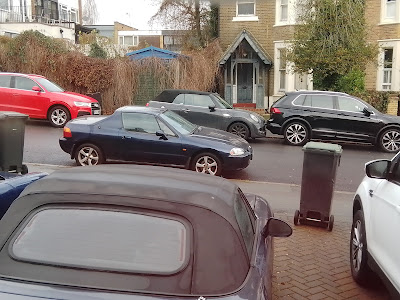
The Mini was parked where the red Audi is, but the handbrake wasn't fully on and it rolled gently down the hill, coming to rest against the rear bumper of the black monstrosity (the driver of which is so stingy that instead of paying to park in a bay, they park it where is will cause maximum blockage of three surrounding driveways. So gets zero sympathy from me.):
There are rules on this.
If the Mini driver gets back first, it is their duty to cast a cursory glance at the back of the black monstrosity for obvious damage, convince themselves it looks OK and then drive off and hope that nothing comes of it.
But what if the black monstrosity driver gets back first? If they just drive off, they know that the Mini will roll off again and hit the car in the next parking bay down, which is another twenty yards down the road i.e. the Mini might have build up enough speed to do proper damage, or veer onto the pavement or into the middle of the road. Which means they have to wait until the driver of the Mini gets back, unless they manage to find something lying around to use as chocks.
Hmm. I know I'd at least look for a couple of bricks or something, but I'm not sure I'd find anything suitable. Does the Highway Code cover this type of situation?
Friday, 24 December 2021
Interesting moral dilemma
Posted by
Mark Wadsworth
at
11:08
8
comments
Wednesday, 15 August 2018
"Dorchester car park spaces to cost £40,500 each"
From the BBC:
A council which spent nearly £1m buying and relocating a church wants to use the site for 23 new car parking spaces... Council documents valued the church at £350,000 but, at the time of purchase, the site's redevelopment potential pushed the value up to £700,000.
The Conservative-led authority also agreed to pay the church £205,000 for its new building next to Damers School in Poundbury and £25,000 in professional fees.
Liberal Democrat Ms Hosford, who represents Dorchester North, said: "The projected income from the extra spaces created cannot possibly justify the huge amount of expenditure that will have gone into producing them."
A council paying for 'redevelopment potential' is madness, because quite what the permitted development is is up to the very same council to decide. Had the council made it clear that they would refuse all planning applications, they could have bought the site for peanuts. Had the council granted permission for a twenty-storey tower block, the redevelopment potential would have been much higher, so why not grant that permission and then pay £10 million for the site?
Be that as it may, the Lib Dem lady is succumbing to the 'big scary numbers' fallacy. Google Maps shows that the church is in the corner of an existing large car park with an awkward layout in the church corner, so they can now re-jig the layout and increase capacity by 30 or 40 parking spaces, not just 23.
The council ought to know its average income per parking space, let's assume it's £5 a day, Mon - Sat, 52 weeks a year. Potential income from 30 extra spaces = £46,800, which in this day and age is a reasonable return on an outlay of £1 million.
Posted by
Mark Wadsworth
at
18:33
5
comments
Labels: Parking
Tuesday, 6 March 2018
California's Love of Cars Is Fueling Its Housing Crisis - allegedly.
Emailed in by Mombers from Bloomberg:
In Los Angeles, it’s perfectly legal to build a new apartment without a refrigerator, a balcony, or air conditioning. But you can’t build one without plenty of parking. In most cases, in fact, you have to build at least two spaces per unit -- and no fudging with tandem or compact spaces. That makes housing much more expensive. Removing parking requirements would be one of the simplest ways to ease California’s housing crisis...
Shoup gives the real-life example of a standard-size L.A. parcel whose zoning allows eight apartments, with required parking of 2.25 spaces each, or 18 total. The lot is only big enough to accommodate 16 spaces on one level of underground parking. Going from seven to eight apartments thus means digging down another level, which is prohibitively expensive. So the builder settles for seven units. The parking requirement costs one more family a home...
Scott Wiener, a San Francisco Democrat, has introduced a bill whose provisions include exempting new residential buildings from parking requirements if they’re within half mile of a major transit station or a quarter mile from a frequent bus stop. The bill would certainly ease California’s housing shortage. But, especially in the era of ride-sharing, there’s no need to tie parking deregulation to transit -- or to wait for the state government to act.
Mombers adds: Question is whether this has any impact on rents – someone without a car will ceteris paribus pay more than someone with one – public transport and/or Uber much cheaper, leaving more income for the landlord/ bank to tuck into. And of course Manhattan has much fewer parking spaces per dwelling and much higher rents...
Ho hum.
1. As we know, construction costs add nothing to the selling price of homes (for a given 'quality') - that is limited by what people can afford. Higher construction costs just depress residual land values.
2. As we know, any sort of planning regulation (like making each unit have two parking spaces - or indeed not allowing a new block of flats to have parking spaces to encourage people to use public transport) must depress the value of the land. The developer works out what is 'best' by looking at what's sold for how much in the surrounding area and works backwards from that. If the regulations stipulate something different, then the value must be depressed, by definition. You wouldn't need regulations to encourage developers to make the best use of a site.
For example, It might be the case that people like having one parking space but aren't bothered about the second, in which case the second parking space adds nothing to the value or the selling price. Or it might be that they do value the second space, in which the developer would provide it anyway (unless the planning rules limited the number of spaces per unit etc).
3. Using more land for parking reduces the amount available for housing. By and large, denser populations lead to higher prices and hence disproportionately higher land values - see Mombers' Manhattan example. San Francisco has the highest prices and land values in California because it has the highest densities, being squeezed into a small geographically restricted area (like Manhattan). Assuming always that there's more public transport to take up the strain.
4. There is no housing shortage in California and prices are not particularly high, it's only expensive on the coast because continental USA has so little coastline, and even less nice coastline that the coastal premium is gigantic. By definition, there will never be 'enough' homes in the best areas (i.e. near the coast) if you define 'enough' as 'one for every household which would like one'.
So I am not convinced.
Posted by
Mark Wadsworth
at
19:47
3
comments
Labels: Land values, Parking, Planning
Sunday, 12 February 2017
"Britain's obsession with big cars sees car park scrapes up by a third"
From The Telegraph:
Family cars are becoming too big for parking spaces, figures from car makers show, as vehicles' expanding size is causing a rapid increase in car park scrapes and accidents…
The number of car park crashes soared by 35 per cent over the past two years, leading experts to warn that standard parking spaces are no longer big enough to accommodate this new, chunkier breed of automobile...
The average parking space is just 4.8 metres long and 2.4 metres wide, making it more than just a tight squeeze for many popular cars. Range Rover and Audi Q7 models, for example, measure five metres long and are more than two metres wide.
This has been at the back of my mind for a couple of months and is brought starkly home every time some idiot in a small tank nearly reverses into me (the tops of my cars are below the window line of many of these tanks!). Like so many perceived problems, it's a job for LVT-man:
1. Set car tax so that it is based on vehicle width rather than fuel consumption, which is already adequately dealt with via fuel duty. Wide vehicles are a nuisance to other road users and can pay 'rent' for road space accordingly, similarly they can reduce the car tax on narrower cars to nil, they are a bother to nobody.
2. Segregate car parks into spaces for "normal cars" and "Chelsea tractors". This is no different to having bike racks or dedicated motorbike spaces, which are usually in the most convenient parts of a car park.
3. If it's a 'free' car park, like at most supermarkets, replace the 2.4m wide bays with some 3m wide bays in the least-used areas i.e. furthest from the shop entrance or the parking ticket machines, or use the top storeys for Chelsea tractors etc.
4. If it's a paying car park, charge extra for the larger spaces. They want a quarter more space? Fine, then let them pay a quarter more than normal car drivers.
Sorted.
Posted by
Mark Wadsworth
at
14:51
9
comments
Labels: Cars, Land Value Tax, Parking
Sunday, 13 March 2016
Good article about demand-priced parking.
From Xerox.com:
Why does parking matter so much? What’s the impact of parking on city architecture and quality of life?
In most cities, the footprint of parking is bigger than that of any other land use. Parking spaces are also the most uniform and most frequently rented pieces of land on earth…
Cities should charge the right prices for on-street parking because charging either too little or too much can do great harm.
If the price is too low and no on-street spaces are vacant, drivers searching for a place to park will congest traffic, waste fuel, and pollute the air. If the price is too high and many on-street spaces are vacant, adjacent businesses will lose customers, employees will lose their jobs, and cities will lose tax revenue.
Consequently, the right price for on-street parking is the lowest price that can keep a few spaces open to allow convenient access for motorists. This is the Goldilocks principle of parking prices.
Posted by
Mark Wadsworth
at
13:19
1 comments
Thursday, 16 July 2015
Now, I wonder if they will think this one through to the logical conclusion...
Here
Better for 'rents', and better for Business Rates.
So how should they fund the parking costs?
Who's going to tell them?
Posted by
Lola
at
20:56
9
comments
Labels: Parking
Friday, 6 March 2015
Parking
From the BBC
Drivers in England will get 10 minutes' grace before being fined if they stay too long in council-owned car parking spaces, the government has announced.(1)
It is one of several changes, expected to take effect later this month, which include new restrictions on the use of CCTV cars issuing automatic fines.
Communities Secretary Eric Pickles said he wanted to end the "war on drivers". But councils said many already allowed 10 minutes' leeway and raised concerns about the safety of other changes.
The changes include:
• guidance for councils reminding them they are banned from "using parking to generate profit"(2)
• a right for residents and businesses to demand - by a petition - that a council "reviews parking in their area"(3)
• new powers for parking adjudicators so they can "hold councils to account"(4)
• protection to stop drivers being fined after parking at out-of-order meters(5)
• a ban on the use of CCTV "spy cars" except in no-parking areas such as bus lanes and near schools(6)
• Mr Pickles said: "We are ending the war on drivers who simply want to go about their daily business.(7)
1. Why? You've paid for parking for an hour, why should anyone expect to get another 10 minutes? You'll just end up with people stretching their time to 1:10 and then thinking they can have a few more minutes "I was only just over the time". The current view of a lot of councils, of an unofficial grace period seems more sensible.
2. Car parking charges are about allowing lots of people to park, and preferably, about penalising people over the normal time to encourage churn. But that's not related to how much it costs to build and run a car park. Take the money, give the residents a cut in their council tax. Simples.
3. So, NIMBYs can try and get car parks closed down to increase their house prices, presumably.
4. Currently known as contesting your fine in court.
5. I've never heard of this happening, but maybe it does elsewhere. Again, if you threatened to contest it in court, I doubt you'd lose.
6. Why? Someone's broken the law, you want to enforce it as efficiently as possible, don't you?
7. Including drivers who break the law.
I'll try it on with free parking, but if I get caught, it's a fair cop.
Posted by
Tim Almond
at
11:55
10
comments
Labels: Eric Pickles, Parking
Sunday, 14 December 2014
The Invisible Hand, Car Parks, Town Planning and Urban Sprawl
Four related topics which I will condense down to one post
1. The Invisible Hand
Adam Smith coined the phrase The Invisible Hand to explain that markets do not need government intervention and control, if you leave people to get on with things, then by and large, this will lead to an optimal allocation of efforts and resources.
(Clearly, this works well up to a certain point, but let's not worry about the various obvious exceptions to the rule).
a) But it doesn't work with land use once you have private land ownership.
At the "free market" end, where The Invisible Hand works well, let's imagine a public beach which people can use for free.
Some areas are better than others:
- if the tide is coming in, you want to be further up, if the tide is going out, you want to be further down;
- you want to be not too far from the beach shop, the car park, the public toilets and shower block, but not too near either;
- some areas nearer the cliff or the sea wall are better protected from the wind;
- people might prefer sunnier or shadier areas;
- people like having a bit of space round their little 'area' so they prefer the areas with fewest other people.
So the first to arrive will choose the best mix, and the next to arrive will choose the second best mix, and so on, all taking up much the same area for towels, windbreaks etc. If it's a nice enough day and the beach is long enough, people will start making a trade off between 'facilities' and 'space', so they might prefer being wedged in between some early arrivers at the shop/car park end to having more space several minutes walk away which will be under water in a couple of hours.
If you leave people to themselves, you'll end up with the optimal allocation; lots of people fairly close together in the best bits and very few people scattered far apart on the worst bits. As soon as one group leaves, others will spread out a bit to use the space.
At the end of the afternoon, everybody packs up and goes home, and the next time the weather is nice at the weekend, the process starts again.
b) Now, what happens if that public beach is parcelled up into equal sized squares of a few yards each, from the cliff right down to the low-tide mark and one is given or sold to each local household. Let's assume that occupation/trespassing is strictly enforced and that wardens go round checking that nobody is using somebody else's patch…?
Whatever happens, the allocation would be nowhere near as efficient as with the true 'free market' example a).
2. Car parks and retail
Turning to my favourite way of illustrating this in real life - car parks and retail.
a) When a developer acquires a very large area to build his retail park/shopping centre, he will devote about half the space to car parks. That's just the way things are. He knows that his tenants will be able to sell more stuff, employ more people and pay higher rents than if he has just shops and no parking spaces. And people like choice, so you'd rather go to a retail park/shopping centre with hundreds of shops than one with dozens of shops etc.
b) At the other end of the scale are proper 'high streets', where people go when they don't have to carry lots of stuff home. So 'high streets' are ideal for pubs and restaurants; doctors, dentists and estate agents; corner shops for a pint of milk or a packet of fags. Ideally you build up a few storeys and have shops/pubs at ground level, doctors and dentists on the first floor and flats above that.
But in popular belief, 'high streets' are where people are supposed to do all their shopping, including occasional stuff like furniture or a few fridge. It's nonsense, but let's run with it.
So let's a take somewhere in the middle, if there are dozens of small shops and very few parking spaces, they'll be struggling to sell much in the way of physical goods. But we know from our heroic developer in 2 a) that if we were starting from scratch, half the available land would be devoted to car parking spaces. So logic says, the best thing all the little shopkeeperes/landowners could do is knock down all their little shops and start again; even if they 'lose' half the space to the car park, they will still be able to sell more stuff overall from what's left.
Which doesn't happen. Because the incentives are hopelessly misaligned. Each individual shopkeeper/landowner wants to maximmise his sales so he leaves his shop standing. If all of them collectively wanted to maximise their sales they'd knock it all down and start again. Also known as first mover disdvantage. The Invisiable Hand (where there is always a first mover advantage) does not make an appearance, unless the Very Visible Hand of the local council - in cahoots with a well financed developer - does compulsory purchase orders and railroads it all through etc.
3. Town planning
Bearing all this in mind, it baffles me how we ever end up with existing town centres.
Our starting point is a collection of mud huts and wooden cottages thousands of years ago. New arrivals build round these in concentric circles, but the land is divided up into thousands of small plots, each jealously guarded by its owner.
Sooner of later, there is pressure to build a proper town centre, with a Town Hall, a train station, wider streets and a pedetrian precinct, a car park, a public park, big office clocks and a shopping centre. Even though there is a first mover disadvantage for each landowner. And somehow or other, many town centres end up like this, some more than others.
I'll leave it to you to try and piece together the historical process by which this happens, or why it happens in some places and not others. Your guess is as good as mine, to be honest. It might be cause and effect. Perhaps what we now see as 'the town centre' was originally built off-centre where larger areas of land could be acquired more easily/cheaply, and somebody took a leap of faith and built it, and then the town continued to expand round it (like an oyster developing a pearl round a grain of sand). And those towns where nobody had this vision simply stopped growing?
The same dillemma applies in spades to urban parks. No individual landowner would benefit from declaring his land to be a public park (although some Victorian philanthropists did so, bless them), unless he also owned a lot of the surrounding land and developed it for residential, knowing that he can demand a higher price for housing near the park. So in most cases the Very Visible Hand of the town council has to come along and declare something to be a public park, end of, and no back chat.
4. Urban sprawl
This is universally decried as A Bad Thing, but if you understand the issues above, it is clear that this is inherent with private landownership.
If there is one access point to a very large beach (car park, shop, toilet block etc) then people will gather round it, moving closer together in the good locations, beyond a certain distance, there won't be anybody. The 'sprawl' is self-limiting. I'm not making this up, a classic example of such a beach is Rhossili Bay on the Gower Peninsula. There's basically one access point, where the photo was taken. The far end of the beach is usually deserted, even if the first few hundred yards of it is 'full'.
So it's only because The Invisible Hand doesn't work that Urban Sprawl is an issue. If the first mile of Rossili Beach had been parcelled up as outlined in example 1 b) above, then people from elsewhere who want to visit would have to trudge a mile past the privately owned squares (many of which will be empty on any given day) to find one of the unclaimed spaces. So far fewer people would visit. Fail.
It's exactly the same with town planning, exacerbated by this flawed idea of the Hallowed Green Belt. I've done three examples with the same amount of developed i.e. useful land, I haven't drawn all the connections like roads, railways, water and sewage pipes, electrictiy and gas, but it must be clear that you want to minimise on this with A or B you need the least (surprisingly, A requires less than B, but that's a maths thing) but with C you need the most, which will devour as much land again as the actual developed areas.
A. We know that the ideal kind of town is spread out along branches (see here). Everybody gets benefit of being near the centre and near the countryside:

B. If you have a fairly strict green belt policy, you end up with a second best solution. People are nearer the centre but further from the countryside:

C. The worst of all worlds is the very strict green belt, so towns only grow to a certain size and then another New Town springs up on the other side of the green belt. We're all near the countryside but nobody is near the centre, as there isn't one. You waste all the extra money and land on trunk roads etc and you don't get the agglomeration benefits - the dark grey shaded bit in examples A and B:

5. So is there a 'solution' to all this?
There is no perfect single solution to all this, but you can ameliorate it by making it all more free-market again, which counter-intuitively can only be done by some sort of collective action:
a) Replacing other taxes with Land Value Tax, obviously. With LVT, there would be less need for Green Belt policies, sprawl would be self-limiting.
b) Having more land owned by the local council in the first place, who can take the larger view, or owned by large landowners who are paying full-whack LVT and are in it for the money and the larger view rather continuing doing what they are doing for sentimental reasons or sheer inertia.
c) Make smaller landowners (all the little retailers in dying town centres with no parking) pool all their land, so that instead of owning one shop out of a hundred, you are now a one-per cent shareholder in a company which owns a large area. Then slap the company with the higher LVT it can earn buy redeveloping as a coherent whole. The company decides by majority what it is to do, all it takes is one person to have the initiative and to offer to redevelop the whole lot, so you vacate your little unit and after a year or two you can now rent back from the company one unit to re-start your business, assuming it was a viable business to start with, and still collect your dividend of one per cent of the profits.
Posted by
Mark Wadsworth
at
16:35
15
comments
Labels: Adam Smith, land ownership, Parking, Town planning
Monday, 23 December 2013
Parking 'brings £594m surplus for English councils'
From the BBC:
Councils are making record surpluses from parking charges and fines, according to the RAC Foundation.
In 2012-13 local authorities in England made a "profit" of £594m from parking activities, the organisation said.Seven of the 10 greatest surpluses were in London - including all the top four. The largest was £39.7m in Westminster.
This is exactly what should be happening. The point of car park charging is rationing, and in higher land value areas, you're going to charge more. Considering how automated parking is and the running costs, there should be an surplus in London.
If you look at the list on the BBC article, at least 8 of the 10 are in high land value areas: 7 in London + Brighton. I'm not sure what the situation is with Manchester and Nottingham, but these are basically councils renting out land to the higher bidders, effectively. People are going to bid more in London and Brighton than Wolverhampton.
Now, let's imagine that Westminster made no profit on parking and it did this by lowering charges. At this point, you aren't now prioritising parking on who will pay the most to rent a space, which is arguably about the best form of rationing, but on who gets out of bed first in the morning.And of course, as you've lowered the cost, they'll probably stay in the parking space longer, sipping a latte in Starbucks for longer, rather than getting out and going home and freeing up the space for someone else to use. That's a less functional system than what happens now.
And the excess goes to the council, and that council spends it on local people, who are also people who have paid for the privilege of living near certain locations that parkers are enjoying, so someone travelling in should also pay those costs that then (via the council) go back to the residents. When I went to the Bath Literature Festival, I paid for parking to go to a festival that the council tax payers of Bath had subsidised. Seems only fair to me that those council tax payers should collect any excess parking charge from outsiders that arises from a service that they've paid for.
It's not quite an LVT system, as the price is variable, and there's a benefit with town centre or tourist parking in getting people to get a move on (which is why the prices start to rise after 2 hours). But it's not far off, and it works.
------------------
Added by MW, from The Metro:
Local government minister Brandon Lewis said parking fees became ‘an unjust form of arbitrary taxation’ under the Labour administration. Using them to raise revenue ‘was contrary to the long-standing principles of the Magna Carta and the Bill of Rights.’
The man is a complete and utter fucknut.
Posted by
Tim Almond
at
13:54
3
comments
Labels: Land Value Tax, Parking, Rents
Friday, 8 November 2013
"Mix control"
There was finally a sensible article about retail and 'The High Street' in today's City AM Forum:
The thing is worth reading in full, but it appears to boil down to this:
A lot of high streets have nothing intrinsically wrong with them. Mix problems are, however, inevitable when there is a plethora of different shop owners. Multi-ownership leads to a letting free-for-all. In the absence of mix control, there is nothing to sustain attraction. Mixes are not self-sustaining: they need continuous work...
The more modern managed shop space we have added (mostly with free parking), the more shopping centres, retail parks, superstores and outlet centres we have built, the more chain operators have migrated from small shops in small unmanaged high streets to larger, higher productivity, modern spaces serving bigger markets...
But a lot of the recent high street attrition is not due to obsolescence: it is self-inflicted. On the one hand, mixes have been undermined by multi-ownership; meanwhile, the quality of the shopping experience has been further eroded by lack of investment in the parking and access infrastructure needed to serve high street shopping.
There are a few general rules here:
1. Except for the very centre of very large towns, the ideal use of available space is about half car parking and half retail space.
2. Retailers benefit from each others' presence, so the rot sets in once there are one or two empty or very down market shops.
3. From the specific point of view of retailers on the same street, there are "public goods". They all benefit if everybody smartens up their shop fronts, or if the pavement is widened/enhanced to include trees, benches, bins and bike stands etc. They all benefit from better bus services and more attractive bus shelters.
4. Public goods are the flip side of the first mover disadvantage. Smarten up your own shop front in isolation, or get permission for a bench or bike stand and there is little or no benefit to you. And no individual retailer is going to voluntarily subsidise the bus service.
5. There is also a free rider problem, i.e. if nine out of ten shops smarten up, pay for benches and bike racks, then the one in ten refuseniks benefit as well.
As the author explains, this is because large shopping centres and out of town retail parks are owned by one large landlord, he is far more likely to get the "mix" right and speed up the process of agglomeration than if there are dozens of shops owned by dozens of landlords or leaseholders, with separate ownership of the flats and offices or wasted space above.
If one shop falls vacant, even if the large landlord refuses to drop the rent (for fear of all the other tenants demanding a reduction), he will at least do something with the empty shop front (you hardly notice the empty ones in Westfield, Stratford, it's very cleverly done). A landlord with one vacant shop doesn't care how terrible it looks.
Returning to my favourite topic, car parks.
If you are building a new shopping centre, what you do is make sure there is as much parking space as their is retail space, a 50/50 "mix". So on many high streets, it would be in the collective interest of all shop owners to demolish half the shops and have a large car park instead (Rule 1).
The sales at the remaining shops would nearly double, their net profits would more than double and the rents which can be extracted would treble.
But if each shop is small, no individual owner has a direct incentive to knock down his own shop (even if he could get planning and that were physically possible) and build a car park. He's waiting for everybody else to do it.
(And if he did make a car park, you can be quite sure that his parking charges would be just as swingeing as the local council's parking charges.)
So as ever, breaking up a monopoly into a cartel leads to an even worse outcome. Owners of large shopping centres might be rent seekers, but at least they are on the side of progress and look at the bigger picture.
If there are are lots of small landowners, each one of them acts as a drag on progress and development (as well as draining money from the productive economy). Put them all together and your high street is doomed.
As to what the solutions are - if any - you will have to work that out for yourselves (they seem blindingly obvious to me, being a combination of three or four things).
Posted by
Mark Wadsworth
at
14:12
6
comments
Labels: Parking, Retail, Town planning
Tuesday, 17 September 2013
The Lib Dems we know and love
From The Daily Mail:
Cars should be banished from town centres, a Liberal Democrat minister has claimed.
Transport Minister Norman Baker said drivers should be hit with big increases in parking charges so they are ‘disincentivised’ from parking near high street shops. He renewed the Lib Dems’ war on motorists at a fringe meeting at his party’s conference in Glasgow.
Mr Baker admitted that higher parking charges could ‘damage town centres’ but he then claimed that pushing people onto public transport and bicycles would help revive the high street.
That doesn't really merit a response, does it?
Posted by
Mark Wadsworth
at
08:32
9
comments
Labels: Cars, Insanity, Lib Dems, Norman Baker, Parking, Retail
Wednesday, 7 August 2013
"Parking space near Hyde Park goes on sale for £300,000"
From The Daily Mail:
A parking space has been put on the market for a record-breaking £300,000 - almost twice the price of the average UK home.
The spot in London's exclusive Hyde Park Gardens measures just 11ft x 12ft, but its price tag is almost double the £162,000 paid for the average house sold in England and Wales last month...
Matthew Abernethy, associate director at Kay & Co, said: 'There are a number of properties in the area which range from £1 to £15 million and there are not enough parking spaces for all the residents..."
Parking fines in Westminster range between £80 and £130 depending on the severity of the offence, and they are halved if paid in less than 14 days. This means, on the basis of the £40 fine, it would take more than 20 years - 7,300 days - to rack up £300,000 in fines. However, over the period of the 91 year lease, it works out at just £9.20 per day to park in the space.
For some reason, they don't report which horrendous crimes have been committed on that parking space as is traditional at The Mail, just to spice things up, but hey, their maths isn't quite correct:
The true daily cost of a permit which costs you £300,000 and is valid for 91 years is not £9 per day but about £26 per day, because you are losing interest on the money you spend (Excel =PMT(0.03,91,300000)/365.25), however £26 or thereabouts is the normal daily rate for a 24-hour parking space in central London. If you don't consider the lost interest you would end up with a nonsensical answer for the daily cost of a freehold parking space, i.e. virtually zero.
The other way of looking at this is to assume that in the long run, land in any vicinity will be put to its most profitable use.
If car parks are more lucrative than housing, then houses get knocked down and if housing is more lucrative than car parks, car parks get built on. So the equilibrium is that the purchase price of a unit area of land in a vicinity is the same whatever it is currently being used for.
£300,000 divided by 16 sq yards = approx. £20,000, which is much the same as the cost of a residential plot in that area, i.e. a terraced house on a small 200 sq yard plot = £4 million, plus a bit extra for the actual building.
(All of which makes valuations for LVT much easier. Assuming that the "bricks and mortar" value of a parking space is more or less nothing, you could tax everything - regardless of what is on it - on the income per square yard generated by the nearest private car parking spaces, in this case £26 per square yard per day, for sake of argument).
Posted by
Mark Wadsworth
at
14:28
0
comments
Labels: Parking, Residential Land Values
Monday, 29 July 2013
A splendidly British solution
According to information available on the GOV.UK website: (https://www.gov.uk/waiting-and-parking/waiting-and-parking-238)
You MUST NOT wait or park on yellow lines during the times of operation shown on nearby time plates (or zone entry signs if in a Controlled Parking Zone) – download ‘Traffic signs’ (PDF, 486KB) and ‘Road markings’ (PDF, 731KB). Double yellow lines indicate a prohibition of waiting at any time even if there are no upright signs. You MUST NOT wait or park, or stop to set down and pick up passengers, on school entrance markings (download ‘Road markings’ (PDF, 731KB)) when upright signs indicate a prohibition of stopping.Today we are informed that consideration is being given to a clarification of that "Double yellow lines indicate a prohibition of waiting at any time" instruction - which according to the BBC doesn't actually mean what it says any way, because, say the BBC:-
Parking and waiting on double yellow lines is prohibited - unless stated - for all vehicles except for those making commercial deliveries and pick-ups, blue badge holders and the emergency services.by having a new regulation which says that during the hours that trading establishments are open anyone may park for up to 15 minutes on double yellow lines outside or near to said trading establishments, with presumably this "you may stop for up to 15 minutes during the following hours" exemption from the "normal rules" being displayed on a sign on an upright immediately below the sign on the upright stating the "no stopping at any time" rule ... You simply have to laugh, else ...
Posted by
Bob E
at
11:40
4
comments
Labels: legislation, Parking
Thursday, 18 July 2013
"Homes become garages in drive to ease parking"
From The Evening Standard:
Architects in Islington, one of London's most overcrowded boroughs, have come up with a new solution to the chronic lack of parkings spaces — converting 60 disused council flats into high-spec garages.
On the Westbourne Estate in Holloway, the block of flats —- which was the haunt of fly-tippers and drug dealers — has become 20 new parkings spaces, at a £3.3 million cost to Islington council.
There are about 18,000 people who regularly park on the street in Islington, but architects Burrell Foley Fischer had to work with what little space was available. Five of the flats were socially rented at £110 per week, five were privately owned and worth £265,000 and five were shared-ownership.
The surrounding area was also improved for other residents, with new landscaping including trees, grass and flower beds, and improved lighting.
Priority for the garages goes to local residents who are currently forced to use on-street parking and disabled people. Islington wants to build 2,000 "new affordable garages" by 2015. More garage conversions are planned, including in Finsbury Park, where three- and four-bedroom flats will be converted as part of the borough's plan to convert assets — possibly even disused schools — into secure parking.
Maria Christianou, 24, is among the first people to be allocated a lock-up garage on the Holloway site, on Vulcan Way. A full-time carer for her mother, she was forced to look for a parking space on nearby streets for seven years.
"I had to walk for half a mile sometimes and it was so stressful for me," she said. "Having my own secure space for my car is happiness and freedom. The old flats were horrible, now it's lovely."
James Murray, executive member for parking and transport, said: "Islington faces a parking crisis, with government benefit cuts and private sector rent rises making it harder for many residents to afford to run a car here. Building new garages for local people helps families who want to travel safely and comfort and means we can make sure there is more genuine transport choice for disabled people in Islington."
Posted by
Mark Wadsworth
at
16:46
0
comments
Labels: Parking
Wednesday, 10 July 2013
The marginal benefit of using land for car parking spaces or for housing
As I've pointed out before, there is a trade-off between using land in an urban area for housing/buildings and using it for parking spaces.
It would be stupid to demolish every single building and replace them with a massive car park; it would be equally stupid to build housing/commercial premises on the last few car parks. There is simply an optimum ratio between the two, so near the shops/places of work up to half the available area will be car parks, with a much lower amount in residential areas, depending how densely built the housing is etc.
I've done the numbers, and expressed per square yard per year, the rental income you can get from a car park where I live is roughly the same as the income from housing or from retail premises.
Clearly, if there is under-provision of car parks, this pushes up the potential rental income from parking spaces and it will make commercial sense to knock down a building on a large plot and use it for parking, and vice versa. This dynamic process ensures that there is an equilibrium between the two and we would expect to occasionally see a car park being built on and occasionally a building being knocked down.
I'm therefore happy to report that - proving my point - in last couple of months, a large local employer (who has lots of employees and visitors and appears to be open pretty much 24/7) acquired a smallish house on a largish plot right next door and knocked it down to create an extra dozen parking spaces. Instead of collecting £24,000 rent from the house (it's an expensive area!) the employer values each space at £2,000 a year = £5 or £6 per day (which might be two or three employees working shifts, or half a dozen visitors per day, or whatever).
This all makes life much easier when it comes to doing assessment for land value tax purposes. In the instant case, the tax liability on that plot wouldn't actually change simply because the little house was replaced with parking spaces - the rental value is clearly much the same before and after. (Theoretically, it's slightly higher afterwards but not that much higher, or else this would have happened years ago).
Posted by
Mark Wadsworth
at
19:12
4
comments
Labels: Land values, Parking
Saturday, 9 March 2013
Town planning: car parks (2)
To continue last weekend's post on the topic:
a) Caveat: as Chrometum explained somewhat over-forcefully, if we had more respect for each other and the environment, we'd have organised things to that we live in denser, better laid out towns and cities (branches not blobs) and we'd all manage perfectly well with public transport, being trains, underground, trams, buses all depending on the terrain. So much to the "liberal metropolitan" point of view.
b) But a lot of people like the faux bucolic rural idyll (TM, Bayard, popularised by The Stigler) of commuter suburbs and satellite villages which are only accessible by car. They don't really want their village to be accessible by bus, because buses are for the wrong sort of people. So people do their shopping by car as well, and as A K Haart, confirmed, if you've a choice between going shopping in Town A which has a big council car park near the high street or Town B which doesn't, people will choose Town A.
c) Pub Curmudgeon then made the interesting point that commuters, who need all day parking near the station are far less price sensitive than shoppers who need parking. This is a very interesting topic indeed, so let's have a closer look.
i. As a matter of fact, all day parking at the next Tube station in from where I live costs £6 on Monday to Friday, so people who drive to the station and then take the Tube are spending nearly £1,500 a year on parking as against £1,744 for their Zone 1 to 4 Travelcard. Which just goes to show, doesn't it? What do you think is more effort: owning a strip of land near a station, tarmacking it and sticking up some parking meters or laying and maintaining hundreds of miles of track, dozens of miles of tunnels, millions of miles of cables, lighting, rolling stock etc?
ii. But shoppers are price-sensitive, they'll happily spend £100 on the weekly shop in the supermarket but complain bitterly if parking costs them £1. And yes, that includes me. It's the sheer faff of working out what the bloody system is; finding the right change; do you pay before hand or afterwards; at a meter or at the barrier on the way out; which shops will refund the cost of your ticket etc.
UPDATE: Pub Curmudgeon adds: "Actually I think you got the wrong end of my point there. I was talking about car commuters into town centres. They will pay £2 for somewhere ten minutes' walk from their workplace rather than £6 for somewhere next door, whereas shoppers aren't really interested in anywhere ten minutes' walk away. This means that it makes sense for a town centre to have a stratification between short-stay, very central car parks, and all-day ones on the periphery."
Fair enough. I suppose the way to square this is for the town centre car parks to charge £1 per hour and the peripheral ones to charge a flat £2 regardless how long you stay. Which again highlights the difference in rental values between the middle of town and the edge of town.
iii. The simple revenue maximising model for commuter car parks works fine; you nudge up the price to whatever maximises your revenue. If you find that the revenue-maximising price means your car park is only two-thirds full, then you just sell off/use a third of it for something else.
iv. But the revenue maximising point for shopper parking is quite different. The spaces are primarily there for the benefit of the shopkeepers, and what they want is the maximum flow of customers. So the dry-cleaner or newsagent want the first fifteen minutes parking to be free; the hairdresser wants the first half an hour to be free; the supermarket wants the first hour to be free; the cinema wants the first three hours to be free.
v. Whoever owns/controls the parking just wants to maximise revenues. You normally find that the cost per hour falls the longer you stay, so the first half hour is 50p, the first two hours is £1.50, the first five hours is £3; all day is £5 and so on. This is exactly the opposite of what the shopkeepers want; they want the first hour to be very cheap (or free, see para. iv.) and for each subsequent hour to be more expensive than the last.
vi. Most station car parks are, by definition, near the shops because the shops are near the station. So we have a "kinked demand curve"; the revenue maximising price for commuters (price insensitive) is much higher than for shoppers (price sensitive). But the number of commuters is fairly fixed and the number of potential shoppers is much larger. This whole topic is heinously complicated and nobody is really sure how it works (or whether it is a good explanation of pricing policies), so I'll steer well clear.
vii. So let's go back to our shopkeepers and what the optimum car parking charges are from their point of view. As explained in v., there is a conflict of interests between whoever owns/controls the parking spaces (usually the council, the local train/bus company, but it might be somebody like NCP) and the shopkeepers; as explained in iv. there is also a conflict of interests between the "short stay" shops (dry cleaner, newsagent) and the long-stay shops (restaurant, cinema).
The only way to square all this is for the shopkeepers to collectively control the parking charges!
So, if the car park has a hundred spaces and currently rakes in £100,000 a year and there are twenty-five shops, each shop pays £4,000 a year into the pot (or some formula adjusted for size of shop or total turnover etc) and they take over the car park, decide their own scale of charges, and at the end of the year, they share out the parking revenues between them (pro rata to their initial contribution). Whether the larger shops think that paying a larger share of the £100,000 is "fair" all depends on whether the total revenues are more or less than £100,000!
viii. The shops then have to arrive at the maximum flow of cars i.e. customers by adjusting the parking charges by trial and error. At the margin, they are indifferent between receiving £1 from additional parking revenue and somebody spending enough money in the shops to generate £1 of additional profit. So it might well be that they are happy to collect only £50,000 in parking charges if that means people spend an extra £100,000 in the shops (generating an additional marginal gross profit of £50,000).
ix. To then balance the interests of long and short stay shopkeepers, the hourly price has to be constant; so half an hour is 50p, two hours is £2; three hours is £3 and so on. Shopkeepers can then decide whether to give their own customers/patrons refunds on their parking tickets to somehow maximise their own customer flow/revenues.
x. This all tells us that car parking is part of the overall service which the motorist/shopper is paying for and that the car parking charges are just part of the shopkeeper's total income. If Barber Mario charges £10 for a haircut and gives people a refund of 50p for half an hour's parking and Barber Mario next door does haircuts for £9.50 but does not give a refund, then motorists/shoppers will be indifferent between having their hair cut at Tony's or at Mario's, and so on.
xi. Clearly, the car parking revenues are rental income. Ultimately, all the extra income which dry-cleaners, hairdressers, supermarkets and cinemas earn above and beyond their actual marginal costs is all just rental income, isn't it? The parking space is as much part of their business premises as the newsagent's shelves, the dry-cleaner's clothes rails or the barber's chair or the cinema seat in which you pay to sit.
Posted by
Mark Wadsworth
at
15:44
33
comments
Labels: Parking, Pricing, Rents, Town planning
Sunday, 3 March 2013
Town Planning: Car parks
Let's put to one side that in densely-built urban areas, local rail networks beat the car hands down, or that it's nice to be within walking distance of the pub, the off licence, the post office and the café etc. I used to live in London Zone 3 and managed perfectly happily for fifteen years without a car.
As a matter of fact, most people go to work by car, do a weekly shop by car, drive to the seaside etc. In outer urban areas, people drive to the station by car and do "park and ride". And once I moved out to "the countryside", i.e. Zone 5, I soon realised that public transport or walking is totally impractical.
There is a temptation to somehow see car parks in urban areas as a something secondary, a bit of a sad waste of space or something squidged into the little gaps or on bomb sites, and some of them are genuinely ugly, just a patch of cracked asphalt with a meter or two. Others look quite nice, with little strips of shrubs and trees or surfaced with those little bricks which let the water drain off, I've even seen some with playgrounds, where Dad can take the kids while Mum finishes the shopping.
For some reason, many people have a romantic fascination with trains, train stations and harbours. There are some people who are "train spotters" and the architecture of many larger train stations is very impressive, be it Victorian Gothic ironwork or something flash and modern and underground. It's nice to sit in a restaurant overlooking the harbour watching the boats come and go. But nobody says "Ooh, what a lovely car park!" or advertises a flat by saying "Uninterrupted views over the car park".
Let's take the world as it actually is; on industrial estates at the edge of town, it is not unusual for three-quarters of the area to be used for employees' parking. With retail estates, the area of the car park is usually at least half the total area. Here's one a few miles down the road from me, which has lots of little trees and shrubberies and used to have a nice little playground next to the Burger King:
.
The matter is more complicated with the really big shopping centres (or airports), the amount of parking space has to equal total shop space, but nobody wants to walk two miles across a car park, so they build multi-storey car parks (the car park is usually as high as the shopping centre itself), which are impressive in engineering terms but not nice places to be. Interestingly, airports make as much money from parking charges as they do from landing and take off fees, allegedly.
But car parks are vitally important if you want to "rejuvenate the town centre" (above and beyond collecting taxes from the rental value of land and not turnover or wages, and with LVT, there is all the more incentive to rejuvenate them, because that means more revenues, natch). One of the reasons people give for shopping "out of town" is that it is easier and cheaper to park your car.
So maybe one solution to declining town centres would be to knock down half the shops and build a multi-storey car park instead. Remember, the rental value of shops is limited by the amount of easily available parking spaces nearby; and the rental value of car parks is limited by the number of shops, places of work etc in the vicinity. Whether that rental value is collected directly with parking charges, or whether parking is "free" and the shops pay higher rents comes to the same thing.
So a town centre with just shops and no parking can never grow beyond "just enough for the daily or weekly needs of people within walking distance", if these people want more than that, they have to drive elsewhere. And a town centre with just a huge car park and no shops is pointless as well. It's a question of finding a balance, and as a rule of thumb, equal areas of car parks and of shops seems "about right".
Of course, if you think about it, nice looking car parks could be the "village green" for towns in the motoring age. You can use them for other stuff at weekends, like public events, Jubilee parties, demonstrations, outdoor concerts, fun fairs, car free days with a bouncy castle and face painting etc. Though of course, you'd need to organise public transport to those events :b
Posted by
Mark Wadsworth
at
18:34
27
comments
Labels: Parking, Town planning
Sunday, 16 December 2012
Town Planning: Terraced houses
Two huge advantages of terraced housing over semi-detached or detached housing are as follows:
1. You don't absolutely need to lock your back door to the garden, and stuff which you have in the garden is far less likely to be nicked. This doesn't apply so much if you are at the end of the row, but it applies even more if your back garden backs on to the back gardens of another row of terraced houses behind. (The minor downside of this, as BJ points out in the comments, is that you have to be a bit careful carrying garden waste through the house).
2. You get less traffic noise when you are sitting in your back garden. I currently live in a detached house, and both my house and the building next door are built to within one yard of the fence, so the sound of cars going past is amplified if anything as it echoes through the gap. If you sitting in the back gardens between two rows of terraced houses, you notice the traffic noise much less, or at least, it is a steady background noise rather then you noticing individual cars.
3. The downside of living in a terraced house is that it doubles your chances of having an idiot neighbour who makes a noise. But assuming only a minority of neighbours do so (3%), the chances of not living next to and suffering from an idiot only goes down from 97% to 94.09%. This is the more relevant comparison.
4. A third more subtle point is that with a row of semi-detached houses, the strip of land between your back door (which in England is usually at the side, go figure) and the fence to your neighbour's house is either used to park the car or as access to a garage behind the house. This appears to be the least valued part.
In the heyday of semi-detached house building, cars were pretty leaky things, so it was good to park them in the garage when not in use, but nowadays, cars are much more resilient, and you can leave them parked outside to no ill effect. It is an absolute mystery to me why so many relatively new houses have inbuilt garages, it is a complete waste of space, you'd be better off leaving the car outside and having an extra room downstairs.
So when people want to extend their semi-detached houses, the first thing they do is a loft conversion (because that's the cheapest), and if they want to extend the footprint, they don't extend at the front (because that would spoil the appearance of the street and is usually against planning regulations for that very reason) and they don't want to lose any of their back garden, so they tend to build sideways, thus ending up with what is effectively terraced housing (image from Francis Builders):Usually this ends up looking a bit of a mess, it would usually have been better to build terraced houses with a wider frontage from Day One.
5. As we also know, on-street parking is in some respects better than in your own driveway:
a. Getting and out of traffic flows and crossing the pavement (half the time in reverse) is a right old faff, you have to be really careful about pedestrians, other motorists don't like it when you have to stop in the middle of the road to reverse in, and they don't like stopping for you when you have to come out again.
b. If your car is on your driveway, burglars know which house to burgle if they want to get the keys. If you have an old car in your driveway, you are at little risk of this, but if you have something swanky, it increases the chances you will be burgled. Apparently, some insurance companies offer lower premiums to people who park on the street.
c. You don't need to worry about some inconsiderate b*****d blocking you in on your driveway.
The obvious down side of on-street parking is that you can't always get a space right in front of your house (although parking spaces could be marked and allocated to houses, I suppose), which is not such an issue.
6. The two observations, that terraced housing is best and on-street parking is best can lead to a conflict if households on a street have more cars than will fit on the street.
Having paced this out on the street just now, I can report that cars parked lengthways on the street require about six yards of road. We also know that the average plot width of a typical terraced house is five-to-seven yards and of a semi-detached is about eight-to-ten yards. So as long as households only have one car on average, there is enough road space for everybody to park on the street; but every household has two cars, then the frontage would have to be about twelve yards.
Posted by
Mark Wadsworth
at
15:59
43
comments
Labels: Cars, Housing, Parking, Town planning
Thursday, 13 December 2012
Theatrical dry cleaners & eye-watering parking charge increases
I spotted a delivery van today bearing the name Upstage: Theatrical Dry Cleaners.
I bet they are sick and tired of people who turn up for a job interview and launch into this speech.
--------------------
From The Evening Standard:
Tube station car park charges to go up by eye-watering 18.73%... From January 5, weekday parking fees will rise an average 18.73% - going up from £4.27 to £5.07.
No, that's not an eye-watering increase. This is:
18.735362997658131415926535897914142135623731 %
Posted by
Mark Wadsworth
at
18:25
0
comments
Labels: Humour, Maths, Parking, Shakespeare
Tuesday, 28 August 2012
Car park news
I love a good car park story, here's one from the BBC:
An average of just 10 motorists a day are using a £1.3m car park built near Bristol, a council has admitted. The facility, intended as a park-and-ride, opened in June 2011 but will not get a bus service until 2015.
South Gloucestershire Council said it was used by only 139 motorists in its first three months and raised £13,899.74 in revenue last year. The council said it wanted to make local firms more aware of the Stoke Gifford car park, which has 200 spaces... The nearest public transport is Bristol Parkway railway station, which is about five minutes walk away.
I don't see how you can fault the council for this one.
1. If they get the car park full five days a week and half days at weekends, then based on their daily charges listed here, that would be income of nearly £300,000 a year, which is not a bad return on the £1.3 million they spent on tarmac. The site appears to be about two acres, so if the council had built (say) thirty homes on it, it would have to rent them out for at least £10,000 a year each to make the same money (far higher costs, hassle and stress from NIMBYs and tenants). So it's hardly the stupidest decision a council has ever taken.
2. Demand for the car park might not materialise overnight, word has to spread round and people have to adjust, maybe a few people who find taking the bus to the station a bit awkward will take the car in future, for example.
3. And so what if the car park was finished three years before the dedicated bus service? The problem there is lack of bus service, not surplus of car park.
4. If they hadn't built the car park, were they just supposed to leave the land derelict for three years? If the worst comes to the worst, they can always rip up the tarmac and build something else.
5. I'll mark them down for only allowing payment by debit/credit card or mobile phone (wot?) and not accepting good old fashioned cash, and maybe their charges are a little too high, but that's details.
6. Personally, I'd bung in a proper old fashioned car park attendant to sit in a little booth collecting your money on the way in; have a van selling tea and coffee during the rush hour, set up some skateboard/BMX ramps at the far end, encourage the local car enthusiast club to hold their rallies there on a weekend, get a bit of community spirit going etc. That's just more details.
Posted by
Mark Wadsworth
at
14:05
8
comments
Labels: Parking, Public transport