
Lola emailed me a link to this regurgitation of the press release:
New modelling shows that the average homeowner who did take up the scheme could make hundreds of thousands, or even millions of pounds, depending on where they live – after building costs and costs of finance. One worked example in the paper shows how a post war cul de sac in Barnet could voluntarily decide to uplift. This would transform the 26 bungalows worth £14 million in total, to be given an additional £54 million in uplift, £10 million of which goes to the council, £44m of which goes to the homeowners (£1.7 million each).
Economist Sam Bowman tells Guido that the policy could solve the housing crisis by unusually making everyone a winner:
“This is the silver bullet that could solve the housing crisis – unlike almost all other proposals, this one works by enriching existing homeowners when they allow more homes to be built. The solution to this decades-long problem is to make it a win/win for people who own their own homes and people who want to. If the government goes ahead with these plans it could make Thatcher’s right-to-buy look like a drop in the ocean in terms of increasing homeownership in Britain.”
This superficially sounds like the grey market in air rights in Manhattan or some Home-Owner-Ist Ponzi scheme. So I followed the links to the actual proposal in order to see if it really was that dumb.
It isn't actually. What it boils down to is that under current rules, one person on a street puts in a planning application to significantly extend his home, and all his neighbours oppose it. Under their cunning plan, those on a street who want to extend come up with a planning application for the whole street which gives every owner the same right to extend, and they all take a vote. If a majority agrees, then everybody can extend up to the new maximum.
Those who are opposed will vote against. Those who aren't bothered either way have to make a calculation - being surrounded by larger/higher buildings depresses the current rental value of a home, but the automatic right to extend it by a certain amount increases its potential selling price. If it's a net uplift, then it makes sense to vote in favour and bank the uplift.
So actually it's quite a sensible suggestion. In theory, it pushes the balance towards densification rather than sprawl, which is believed to be A Good Thing. But clearly, it will make very little difference to anything. I can only see it taking off on streets where all homes are similar, so everybody's uplift is the same.
And as per usual, it just funnels money/value towards people in high value areas. In an average residential area with averagely spaced semi-detached houses worth £200,000, the ones with a third storey are worth (say) £50,000 more, but the third storey costs £50,000 to build. In an expensive area where an average semi-detached costs £600,000, the extra storey might increase the value by £150,000 for a build cost of £50,000, so that's a straight profit of £100,000 for just ticking the "yes" box.
-----------------------------------------------------
As ever, this is a job for Land-Value-Tax-Man.
For a start, existing buildings would be used more efficiently so there's less need for new construction.
Councils can also be more generous with the right to extend. Every time a home is extended (or improved), the average rental value of all homes in that area goes up ever so slightly, so everybody's LVT goes up slightly. The first ones to extend (or improve) are getting a good deal, because they are only paying for a small fraction of the extra rental value.
When enough people have extended (or improved), the last few who haven't might as well extend (or improve) as well (or sell on to somebody who will) to catch up - there is no point paying for something (i.e. the market value of planning permission i.e. the LVT bill as if they had done an extension or improved) which you aren't using.
This is a very gradual thing, but it sorts itself out in line with market forces. If it's a low demand area, few will extend so there's not much impact, LVT bills don't go up and not much gets extended. Even if the council in a low demand area gave everybody permission to extend by two-storeys, very few would bother - it would be cheaper to just move to a bigger house. In high value areas, it will be a more rapid race to the top.
Saturday, 20 February 2021
"Silver bullet housing policy could make homeowners millions"

Thursday, 27 September 2018
I'd keep very quiet if I were him
From The Sun:
AN ARCHITECT could be forced to tear down a £4.65million building where he lives with his family because of a planning row with the local council.
... the 47-year-old is locked in a battle with Islington Council who claim it is out of keeping with the neighbourhood and it is not the same as the original plans submitted in 2012 – which, for example, indicated a brick-faced building.
Mr Taha insisted the switch to stone was subsequently approved by planning officers and they had simply lost, and therefore not uploaded, the most recent designs.
Whatever the rights and wrongs of this, admitting that he didn't get the right planning permissions (or some proof that his submitted application had been approved) is not very good advertising for an architect.
Wednesday, 29 August 2018
Ransome values
From The Daily Mail:
A group of 26 ambitious homeowners are hoping to sell their properties as one big 'super site' to maximise their profits.
The residents in Baulkham Hills, in Sydney's north-west, have joined forces to create what they are calling 'Hillsview Central', a site almost two hectares in size... The average median house price for the area is $1.15 million, but residents are hoping to get approximately $2.3 million per property if the new deal goes through.
Well done Mrs Papas for getting this all off the ground! That planning uplift has to go somewhere, and (in the absence of LVT), if the current owners do the site assembly themselves, then they get all get a share of the gain. This must be preferably to a large developer mucking about for years or decades buying up the sites piecemeal in the hope of banking the entire gain for himself - but making himself more and more vulnerable to a ransom demand as time goes on.
This illustrates the point that all ultimately all land values are ransom values, despite RICS' flummery, in the criminal sense. Every landowner is holding everybody else to ransom.
As we see from the photograph, there are two gaps along the front row, let's call them Plot 2 and Plot 13. This puts Plots 1 and 14 in a very weak position, as I doubt a large developer would be interested in such a wonky shaped plot.
Heck knows what the (owners of) Plots 2 and 13 are playing at. Are they:
1. Just complete spoilsports who don't understand the maths of all this and who don't care if they ruin things for Plots 1 and 14, and probably dilute the gains for everybody else?
2. Hoping to do private deals with Plots 1 and 14 whereby those two have to hand over a chunk of the marriage value to Plots 2 and 13?
3. Gambling on the developer buying all the plots including 1 and 14 and then holding him to ransom for an even larger amount?
4. Risking the developer just buying up plots 3 through 12 and cracking on with it, in which case Plots 2 and 13 fall in value considerably and have to put up with being next to a building site for a year or two? Plots 13 and 14 in isolation have little marriage value and will be stuck between a block of flats and an office block, so Plot 13 is playing the more dangerous game.
It might be a long time or never before there's an opportunity to sell Plot 2 to a future large developer who wants the land to the left, in which case the boot is on the other foot and Plot 1 can hold Plot 2 to ransom.
Saturday, 28 April 2018
Outbreak of common sense in Islington
Opinions are divided on the topic of 'affordable housing' quotas*, and I am pretty indifferent either way, but rules are rules.
The scam in question goes like this, based on a real life example that Peter S helped me piece together:
1. Developer bought some land in London pre-2008. He planned to build 100 units, 30 affordable units were to be sold at break even and he hoped to make £100,000 profit (i.e. selling price minus construction costs but ignoring the land price) on each of the other seventy unaffordable units = £7 million profit. The amount he paid for the land was a large chunk of this £7 million, call it £5 million, leaving £2 million normal builder's profit.
2. In 2009, selling prices had fallen. The developer managed to get the affordable quota reduced to zero by submitting a new viability assessment...
3. The developer's logic was this: the profit per unaffordable unit has fallen from £100,000 to £70,000, so to make my normal builder's profit and recover the £5 million I paid for the land, I have to be allowed to sell all 100 units for the new (lower) unaffordable price.
4. The council gave in, scrapped the affordable quota and told him to get on with it.
5. The developer cheerfully did nothing for a few years until prices had recovered back to pre-2008 levels. So the potential profit was now 100 units x £100,000 = £10 million; £3 million more than he had originally hoped for.
6. The council did not re-impose the affordable quota, even though logic says they should have done.
7. That developer then sold the land to another developer for nearly £3 million more than he had paid for it pre-2008 (to reflect the additional £3 million profit which the next developer can make).
8. Clearly, if the council now tries to re-impose the affordable quota, the second developer can submit his own viability assessment, and say that if he is not allowed to sell all 100 units for the unaffordable price, he will be pushed into losses, bearing in mind the £8 million he paid for the land.
9. As we can see, viability assessments and the price paid for land are a circular argument.
The Planning Inspectorate has finally decided that overpaying for land (or falling prices) are simply not an excuse to wriggle out of the affordable quotas any more.
Islington’s housing boss Cllr Diarmaid Ward said the decision would help stop developers “manipulating” the viability process.
He said: “Islington, like all boroughs in London, faces a significant shortage of affordable homes. A viability process in planning that allows developers to rely on a flawed approach to market value that delivers little or no affordable housing makes this problem worse, and means developers are not making a fair contribution to the community.
“The decision sends a strong signal that developers need to take into account planning policy requirements when bidding for land, and that they cannot overbid and seek to recover this money later through lower levels of affordable housing.”
------------------------------
* On a very small scale, I don't think it has much impact and normal supply-demand rules apply, whereby selling prices are dictated by the incomes of potential purchasers. A developer would normally sell all finished units for the same price - based on the average incomes of all purchasers (price differentiation is nigh impossible).
If some units have to be sold for a lower price (and a much lower profit), then that takes the lower-earners out of the market. The average income of the remaining purchasers is therefore higher, so the unaffordable units can be sold for a higher price and the overall average selling price is not wildly different.
It is however a beggar-my-neighbour situation. An individual developer is always better off he can wangle a lower affordable quota that other developers in the same geographical area. Taking all developers in that area together, it doesn't make much difference.
Saturday, 17 March 2018
One has no need for slug pellets...
Tuesday, 6 March 2018
California's Love of Cars Is Fueling Its Housing Crisis - allegedly.
Emailed in by Mombers from Bloomberg:
In Los Angeles, it’s perfectly legal to build a new apartment without a refrigerator, a balcony, or air conditioning. But you can’t build one without plenty of parking. In most cases, in fact, you have to build at least two spaces per unit -- and no fudging with tandem or compact spaces. That makes housing much more expensive. Removing parking requirements would be one of the simplest ways to ease California’s housing crisis...
Shoup gives the real-life example of a standard-size L.A. parcel whose zoning allows eight apartments, with required parking of 2.25 spaces each, or 18 total. The lot is only big enough to accommodate 16 spaces on one level of underground parking. Going from seven to eight apartments thus means digging down another level, which is prohibitively expensive. So the builder settles for seven units. The parking requirement costs one more family a home...
Scott Wiener, a San Francisco Democrat, has introduced a bill whose provisions include exempting new residential buildings from parking requirements if they’re within half mile of a major transit station or a quarter mile from a frequent bus stop. The bill would certainly ease California’s housing shortage. But, especially in the era of ride-sharing, there’s no need to tie parking deregulation to transit -- or to wait for the state government to act.
Mombers adds: Question is whether this has any impact on rents – someone without a car will ceteris paribus pay more than someone with one – public transport and/or Uber much cheaper, leaving more income for the landlord/ bank to tuck into. And of course Manhattan has much fewer parking spaces per dwelling and much higher rents...
Ho hum.
1. As we know, construction costs add nothing to the selling price of homes (for a given 'quality') - that is limited by what people can afford. Higher construction costs just depress residual land values.
2. As we know, any sort of planning regulation (like making each unit have two parking spaces - or indeed not allowing a new block of flats to have parking spaces to encourage people to use public transport) must depress the value of the land. The developer works out what is 'best' by looking at what's sold for how much in the surrounding area and works backwards from that. If the regulations stipulate something different, then the value must be depressed, by definition. You wouldn't need regulations to encourage developers to make the best use of a site.
For example, It might be the case that people like having one parking space but aren't bothered about the second, in which case the second parking space adds nothing to the value or the selling price. Or it might be that they do value the second space, in which the developer would provide it anyway (unless the planning rules limited the number of spaces per unit etc).
3. Using more land for parking reduces the amount available for housing. By and large, denser populations lead to higher prices and hence disproportionately higher land values - see Mombers' Manhattan example. San Francisco has the highest prices and land values in California because it has the highest densities, being squeezed into a small geographically restricted area (like Manhattan). Assuming always that there's more public transport to take up the strain.
4. There is no housing shortage in California and prices are not particularly high, it's only expensive on the coast because continental USA has so little coastline, and even less nice coastline that the coastal premium is gigantic. By definition, there will never be 'enough' homes in the best areas (i.e. near the coast) if you define 'enough' as 'one for every household which would like one'.
So I am not convinced.
Indian Bicycle Marketing
Those who stand above the fray know that in many respects, Labour and the Tories nick policies off each other and sometimes it's difficult to remember who proposed it first.
Let's take the proposal to give land bankers a kick up the pants by some combination of imposing a tax on undeveloped sites, cancelling unused planning permissions, compulsory purchase orders on land with unused planning permission etc.
@traderpaulfx on Twitter found a superb example of Indian Bicycle Marketing - compare and contrast these two Daily Mail articles.
27 April 2015:
* Red Ed [Labour Leader Ed Miliband] wants councils to encourage building by hiking tax on unused land
* Sites still left idle could be compulsorily purchased by another developer
* Property analysts say it would take UK back to 'dark days of the Seventies'
* Tory candidate said it's 'sort of policy you might expect from Soviet Russia'
5 March 2018:
* [Tory leader] Theresa May has launched a major push to restore the dream of home ownership
* The PM wants to encourage new houses and more storeys on existing buildings
* Threatened crackdown on developers who 'bank' land and wait for value to rise
Admittedly, today's Tory proposals are a little vaguer than Labour's, but the actual details aren't be that much different.
Sunday, 29 October 2017
How to make attractive cities.
As we all know, where there is an optimal balance, there is a laffer curve to measure it. In the case of development, that's best measured as aggregate land rents. see here
So, in order to align the incentives of the state to make sure they produce a framework of laws, rules and regulations that maximises those rents, they should be collected as public revenue to be spent on services or redistributed as a Cititzen's Income.
Wednesday, 6 September 2017
"Nor Hell a Fury, like a Woman scorn'd"
From The Daily Mail:
A farmer who wants to give travellers her land for free because she hates her neighbours was confronted by irate locals today and told: 'We are not up our own a****'...
Mrs Watson made her controversial offer after a local council turned down her application to building temporary accommodation for stable workers on her two and a half acre plot.
She insists that travellers would have better luck making a similar planning application.
Today she said she had been 'flooded' with requests from travellers who wanted to take her up on her offer of buying the plot which she says is worth around £350,000.
One suspects that the new building really would only have been 'temporary accommodation for stable workers' for a year or two, after which it would be sold as a normal house, but so what?
Sadly, the article does not tell us what a typical house would cost in the village. Her plot would be worth £350,000 if she had planning for a couple of houses, but she doesn't.
Sunday, 4 September 2016
Censorship
Over the years of leaving comments on articles and blogs, I've noticed a few don't make it pass the moderators. Frustratingly, the more well thought through and polite the comment, sometimes the less likely it is to make it into the public domain.
One of my favourite places to leave the odd comment or two is the London School of Economics SERC( Spatial Economics Research Centre) blog. There, economists like Professors Cheshire, Overman and Hilber write about the evils of the UK planning system and its stifling effect on new construction, the cause of our so called Housing Crisis.
To be fair, they do by and large indulge my hectoring of the learned professors, but when I do manage to point out the contradictions in what they say, my comment never goes up.
Here's my latest in response to this article written by Professor Hilber over a month ago "The UK planning system: fit for purpose?"
"I completely agree with Prof Hilber that supply is not being matched with demand in the UK housing market, causing many serious problems. I am sure the Professor would agree that market rents are the best way of allocating scarce resources like valuable land(location). Problems arise when owner occupiers can impute their rent, as the market can not then fully internalize opportunity costs. This leads to misallocation, the cause of excessive vacancy, under occupation and investment distorted in favour of London/SE, at the expense of the economy as a whole.
We can therefore kill two birds with one stone. A title deed can currently be seen as meaning"rent free". If title owners paid full market rent(as tax) for exclusive rights to a valuable location, as renters do now, the selling price of land(location) would fall, theoretically, to zero. Dropping the selling price of property to its capital only value.
Only then could the market allocate land and immovable property at optimal efficiency. Negating the need to wastefully build homes and additional infrastructure where a functional market would deem them surplus to requirements.
It’s a puzzle then why the Professor and his colleagues continue to recommend policies that concentrate on building more houses, as this is clearly sub-optimal from an efficiency point of view, let alone one where lowering house prices is a priority.
Of course politics of land value taxation is tricky, but then the consideration of political issues is not the job of an economist."
If Prof Hilber responds on this blog it would be gratefully received and published.
Tuesday, 14 June 2016
Laffer Curve of Planning
From Wiki
"The tragedy of the commons is an economic theory of a situation within a shared-resource system where individual users acting independently according to their own self-interest behave contrary to the common good of all users by depleting that resource through their collective action."
We all understand the concept of the Tragedy of the Commons. Today, most of us know that over fishing and deforestation are symptomatic of this.
In the case of fish stocks, we have recognised that they are a common resource which needs to be regulated in order to achieve a sustainable level of “catch maximisation”.
So, like all things there is a Laffer Curve, by which to the left of the curve there aren't enough fish being caught to maximize yields, and to the right too many for the stocks to be sustainable.
These is why we have quotas. Quota systems are not the most efficient way of allocating the rights to catch fish, but that's a separate issue (an auction system would be better, but for some reason, Governments love grandfathering property rights to natural resources). Point is, we no longer allow a fishing free-for-all around our coasts.
Our shared environment, is also a common resource. And without the right framework of property rights and regulations, will lead to an over consumption of horizontal and vertical location, lowering our stock of wealth and welfare.
As land values are derived from the efficient exploitation of agglomeration effects on one hand(development) and a preference for spending on locational amenity over alternative goods and services on the other (preservation/enhancement), there is a sweet spot for the maximisation of our stock of wealth and welfare, which can be measured as the aggregate rental value of land (location). In other words there will also be a Laffer Curve of planning.
At zero, there are no restrictions. That is no rules, restrictions or property rights over land.
At 100, there is no development allowed. That is there cannot be any changes to the environment caused by human actions.

The trouble is that while high aggregate land values are a good thing, they go bad when capitalised into private rental incomes and selling prices because they are not spread evenly throughout society. This not only transfers incomes from the young and the poor to the elderly and the rich, lowering the discretionary incomes of typical working households, but causes excessive vacancy, under occupation, land banking and urban sprawl.
The solution to this are just property rights, whereby we equally share the value agglomeration effects and good planning gives to locations, via a 100% tax on it’s rental value.
As the State would be collector of rents on our behalf, it must therefore align itself with our interests in order for it to maximise revenues in order to pay for public services. In other words, it would have to get very interested in the subject in finding that planning sweet spot, as it would be competing for our spending (LVT is about choice, not coercion) against privately provided goods and services.
It’s not that an LVT causes more or less development, but the right kind of development where it is most needed.
Efficient markets are not the same as "free-for-all" markets.
Wednesday, 4 November 2015
Local council incompetence reaches rage-inducing levels.
From the BBC:
A pre-fabricated property dubbed a "shed" in south-east London has been auctioned off for just under £1m. The 1950s bungalow situated on 0.6 acres of land in Peckham contains three rooms, a kitchen and unfitted bathroom.
Described as "dilapidated", Southwark Council said it was "extremely pleased" it sold for £950,000. The money raised for the property, which is not thought to have been lived in since 2002, will be ploughed back into the council's housing programme.
FFS. They did not sell "a shed", they sold land which will be worth at least £3 million* if it had appropriate planning consents, planning consents which the very same local council will now be granting to the lucky new owner.
* Call it four terraced/town houses similar to the ones on the left of the picture along the front of plot, plus another four along the back, sell them for £600,000 each (according to the article) = £4.8 million, knock off 8 x £100,000 build costs = £4 million, round it down to £3 million for margin of error.
Saturday, 13 September 2014
Why does it depend on who came first?
Interesting story in The Daily Mail:
When Gerard and Christina White moved into their home 37 years ago, they felt the leafy street of detached properties was among the finest in the suburb.
But the couple fear their £275,000 home is now unsellable – after an extension on the house next door effectively turned the Whites’ three-bedroom detached property into a semi.
The two 1930s houses originally stood 4ft apart but are now separated by only inches. They stand so close together that their roofs and gutters overlap.
For a start, the house next door looks a lot nicer in its converted/extended state than it did before. If Mr Nazir can get the right kind of windows, it will look as if it had always been that way: .
.
But forget about who did what first, if you look at the photos in the article carefully, you will see that the white house is build right up to the boundary and that its gutter is overhanging the plot next door. So if anything, it's the owners of the white house who are taking the piss.
Tuesday, 29 July 2014
"There’s room for 10,000 new luxury apartments on spare land in council estates, say London Tories"
From The Evening Standard:
There is enough “redundant” land on London’s council estates to build an extra 10,000 luxury apartments, a report concludes today.
It claims that blocks could be built on swaths of derelict land currently being used for old laundries, garages and housing poor people and calls for “urgent” action to push councils to survey the land and sell it to Middle Eastern sovereign wealth funds.
A spokesman for Mayor Boris Johnson’s office said it had seen the report and was planning to allow the construction of top-end flats for buy-to-leave investors.
The report was released 24 hours after research showed that London’s housing crisis was deepening, with many multi-millionaires locked out of the market, with some oligarchs spending almost half a year's income to snap up a London pad.
Today’s report, Gap In The Top End Of The Market, identifies 4,552 redundant spaces in 13 boroughs. Tory London Assembly members behind the report extrapolated the figures to estimate that 10,000 glittering show homes and penthouses could be built across the city.
Steve O’Connell, report author and Assembly member, said: “We need an urgent, mass-scale, co-ordinated effort to turn the thousands of redundant spaces in blocks and estates into seldom-used housing for our party donors.”
He also highlighted Southwark Council's achievement in rehousing 1,500 social tenants to make way for privately owned flats at Elephant & Castle.
Thursday, 6 March 2014
Regional Inequality. LVT will sort it out.

Tuesday, 4 February 2014
[Divide and conquer] Missing the point most gloriously
From City AM Forum, Tech resentment in San Francisco is ignoring the real culprit: Government
RENTS are rising, pushing people on low incomes out of the neighbourhoods they’ve lived in for years. Resentment towards the rich is growing, with the most profitable and dynamic industries singled out for the most ire. Talk of a cost of living crisis, driven above all by the cost of housing, is dominating politics.
This isn’t London, it’s San Francisco. In Resentment City, as Time called it this week, discontent has focused on the Silicon Valley workers whose housing needs and high incomes have driven the price of rents out of the reach of many long-time residents...
Yes, that's as can't be helped. We want to have successful businesses who pay high wages, and their employees like living near their employer so rents go up.
But the transfer of wealth here is not from the natives to the newly arrived high earners (if anything it is in the other direction, trickle down), it is from both groups to land owners, who collect the higher rents from both groups (trickle up).
But they’ve chosen the wrong target. The problem is not too many rich Silicon Valleyites buying and renting, it’s that the city has a housing shortage. It comes down to supply and demand. As the Cato Institute’s David Boaz has noted, San Francisco’s strict planning laws have made it much more costly to build new housing to meet rising demand. Zoning laws restrict the construction of higher density buildings on the city’s limited land mass...
Yes, they've chosen the wrong target. But the target is neither "the government" nor "strict planning laws".
The real passive beneficiary of all this are the landowners. Governments don't go round imposing strict planning laws for the sadistic fun of it, they do it under pressure from different groups of landowners, all wishing to collect/enjoy as much rent as possible while preventing others from doing so.
The fact that they are cutting off their noses to spite their own faces and making things worse for everybody is by-the-by.
Instead of Google employees, we have bankers and foreigners, but the principle is the same: people are attacking the demand-side, instead of asking why the government has put a stranglehold on the supply-side...
The government didn't, the landowners did, using the government as its own agent.
The US economist Karl Smith has pointed out that a new book by Thomas Piketty on the history of equality seems to show that the rise in capital’s share of GDP in the West is largely down to land-use planning controls like those of London and San Francisco. If we want to let the market do its job of resolving conflicts over scarce resources, we – and San Franciscans – should be angry at the government, not the rich.
For a start, the share of GDP going to capital has been going down in line with the share going to wages (reflected by lower interest rates), it is the share going to monopolies, above all to land owners, which has been increasing.
We also happen to know as a matter of fact that new construction only puts a very short term dampener on price rises, and then only if new construction is on a massive scale. Once the dust has settled, rents and prices will tend to go up (more housing = more people = more specialisation = higher wages = higher rents).
Why did Google (and all the other Silicon Valley companies) decide to set up shop where they did rather than in the middle of the desert? Because they need lots and lots of employees, so they go where all the people are.
That's why rents in areas with a high population/density are higher than in areas with a low population/density. Just building more homes to try and get rents down is like throwing twigs on a fire to cool it down.
And if they allowed higher density buildings, the total rental value of each individual site goes up; instead of collecting rents from ten flats, the lucky landowner can now collects rents from twenty flats; land outside the 'zone' which gets rezoned for development sees a huge uplift. Whether the new rent-per-unit falls slightly or goes up slightly is neither here nor there.
So he has managed to turn the whole logic on its head - the share of GDP going to land owners is 'too high' and he suggests something (liberalise planning laws) which will push it even higher.
Oh dear.
Tuesday, 7 January 2014
The Ultimate Regulation Tax
Economists keep banging on how planning regulations are the main cause of high house prices. They say, if we scrapped regulations, prices would dramatically fall.
We tend to disagree with this simplistic analysis, but no matter. Even if they were right, is it still the correct policy?
Good urban planning goes a long way to making a location desirable. Not just amenities, but making sure development enhances the shared environment.
High rental value of land is a sign not just of a good economy but good planning too.
The problems in regard to affordability all start when high rental values(good) get capitalised into selling prices(bad).
The reason for this is landowners do not create location values. Locations has value, but no cost of production. In other words, this is the Mother of all subsidies/free lunches.
Naturally, this also creates the Mother of deadweight losses too. Huge transfers of wealth from poor/young to rich/old and land inefficiency and mis-allocation. Those looking to get on the housing ladder are therefore most disadvantaged by this.
Therefore, the correct policy for the most net welfare gain cannot be to just "relax" planning, but to stop the gains from it being monopolised.
Anything else is akin to throwing the baby out with the bath water.
LVT is the perfect mechanism for internalising all the externalities regarding the issues surrounding planning vs demand.
If local authorities were incentivised by receiving a share of any uplift in rental values, planning would take care of itself.
Greenbelt laws not required.
Or we could always get rid of the ultimate "Regulation Tax": law and freehold property rights.
Without those "regulations" we can absolutely guarantee lower "house prices".
Not doubt we would be accused of being silly and "throwing the baby out with the bath water", but then why not take this "Regulation Tax" idea to its logical conclusion?
Friday, 3 January 2014
The indestructibility of land values
From yesterday's Metro:
A detached 17th-century home is available for as little as £25,000 – and is expected to go fast.
The property is just 8m (26ft) from the edge of cliffs in Easton Bavents, Suffolk. It was 1.6km (one mile) from the sea when first built, but coastal erosion has placed it under threat.
Waveney district council will give the home’s new owners help and planning permission to demolish it and rebuild elsewhere.
Insolvency practitioners McTear, Williams & Wood said: ‘Plots of land near Southwold with planning permission are clearly highly sought-after, so we hope to be able to sell the cliff-top home – even in the knowledge it will have to be demolished.’
So basically what is being sold/bought here is the right to build a similar new home elsewhere in the vicinity, whatever the final selling price is tells us exactly what this council-bestowed monopoly right is worth. Why the council should bestow this right on whoever owns the land at the time it tumbles into the sea rather than to anybody else is unclear.
The whole thing is similar to the plot of Superman: The Movie:
… criminal genius Lex Luthor has developed a cunning plan to make a fortune in real estate by buying large amounts of barren desert land and then diverting a nuclear missile test flight to the San Andreas Fault.
The missile will sink California and leave Luthor's desert as the new West Coast of the United States, greatly increasing its value.
Wednesday, 4 December 2013
The Median Multiple
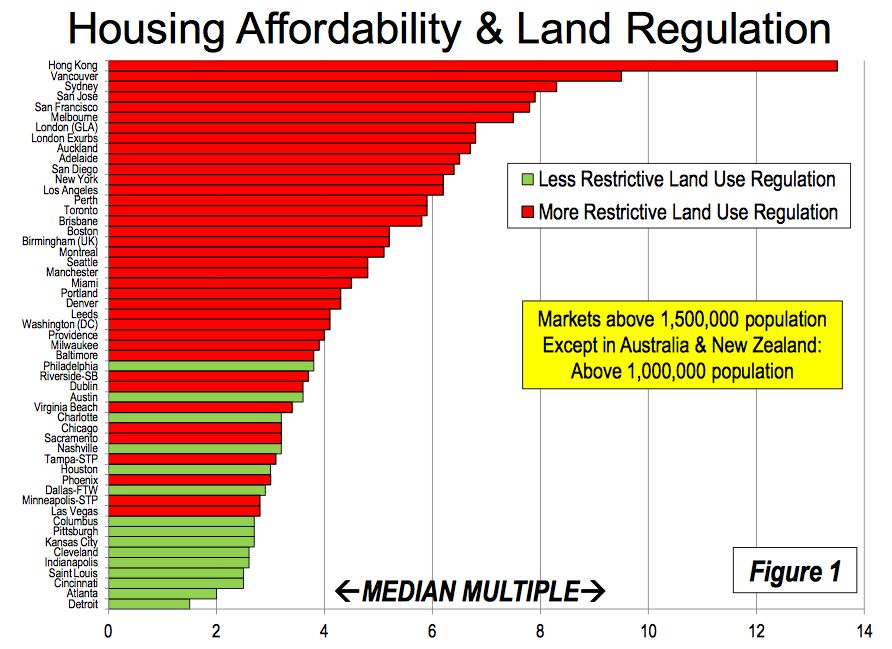


Economists, policy wonks and journalists from all round the World are united in their analysis of the problem of housing affordability. It's all the fault of the Government.
Planning regulations are the cause and location values are the effect. Many economists now call land values "regulation tax" instead.
The tables above are taken from a typical report on the subject by Demographia here .
What the report does is rank 377 cities in USA, Canada, Australia, New Zealand, UK and Ireland by their median multiple, which is the median house price divided by median household income ie affordability.
With this they also give various examples from the USA linking affordability with planning . Dallas being a perennial cherry picked favourite among economists (there are obvious reasons why the largest cities in Texas are outliers, but these are never mentioned in any of the reports).
For arguments sake, let us agree that yes, in general the higher the median multiple, the more restrictive the planning regulations are. But, going down that 377 list from least to most affordable, it's clear there is another differentiating factor that stands out.
I'm sure the sprawling Dallas Fort Worth metroplex (25,000km2) is a good place to find work and bring up a family. Texas as a whole is now doing well with mineral extraction. It also has a competitive tax regime.
But, if you want, beauty, culture, diversity, heritage and the very highest pay you live and work on the east or west coast.
We are told that supply constraints are the problem but there doesn't seem to be a shortage where the MM is highest.

You can make anywhere more "affordable" by trashing the place and making it less economically efficient. In an unregulated land monopoly this is what you'd get. In the absence of LVT, which would automatically prevent urban sprawl, and help efficiency, we need regulations via planning instead.
In the UK we have seen the effects of applying "free-market" solutions to the land monopoly by relaxing building regulations in 1980. The Parker Morris regulations had given us minimum space standards. With those gone, the effects were inevitable. The smallest homes in the developed World and the highest land values. One fed into the other.
Now we are being told to do the same with planning regulations.
Wednesday, 7 August 2013
"Residents on 'Britain's nicest high street' vow to fight plans for row of boarded up shops"
From The Evening Standard:
Residents on a south London high street called the 'nicest in Britain' today vowed to fight the threat of their homes being demolished to make way for a mixture of empty shops and charity shops.
Under government proposals unveiled this week, houses and flats could be turned into traditional high streets which are no longer viable. Planning minister Nick Boles believes local authorities should give up trying to revive town centres and ensure they are blighted by rows of boarded-up shops instead.
His policy would put Lee Green's homes in the firing line. The proposed relaxation in planning restrictions means entire residential streets could be turned into small and little visited retail units. In a double threat, property developer St Modwen has applied to Lewisham Council to demolish giant Asda in the Leegate precinct to make way for yet more small retail units which will also stand empty.
Les Metcalfe, 48, owner of the Faction book and record shop, said: "We are glad that there is so much housing here, that's where our customers live. You'd be surprised at how many husbands pop in while their wives are doing the family food shop at Asda. We are an independent shop and there is no way that supermarkets will ever try to compete with us."
Susan Kinahan, 50, of optician In-sight, said: "This is a nice little hub which has attracted lots of residents who end up as loyal customers."
The Local Data Company said that in three years' time, Lee Green will probably end up as one of the worst UK high streets and will be struggling with charity shops taking the most prominent shop fronts.


