I have shown that the logic behind so-called '33 degree greenhouse effect' is naive to the point of being meaningless and/or deliberately totally misleading.
Now let's look at the next layer of piffle; Kiehl and Trembert's so-called 'energy budget':
Most of the numbers in the arrows are correctly calculated and pointing in the right direction, if looked at in isolation. But because the logic is so deeply flawed and so many facts are simply ignored, we end up with the smoking gun arrow showing 324 W/m2 of 'back radiation' from 'greenhouse gases' (bottom left hand corner).
They are claiming that tiny amounts of CO2 and gaseous water vapour (about 0.04% and 0.2% of the atmosphere respectively) magically shine as brightly as the Sun, if measured in terms of energy being radiated to Earth. That in itself must strike the casual observer as completely fatuous.
The 324 W/m2 is just a balancing figure that doesn't exist in the real world! You can't just add and subtract 'radiation' at different intensities and frequencies anwyay, it is far more complicated than that, energy can take or be stored as lots of different types. Imagine a 3,000 Watt three-bar electric fire versus a 3,000 Watt radio transmitter!
That diagram is so appalling, that it's easier starting from scratch than it is correcting all the compounding errors, so here goes.
1. Basic physics says that the surface of a planet will warm (or cool) to the temperature at which is emits as much radiation to space as it receives from space i.e. from the Sun, that is its 'effective temperature'. Let's look at solar radiation first. We are looking at 'effective temperature' so we also have to look at how much solar radiation the 'effective surface' (this is my term, I haven't found an official one) absorbs. We do this by reducing solar radiation by the amount reflected (by the 'albedo'). The weighted average albedo of the effective surface (2/3 clouds and 1/3 oceans/land) is 0.3, so we reduce incoming solar from 342 W/m2 to 239 W/m2:
This number has been estimated at anything between 235 W/m2 and 240 W/m2. This seems sensible, and nobody has seriously challenged it.
2. OK, the effective surface is absorbing 235 - 240 W/m2. Does it also emit 235 - 240 W/m2? If not, then we need an explanation (most people will assume 'greenhouse gases'). If it does, then AGW Theory is yet again debunked, and we don't need any further explanations.
We know the temperature and emissivity of both parts of the effective surface (oceans/land and clouds - typical altitude 5km and typical temp 255K), so we can calculate how much radiation each is emitting using Stefan-Boltzmann formula and adjusting for emissivity. We then take a weighted average of both, and... what a coincidence... the effective surface's emissions are slap bang in the middle of the 235 - 240 W/m2 range. Yes, there are approximations and uncertainties involved at all stages of this, many of which would cancel out:
That's it, that's the end of the line. There is yet again no big discrepancy that needs to be explained. Solar energy absorbed = infra red energy emitted. If you just make realistic assumptions and apply basic physics (and completely ignore 'back radiation' and 'greenhouse gases'), you end up with a very plausible result. Therefore, your assumptions must be broadly correct (or at least, there's no evidence to say that they aren't). It seems to me impossible to splice in the 324 W/m2 of 'back radiation' without ending up with a nonsensical answer. End of.
3. What is really interesting is what goes on inside the amber box. That is heinously complicated and nobody really knows. Maybe the ficitious 324 W/m2 is in there somewhere, so it's relevant to the temperature balance between oceans/land and clouds, but it is irrelevant to what gets to space and so shouldn't be on the first chart at all.
Why does only one-tenth of 1% of 1% of all water on Earth end up as clouds? Why are clouds at the altitude they are? You'd need several degrees in physics and meteorology to even be able to understand the ground rules, let alone put numbers on the effects and work out how all they all interact (positive and negative feedbacks etc) to end up with things the way they are.
Needless to say, plenty of people have looked at isolated aspects of this; but even if somebody every aspect and explained how it all interacts, it I doubt I'd be able to follow and would end up taking it on trust. But no 'climate scientist' cares about these finer details, so why should I?
Sunday, 8 May 2022
Debunking the other cornerstone of AGW Theory
Posted by
Mark Wadsworth
at
15:14
12
comments
Labels: greenhouse effect, Physics
Saturday, 23 April 2022
Out of the frying pan... into the Greenhouse Effect
As is well known, if the sun is shining brightly enough, you can leave a frying pan in the sun and then fry an egg on it. This works because aluminium (and many other metals) have low emissivity.
And as we also know, if an object is absorbing solar radiation, it will warm up until it is emitting the same amount of radiation energy (ignoring other forms of heat transfer, like conduction etc).
If an object (the frying pan) has low emissivity, then for a given temperature, it is emitting less radiation than another object at the same temperature with higher or 100% emissivity (a 'blackbody'). But the amount of radiation absorbed, and hence emitted, is fixed, so the frying pan reaches a higher temperature (than the ground around it) before it reaches a steady-state temperature where solar radiation absorbed = radiation emitted.
So on a hot sunny day, ground-level air temp might be 'only' 30 degrees C, but the frying pan is more than 100 degrees C, hot enough to fry an egg. Key thing to note is that ground and pan are emitting a similar amount of radiation. Which is why you have to calibrate an IR thermometer to take the emissivity of the object into account - if you don't, it will tell you that the ground and the pan are a similar temperature.
[OK, I have glossed over the fact that pans are shiny and therefore reflect more, and absorb less, radiation, which would make them cooler than their surroundings, all things being equal. But all things are not equal and the lower emissivity outweighs the albedo effect.]
I doubt any Physics Denier looks at the hot frying pan and concludes that, because the frying pan's actual temperature is greater than the hypothetical temperature it would be if it were a 'blackbody' with 100% emissivity, this must be an example of the Greenhouse Effect.
-------------------------------
But this is the best (and basically only) evidence they have that there is a 33 degree Greenhouse Effect in the first place - they just compare actual temperature of oceans and land with hypothetical surface temperature of a planet with a uniform surface, all at the same temperature and with 100% emissivity. This is like saying that clouds, oceans and land are a) all at the same temperature and b) have 100% emissivity. Neither a) nor b) is correct, it would be fairer to say a) and b) are deliberately misleading assumptions. (Cooler clouds are missing from the first part of the comparison, this is a key part of the deceit).
There's a handy overview of cloud properties here. Note that typical or average cloud emissivity is given as 0.7. If you pick sensible estimates for typical or average cloud-top altitude, then you know how much warmer it is at sea level than at the cloud-tops (this relationship is fixed by the gravito-thermal effect), then you can work out total radiation emitted to space by clouds and cloud-free oceans/land respectively (oceans/land beneath clouds can't emit radiation directly to space, the clouds absorb, reflect and re-emit it). Take a weighted average and hey presto, the overall radiation being emitted spacewards is the same as incoming solar.
Therefore, no radiation is being blocked or absorbed by 'Greenhouse Gases'; there is no 'Greenhouse Effect' (unless you see clouds as acting like the roof of a greenhouse, which I suppose they do) and there is nothing left to explain away.
When I did the workings, I calculated that clouds emit about 47% of the total radiation reaching space, the 'official' estimate of "cloud amount weighted by the cloud IR emissivity" is 50%, so I'm not far off and I suspect the 50% is rounded.
And of course, clouds are nebulous. Nobody will ever know what the exact thickness; altitude; temperature; emissivity; or radiation being emitted by any particular cloud or cloud-top at any particular moment are. How many measurements would you have to make to have a fair picture of the global average over a year? Dunno, even though it wouldn't be that difficult with enough weather balloons and satellites.
But it's easy enough choosing reasonable mid-points of ranges of estimates to get sensible answers, and until these time wasters dedicate a bit of time and effort on doing actual observations of all these variables (and proving me wildly wrong), I will assume that they simply don't want to know (and they can't).
Posted by
Mark Wadsworth
at
13:35
32
comments
Labels: greenhouse effect, Physics
Wednesday, 8 December 2021
"How do we know more CO2 is causing warming?"
Easy, just measure A and claim you have measured B.
From the Motherlode of Shite, they make the obligatory and wrong assumption that sea level temp's should be the same as cloud temps (it is the clouds that absorb most of the arriving sunlight; not the sea level surface - this is the basis for the correct explanation of the Greenhouse Effect because that is what we are measuring - difference between cloud temp and sea level air temp = 33 degrees) and then crack on with the flimsiest of evidence:
The temperatures are going up, just like the theory predicted. But where’s the connection with CO2, or other greenhouse gases like methane, ozone or nitrous oxide? ... Is there a reliable way to identify CO2’s influence on temperatures [over that period]?
There is: we can measure the wavelengths of long-wave radiation leaving the Earth (upward radiation). Satellites have recorded the Earth's outbound radiation. We can examine the spectrum of upward long-wave radiation in 1970 and 1997 to see if there are changes.
This time, we see that during the period when temperatures increased the most, emissions of upward radiation have decreased through radiative trapping at exactly the same wavenumbers as they increased for downward radiation. The same greenhouse gases are identified: CO2, methane, ozone etc.
OK, CO2 tends to block and/or re-radiate infra red at about 14 nanometers (= about 700/cm), there's less going to space and more hitting the ground. Clever scientists say so and they have measured it and who am I to disbelieve them?
But WTF does that have to do with temperatures?
Wien's Displacement Law tells us the relationship between an objects temperature and peak frequency; the object absorbing that frequency can't get any warmer than the apparent* temperature of the emitting object. 14 nanometers = apparent temperature approx 200K (minus 73C).
* I say apparent because the actual average temp of the CO2 is about 250K, but it emits radiation as if it were only 200K, so can't warm anything up to more than 200K.
Even if CO2 emitted radiation at the shorter peak wavelength we would expect from an object that is approx. 250K, that wouldn't be able to warm an object (sea level surface) either, as sea level surface is warmer than that anyway. If you have a forge furnace burning coal at 2,000C, you can't use it to warm anything up to more than 2,000C, that must be obvious.
A 2,000 Watt three-bar electric fire is about 1,000 degrees C (I think, can't be bothered looking it up again). However close you hold something to the bars, even if it's only a millimetre away, it can't absorb so much radiation that it reaches a temperature higher than 1,000 degrees C.
Hold the same object a millimetre away from a 2,000 Watt radio transmitter and it barely warms at all. Radio waves are at very long wavelengths, so using Wien's Displacement Law, the apparent temperature of the transmitter (based on the wavelengths of the radiation it emits) is barely above absolute zero.
Posted by
Mark Wadsworth
at
15:03
8
comments
Labels: greenhouse effect
Saturday, 6 November 2021
It takes one to know one and causation/correlation
From MSN News:
The climate activist Greta Thunberg slammed Cop26 as a “failure” and a “PR event”. “The leaders are not doing nothing, they are actively creating loopholes and shaping frameworks to benefit themselves and to continue profiting from this destructive system,” she said.
The last three years of ms Thunberg's life have been a carefully managed and superbly successful PR event.
From the BBC:
Highly shared [Facebook] articles made false assertions that climate change was not confirmed by science or claimed to debunk it with data. Of these, 69% could be traced back to just 10 "super-polluter" publishers - dubbed the "toxic ten" - the campaign group found.
In fact, our understanding of climate change comes from analyses of millions of measurements gathered in different parts of the world. And multiple independent teams of scientists have reached the same result - a spike in temperatures coinciding with the onset of the industrial era. [Photo caption] Flooding in Indonesia has been linked to climate change- yet some online still deny its effects
Hang about here. If the clever scientists and weather forecasters say that the climate has changed over the past few decades, then I'm happy to accept it. I've no strong opinion on that either way.
What bugs me is the false logic that slightly higher atmospheric CO2 levels are the cause. They might well be the result of higher temperatures or it might be entirely coincidental.
The cornerstone of the Alarmist belief system is that the 33 degree Greenhouse Effect (sea level temperature minus Earth's effective temperature) is entirely due to 'greenhouse gases'. This belief is based on selectively ignoring the existence the cloud cover.
When we calculate Earth's (or Venus') effective temperature, what we are actually calculating is the expected temperature of the cloud cover, so a fair comparison is effective temperature vs actual temperature of the clouds.
If you do the like-for-like comparison (on Earth or on Venus) you observe that the Greenhouse Effect is precisely zero. So if 300 ppm CO2 has no measurable effect, then why would 420 ppm have any effect?
That's the line the Climate Deniers should be taking, not getting into pitched battles over whether the climate i.e. weather patterns are changing.
Posted by
Mark Wadsworth
at
15:32
38
comments
Labels: COP26, greenhouse effect, greta thunberg
Sunday, 17 October 2021
Why is there no Greenhouse Effect in the desert?
The GHE is calculated by working out the effective/expected temperature of 'the surface' of a planet by just looking at how much radiation it absorb (i.e. incoming solar radiation minus the amount reflected) and plugging the number (240 W/m2 average for Earth) into the clever formula.
The 'surface' means 'whatever the sunshine hits first', which on Earth is mainly clouds; or all clouds in the case of Venus. So you are actually calculating the expected temperature of the clouds; the Alarmist trick is to compare/confuse that 'surface' (from the point of view of incoming radiation) with what we mere mortals consider to the the surface i.e. land and oceans, which are of course a lot warmer because of the gravito-thermal effect (unless you go to the top of Mount Everest, which is above the clouds and hence no GHE there either).
The clever formula works much better when applied to Mars or the Moon, which have little or no clouds. The actual surface temperatures are pretty close to the calculated effective temperatures (if you adjust for solar angle and night-time cooling; but there's also little or no atmosphere so you don't need to worry about warmth being transferred from Equator to Poles or from day side to night side).
Luckily, on Earth there are also places with little or no clouds; they are called deserts. The Sahara straddles the Tropic of Cancer, so it gets peak 1,361 W/m2 sunshine at midday during the summer months. Divide that by the sq root of two to get average during a 12-hour day = 962 W/m2; halve that for the 12-hour night = 481 W/m2; then knock off one-fifth reflected = 385 W/m2.
Plug 385 W/m2 into the formula and you get an expected average temperature of 287K. Deserts have a large diurnal temperature range, just like The Moon (they cool down fast during the night because there is no cloud blanket), of (say) 40 degrees. A typical desert near the equator is just above freezing just before dawn and 40 degrees hotter in the early afternoon, so the average actual temperature is about 293K.
OK, that's six degrees warmer than expected and these are only back of an envelope calculations, but it's nowhere near the much vaunted 33 degree Greenhouse Effect, despite there being more CO2 than average above the Tropics (the troposphere is thickest over The Equator and thinnest over The Poles).
[We could also dispense with the whole concept of averaging sunshine over 24 hours and look at the hypothetical peak radiation of about 1,000 W/m2 at midday in summer, plug that into the formula and we get peak temp of 364K = 91C. Temperatures get nowhere near that, but to the extent they do, that might explain the 6 degree discrepancy?]
The answer to the question in the title is of course "Because there are no bloody clouds over the desert, and the Greenhouse Effect on Venus or Earth is purely down to clouds and their altitude!", just in case you were wondering.
Posted by
Mark Wadsworth
at
17:48
37
comments
Labels: greenhouse effect, Physics
Thursday, 7 October 2021
"Heat rises" and other Alarmist fairy tales...
Sorry to come back to this, but it has been bugging me for days.
Joseph Postma posted a video on YouTube. He is top man and a "climate denier" but he has sadly fallen into the Alarmist traps of:
a) ignoring clouds, and
b) assuming that the Sun warms land and oceans and that they in turn warm the troposphere from below.
So he fights the Physics deniers on their chosen territory, splitting hairs over radiation theory and thermodynamics and so on, all of which are actually largely irrelevant.
I pointed out in the comments how the Greenhouse Effect actually dictates surface temperatures (cloud temp is fixed by sunshine; add on lapse rate x altitude of clouds = surface temperature) and a self-appointed Guardian Of The Galaxy (a True Believer and regular commenter at Science of Doom) tied himself in knots trying to come up with killer arguments. Apart from the usual ad hominems and meaningless jargon/waffle, the best he could come up with was this:
"The Sun heats the Earth and the lower atmosphere is heated by the Earth's surface... No physics supports top down warming when heat naturally rises."
Let's do the last stupid statement first. In everyday life and on a small scale, sure, hot air (from a fire, for example) moves up vertically. That's only because hot air wants to expand, so becomes less dense than the surrounding air, so gravity pulls the denser air down in its place and this in turn pushes up the less dense air. It's the density that is key - you could put a helium balloon in the freezer for a bit, it will still float upwards in much warmer air.
'Heat' itself doesn't rise, and certainly not 'naturally'. 'Heat' doesn't really do anything, it just a measure of thermal energy that moves from a hot object to a cold object. Put some polystyrene between them, hey presto, much less 'heat'.
When hot or warm air rises and expands, its temperature falls. It has the same amount of energy as before, but it gains as much potential energy equal as it loses in thermal energy. That is key to this, the TOTAL energy.
People always forget potential energy (mass x altitude x gravity), because it's not much practical use. You have to convert it to kinetic energy first to be able to harness it, i.e. allow water from a high reservoir to fall through turbines to generate electrical energy.
Now the first stupid statement, "The Sun heats the Earth". The Sun warms up whatever it hits first, which is clouds for two-thirds of sunshine. And it warms them the same as anything else, you can calculate the likely end temperature (effective temperature) using the Stefan-Boltzmann equation and it's around 255K.
Let's say one-third of the sunshine actually directly hits Earth at ground or sea level, plus a bit more that gets through clouds, call it half in total, This is only sufficient to warm land and ocean surface to 234K. That can't warm something that must be at least 255K, can it?
[Question: if 'back radiation', which is emitted in all directions, can significantly increase the temperature of the land and ocean surface below it, why doesn't it increase the temperature of clouds above it by a similar amount? As a result of which they'd all evaporate?]
Third stupid statement: "The lower atmosphere is heated by the Earth's surface". They are to all intents and purposes the same temperature and are both warm for the same reason.
What actually happens is that clouds are a certain altitude and the Sun warms them to a certain temperature, which of course warms the surrounding air to the same temperature. Clouds are high up, so that air also has a lot of potential energy. Energy likes to spread out evenly, so the air lower down, which has less or no potential energy, has more thermal energy to balance it out.
That PE - TE trade-off is the whole basis for the dry lapse rate, which = gravity ÷ specific heat capacity, and is observed in real life. The Gas Laws just show that low and high temperatures will never equalise. Pressure falls faster than density as you go up, so temperatures have to fall as well as you go up. Temperature is proportional to pressure ÷ density all the way up.
To use a simple maths analogy, Dave is six inches taller than Jack; Jack is six inches shorter than Dave. That doesn't tell us how tall either is. If I tell you the height of one, then you know the height of the other.
The lapse rate also works in both directions; cloud temp is fixed and surface temp is simply cloud temp + their altitude x lapse rate. It would be one heck of a series of coincidences if it worked the other way round and the surface temperature magically adjusted itself to be whatever is required to give a cloud temperature that is exactly what you would expect if you calculated cloud temperature on the basis of the sunshine they receive.
The Guardian Of The Galaxy then played what he thought was another trump card, saying that clouds are below freezing (duh, I kept saying that) and so they can't warm the land or ocean surface. It's not as simple as "clouds warm the surface", it's to do with energy (in all its forms) trying to spread itself out as evenly as possible. I think the fancy term is 'entropy'.
And doesn't this nuke the Alarmist claim that radiation from cold things (CO2) makes a warm thing (the surface) even warmer? As any fule kno, CO2 absorbs/emits radiation mainly at 15 microns, if you plug that into Wien's Displacement Law, that's equivalent to radiation from a blackbody at about 200K (minus 73C).
---------------------------------------------------------
Is this really so difficult to understand?
Is there a proper physicist who can see a flaw in this logic - the approach reconciles even better on Venus with 100% cloud cover so we don't need to make adjustments for that sunshine which directly hits the land or ocean surface like on Earth. If surface temperatures there were purely due to 'back radiation', its atmosphere would have to amplify upwelling surface radiation several hundred times over. Our Alarmist twat insisted, unprompted by me, that "Radiative fluxes do not add, they average" which is not only contradicts his whole thesis (that 'back radiation' multiplies itself) but is complete bollocks anyway, radiation is far more complicated than that.
Posted by
Mark Wadsworth
at
15:03
12
comments
Labels: greenhouse effect, Physics, Twats
Friday, 1 October 2021
"Venus calling"
You might have noticed that I'm not doing so many posts on the Greenhouse Effect anymore, that's because I have finally worked it out and there are few questions left unanswered.
I stumbled across a good article by Clive Best in which he arrives at the same conclusion as I have:
... the radiating level on Venus is set at 260 [degrees K at] 50 km up in the atmosphere because [the clouds at that altitude are] directly heated by the sun. So Venus' surface is heated through convection from above and not directly by CO2 greenhouse effects.
Just remove the word "directly" from "and not directly by" and we're good. Note: Clive still believes in the GHG myth despite all the evidence to the contrary which he presents so eloquently. And I'm not sure it really is 'convection', it is something slightly different which I refer to as the 'gravito-thermal effect', but hey.
So the bottom line question is that if you were to replace 90% of the CO2 molecules on Venus with an equal mass of N2 molecules would the surface temperature change ? I don’t think so – the surface temperature would remain exactly the same.
---------------------------------------------------
On a related note, I had a spat in the comments (on YouTube, no less) with a devout Believer who came up with crap like "heat rises" (he doesn't know what 'heat' is) and thought he could score a point by saying "although the sun warms the clouds, they are still below freezing" - I had clearly stated that the cloud cover on Earth is, very approximately, 255K, which as any fule kno is -18 C. FFS.
Posted by
Mark Wadsworth
at
11:41
5
comments
Labels: greenhouse effect
Monday, 13 September 2021
Why are clouds at that particular altitude?
If you round up two-thirds cloud cover to 100% cloud cover and assume they have an albedo of 0.3, then the real reason for the apparent 33 degree Greenhouse Effect is immediately obvious, as I explained a month ago.
The next question to be answered is, why do clouds form so that the average altitude of their upper surface (the surface which absorbs and is warmed by solar radiation) is at about 5 km* (with a resulting sea level temperature of 288K)? Why not 4 km or 10 km? I've struggled with this for the past month, and, much head scratching, calculating, sketching and Bingling later, what it boils down to is as follows:
* Clearly, cloud cover is not 100% at 5 km and clouds don't have an alebdo of 0.3. Cloud cover is about two-thirds; their upper surface is higher than 5 km (call it 7 km); and clouds have an albedo of 0.4. But if you do a weighted average altitude and albedo of 'what the sunshine hits first' it's 5 km and 0.3.
1. The dew point of the water vapour in any 'parcel' of air depends on three variables. For a start let's focus on i. air temperature and ii. air density/pressure. We'll get back to variable iii. Relative Humidity later, You can merge ii. and iii. into one variable called 'partial water vapour pressure', but it's easier to treat them separately:
For a given R.H., in warm air, water vapour is likely to stay as a gas; in cold air it is more likely to condense and fall as rain. There's a narrow range of temperatures where it remains as tiny droplets which remain suspended in the air:
2. For a given R.H., if air has low pressure/density, the water vapour is more likely to remain as vapour. If it's high pressure/density, it is more likely to condense and fall as rain:
3. We can put those two together into a table of all possible temperature/pressure combinations.
Some vapour in the air will condense into tiny droplets, small enough to stay suspended and form clouds. Only those clouds which happen to form at the altitude where that particular temperature-pressure combination is in the white band will remain as clouds. So they could be low and warm or cold and high:
4. But the upper surfaces of clouds tend towards the same temperature because they absorb solar radiation. With an albedo of 0.3, they will reach an average temperature of 255K (average of day and night). So they mainly form at the altitude where the pressure/density is such that they fall into the white 'just right' band. Any higher, they will evaporate again, any lower and they will condense and fall as rain:
5. OK, so some clouds have formed at the 'right' altitude and are stable for now. We know the temperature of their upper surface, and that that temperature plus altitude x lapse rate (also known) determines sea level temperature.
But wouldn't this be positive feedback? Higher clouds = warmer surface = overall warmer atmosphere = atmosphere expands verrtically = higher clouds? For example, the whole tropsphere over the Equator and Tropics is twice as high as over the Poles, with a correspondingly higher 'right' cloud altitude.
What sets the upper limit..?
6. The upper limit is set by the third main factor for determining dew point - Relative Humidity. It is chaotic and dynamic but self-correcting. If the clouds are too high, so is sea level temperature, which leads to more evaporation, higher R.H. and higher R.H. means lower clouds again, and vice versa:
7. Some clouds will form at the 'Goldilocks' altitude where the resulting sea level temperature generates enough R.H. to maintain the clouds at that particular altitude. This is arrived at by trial and error, and while the precise calculations are beyond human comprehension, clouds do it for us by simply following basic laws of physics until they 'get it right':
8. Finally, you end up with what you expect to see. Sea level temperature 288K; clear air up to a certain altitude (too warm for clouds to form); a layer of clouds 1 or 2 km thick (the 'Goldilocks altitude'); above that clear air again (the pressure/density is so low that clouds evaporate again). Clearly, this is weather, so these are not exact values. They are all constantly overshooting in both directions, but it all oscillates around some sort of equilibrium and averages out.
9. What other evidence to we have to support this, apart from it matching up to observations and being entirely consistent with basic physics and everything else in the overall theory?
a. All I can think of for now is that areas with higher R.H. tend to have lower clouds (as you would expect. If there's more water vapour it's more likely to condense at a lower altitude) and their sea level temperature tends to be a bit lower (lower cloud altitude means the difference in temperature between upper surface of clouds and sea level is lower, as there are fewer km to multiply by lapse rate) than in drier areas.
b. Higher R.H. and lower clouds also mean a much smaller day-night ('diurnal') temperature range - water vapour is good at holding on to thermal energy and the lower clouds are good at reflecting upwelling IR back down to sea level in the night time. This is also observed in real life.
c. Venus and Mars follow exactly the same pattern, even though their atmospheres are nearly 100% CO2 and other 'greenhouse gases'.
Posted by
Mark Wadsworth
at
16:40
3
comments
Labels: Clouds, greenhouse effect, Physics, Science
Friday, 13 August 2021
An inconvenient truth
I have spent the last year and a half reading up on AGW theory. One after another, I have managed to iron out most of the contradictions, half-truths and flawed explanations for correct observations. Each one is a bit of an intellectual effort to overcome because it's all things that most people - Alarmists, sceptics, weather forecasters and the man in the street (i.e. me) - just take for granted.
I have spent most of that year and a half kicking myself for being sent off in the wrong direction for not having noticed something sooner, going back, rethinking and redoing my workings (and regretting many of my posts based on false - but widely held - assumptions). I hope that I have now got the bottom of it all and overcome the final false assumption, which had been nagging me for months...
----------------------------------------
The 'inconvenient truth' is that the entire Greenhouse Effect is due to clouds (and their altitude)!
All the Alarmist pictures and diagrams just show the sunlight hitting the surface and being reflected back down by Greenhouse Gases. Clouds - when they appear at all - merely serve to reflect even more radiation back down and 'warm' (i.e. slow down the cooling of) the surface (which they clearly do during the night time).
To get back to reality, you have to draw in the cloud cover (accepted as two-thirds of the surface, so we might as well round that up to 'all of it') on all their pictures and diagrams and realise that most sunlight hits clouds first - that is the layer that absorbs sunlight. The temperature of their upper surface is determined by sunlight, and that in turn dictates the temperature of land and oceans via the gravito-thermal effect (the Greenhouse Effect = cloud altitude x lapse rate).
When you draw in the missing clouds, you realise what's causing the 'back radiation' and what's blocking terrestrial radiation from all getting to space and being measured by satellites. They are big white things that can be miles thick. They reflect sunlight, so we have to assume they reflect all EM radiation to the same extent (arguably more). It appears to be widely accepted that higher clouds mean a warmer surface than lower clouds, this is a correct observation and ties in with all this.
Another smoking gun is that on Venus and Earth, the upper surface of clouds is at the 'average emitting altitude' aka 'effective radiating layer'. This is not a coincidence - to all intents and purposes, they are the 'effective radiating layer'.
Clouds are also the 'effective absorbing layer' as far as incoming sunlight is concerned. Remember that they calculate a planet's 'effective temperature' based on 'what the sunlight hits first'. The 'effective temperature' calculation gives reliable answers, and so unsurprisingly, a planet's 'effective temperature' is pretty much the same as the actual temperature of what the sunlight hits first - namely the upper layer of clouds.
Unless a planet or satellite has no clouds (Mars, Moon) in which case the 'effective temperature' is a good approximation of the actual surface temperature. (The maths is trickier with the Moon because it revolves so slowly.)
----------------------------------------
To sum up - there is a Greenhouse Effect warming the surface. Clouds (if high enough) mean that the surface is warmer than it otherwise would be. Nothing to do with Greenhouse Gases.
"What?" shouts the audience, "Have you gone completely, stark staring mad?
A. Don't most people say that clouds have a small overall cooling effect?
B. Doesn't it get a bit cooler when clouds pass between you and the sun?"
A. Maybe they do, but it's not true. They don't. Do the interplanetary comparison:
Venus - completely covered with very thick clouds at a very high altitude (50 km to 80 km). Hard surface gets very little sunlight, and only indirect sunlight at that. Huge Greenhouse Effect, about 500 degrees.
Mars/Moon - no clouds. Hard surface gets all the sunlight you'd expect. No Greenhouse Effect - even though the Martian atmosphere has about thirty times as much CO2 as Earth.
Earth - two-thirds moderately thick cloud cover at a few km altitude. Moderate Greenhouse Effect, accepted as 33 degrees.
Conclusion - the higher and thicker the clouds, the larger the Greenhouse Effect.
Caveat - clouds have a higher albedo (reflect more sunlight) than land or oceans, so they have to be at a certain minimum altitude for there to be net warming (so that the lapse rate effect trumps the missing sunlight). When I say 'net warming' I am comparing a hypothetical planet with and without clouds - NOT a cloudy and cloud-free area on the same planet. That minimum altitude is two-to-three km above the Earth's surface as far as I can make out, and on the whole they are much higher than that.
B. Yes, but you have to compare like-with-like.
i. Higher clouds warm the atmosphere, but it is not a local effect. The atmosphere tries to equalize temperatures around the globe (a phenomenon we refer to as 'the weather') and does a fairly good job under difficult circumstances (freezing poles, sweltering deserts). The oceans do the same thing, but that is way more complicated and poorly understood.
ii. Most of the temperature you feel - and all of the official temperature measurements - is the air temperature with no direct sunlight. Direct sunshine just gives a bit of a boost - on a hot, sunny day, it's still very warm in the shade with no direct sunlight. On a freezing cold winter day, it's still very cold even when standing in full-on direct sunlight hitting you at 90 degrees.
iii. So if you want maximum daytime temperature, you have to be a cloud-NIMBY - clouds everywhere else to warm the air (benefitting you as well as 'them'), but clear sky where you are to get the extra few degrees caused by the direct sunshine (only benefitting you and your immmediate neighbours).
iv. How many hours direct sunshine does a typical patch of land or ocean get in 24 hours? About four? Are those few hours really enough to keep the surface warm for the other twenty? Clearly not.
v. While you do feel warmer when there are no clouds between you and the sun, nearly everybody accepts that clouds tend to slow down cooling in the night time. The net effect is an overall win for clouds.
vi. If there are very low clouds (fog or mist) of course they have a direct cooling effect. That has partly to do with them blocking sunlight, partly with them being at a low altitude, but primarily because they make things damp and so the surface (and you) lose thermal energy because of the latent heat of evaporation.
vii. It is also the case that clouds often mean rain. We notice that rain cools the surface but we don't notice that this indirectly warms the atmosphere higher up - it's because of the latent heat of evaporation. So we automatically associate 'clouds' with 'cooler', not realising that most are 'high and dry'. There are clouds directly above you two-thirds of the time, but it's not raining two-thirds of the time, even in Wales or Norway.
----------------------------------------
There. I've said it. Sue me.
----------------------------------------
The icing on the cake is that some Alarmists say that warmer temperatures will evaporate the clouds = more direct sunlight on the surface = higher temperatures. The opposite is true! Less cloud cover would mean a) less Greenhouse Effect and b) more direct radiation from surface to space, especially at night = lower temperatures again, so entirely self-regulating = stable temperatures.
Posted by
Mark Wadsworth
at
16:10
13
comments
Labels: Clouds, greenhouse effect, Science, Weather
Sunday, 8 August 2021
"Let's just ignore the most important thing, as that would blow all our theories out of the water."
From Pseudoscience of Doom:
We are still looking at how radiation travels and interacts with the atmosphere before anything changes.
There is a lot of fascination in the subject of the “average height of emission” of terrestrial radiation to space. If we take a very simple view, as the atmosphere gets more opaque to radiation (with more “greenhouse” gases) the emission to space must take place from a higher altitude. And higher altitudes are colder, so the magnitude of radiation emitted will be a lesser value. And so the earth emits less radiation and so warms up.
This “average height of emission” is often supplied as a mental model and it’s a good initial starting point.
Here is the result of the atmospheric model created with a surface temperature of 288K (15°C), 80% humidity in the boundary layer and 40% humidity above that (the “free troposphere).
This is a cloud-free sample – clouds are very common, but really make life complicated and we are trying to provide a small level of enlightenment. Simple stuff first.
There follows a tortuous series of calculations based on certain arbitrary assumptions which inevitably prove their point.
--------------------------------------
Q. Why do they always ignore clouds, which cover average two-thirds of the Earth at any one time? They are more than "very common". They are the norm.
A. It is because clouds actually explain pretty much the whole of the so-called 'greenhouse effect'...
1. The "average height of emission" concept is actually very useful in mathematical terms, although they are applying it to the wrong thing and in the wrong direction.
2. If we are going to simplify things, it makes more sense to round up that 'two-thirds of the surface' to 'all of the surface' instead of rounding it down to zero. The upper surface of clouds is on average 5 km above the surface. Earth and its clouds have an average albedo of 0.3, so let's assume these clouds have an albedo of 0.3.
3. As far as incoming solar radiation and 'effective temperature' are concerned, the 'effective surface' is the upper surface of clouds. When you calculate the 'effective temperature' you are in fact calculating/estimating the temperature of the upper surface of clouds. Unsurprisingly, a planet's 'effective temperature' is, in real life, very close to the actual observed temperature of the upper surface of clouds. Except on Mars, where there aren't any clouds, so the 'effective surface' and the hard surface are the same thing.
4. The temperature at the hard surface (land or ocean) is simply the temperature of the upper surface of clouds, plus their altitude x the lapse rate (the 'gravito-thermal effect' which is dictated by basic maths, GCSE level physics and a bit of common sense).
5. The simple approach from 4. neatly explains the hard surface temperature of...
a) Venus. 'Effective temp' and actual temperature of upper surface of clouds = 232K. Upper surface of clouds altitude (call it) 63 km. Lapse rate 7.9 K/km. Hard surface temperature = 232 + (63 x 7.9) = 733K.
b) Earth. 'Effective' and actual temperature of upper surface of clouds = 255K. Upper surface of clouds altitude = 5 km. Lapse rate 6.5 km. Hard surface temperature = 255 + (5 x 6.5) = 288K.
c) Mars. 'Effective' and actual temperature of hard surface (no clouds) approx. 215 K, no 'greenhouse effect'. Even though there is about thirty times as much CO2 above every m2 of Mars than there is on Earth!
6. There's always the question of cause-and-effect. What seems more plausible:
a) The "average height of emission" dictated by 'greenhouse gases' and the clouds just happen to form with their upper surface at the same altitude? Or,
b) The clouds have their own rules, they form where they form, and their upper surface is, in practice, the "average height of emission", because they are the only surface that can emit radiation directly to space? Or indeed absorb radiation directly from space?
7. Then *drumroll* there's the 'trapped radiation' myth. The hard surface is 288K and emits, mathematically, 390 W/m2. Measured from space, Earth emits 240 W/m2. The myth is that one-third of radiation emitted from by the hard surface is 'trapped' by 'greenhouse gases'. Nope. When you measure from space, you are measuring the radiation emitted by the upper surface of clouds, which are colder and emit 240 W/m2, the same as what they absorb from the Sun.
(8. There is a completely separate system going on between the hard surface and the lower surface of clouds, it's the clouds that do the 'trapping', they get radiation from the hard surface, absorb some and reflect some back down again. Let's not go there for now.)
Posted by
Mark Wadsworth
at
17:34
42
comments
Labels: Clouds, greenhouse effect, Science
Friday, 31 July 2020
Why a bit more CO2 won't make any measurable* difference to anything
From the motherlode:
The greenhouse effect works like this: Energy arrives from the sun in the form of visible light and ultraviolet radiation. The Earth then emits some of this energy as infrared radiation. Greenhouse gases in the atmosphere 'capture' some of this heat, then re-emit it in all directions - including back to the Earth's surface. Through this process, CO2 and other greenhouse gases keep the Earth’s surface 33°Celsius (59.4°F) warmer than it would be without them.
(This also means that the upper layers will be cooler than they would have been, they only mention that as an aside).
Proper physics is beyond them, but they don't even have a grasp of the weather forecasters' concept of Potential Temperature. That article is recommended reading. They show it diagrammatically as follows:

Remember - if the lapse rate is 6.6 C/km, then air which 1 km up and has an actual temperature of 25C has a potential temperature of 31.6C. If air at ground level has an actual temperature of 31.6C, then the two layers are in a neutral situation.
Neutral
If the air has the following pressure-altitude profile, where the absolute temperature falls by 6.6C for each km of altitude (the observed lapse rate), it is in a neutral situation. Each layer of air is the 'right' temperature for that altitude, and no layer particular wants to move up or down:

Stable
If the air higher up is warmer and the air lower down is cooler (relative to the neutral situation), this is a stable situation. The warmer air is quite happy where it is, the cooler air is quite happy where it is. But this situation does not hold for long, because the lower layers will warm up and the higher layers will cool down (see article), re-establishing the neutral situation:

Unstable
If the air higher up is cooler and the air lower down is warmer (relative to the neutral situation), this is an unstable situation. The cooler air will sink and the warmer air will rise until it is all mixed and the neutral position is re-established:

Why we can pretty much ignore CO2
We know that CO2 in an enclosed glass container in sunlight will warm up a bit more than normal air. This is because CO2 absorbs slightly more of the infra red, and more importantly, because it has a lower specific heat capacity, i.e. it takes less energy to warm CO2 by 1C.
The Alarmists say that having 'trapped' the warmth near the surface, the air lower down will be warmer and the air higher up will be cooler than it otherwise would be (loft insulation makes your home warmer and the loft space cooler).
OK, that's superficially plausible. But to believe that, you must also believe that air is locked in position, and that the warmer air near the surface (and the cooler air higher up) will just stay where it is.
You have to believe that infra red energy can bounce around in a certain volume of space and influence temperature regardless of how the medium which 'trapped' it behaves. This is supposed to be about Global Warming, i.e. temperature changes, so why don't we look at actual temperatures of actual things and see where they go, what they do?
Well of course the warmer air won't stay just hovering above the surface and the colder air higher up won't stay higher up. We now have an unstable situation. The warmer air will rise and the cooler air will fall, it all gets mixed until we are back in the neutral situation again. This will happen at the same time and at the same rate as any 'surface warming' and the two processes constantly cancel each other out, with no overall effect on surface temperatures.
* Clearly, if there is more CO2 in the air, the lapse rate will increase slightly (lapse rate = gravity ÷ specific heat capacity), warming the air at the surface and cooling the air higher up. But bearing in mind we are talking about an increases in CO2 levels of about 0.01% per century, the increase in the weighted average lapse rate is going to be immeasurably small. And we know that water and water vapour will moderate that even further.
Posted by
Mark Wadsworth
at
14:11
4
comments
Labels: greenhouse effect, Science
Wednesday, 15 July 2020
One of these explanations is correct; one is complete nonsense.
It is agreed that in the absence of gravity and 'Greenhouse Gases', Earth's atmosphere would be the same temperature (about 255K, or -18C) all the way up. (The air would have to be held in with a very thin Perspex sphere to stop it floating off into space):

What we actually observe is this temperature profile. Air is warmer lower down and cooler higher up (the average is pretty close to 255K):

[So the much vaunted 33C Greenhouse Effect is only at the surface, it's zero half-way up and negative at the top]
There are two competing explanations as to why this is (why the troposphere isn't 'isothermal' to use a fancy phrase).
From the late 1800s to the 1970s, it was explained using physics. You can explain it in layman's terms in a few sentences. Or you can go on for several hundred pages with endless equations and invoke Ideal Gas Laws, quantum physics at sub-molecular level, concepts like entropy, enthalpy and The Second Law of Thermodynamics. See links in widget 'Gravity and the Greenhouse Effect' in the side bar.
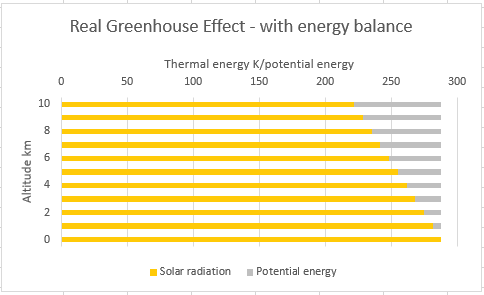
That's all unnecessary for real life purposes. What it boils down is that total energy (thermal energy + potential energy) is the same all the way up. PE must be highest at the top and zero at sea level. While PE adds to total energy, it doesn't increase total thermal energy, it just displaces it from high up to low down. Whether the atmosphere contains 'Greenhouse Gases' or not is entirely irrelevant because they make no difference (except to the extent that their molecular mass and specific heat capacities are different to those of N2 and O2). Of course, you don't measure potential energy in degrees K, but this is just to illustrate the principle:

This has been airbrushed out of mainstream teaching since the 1980s. They don't even mention it as a flawed and superseded theory (like the geocentric model of the solar system or the aether).
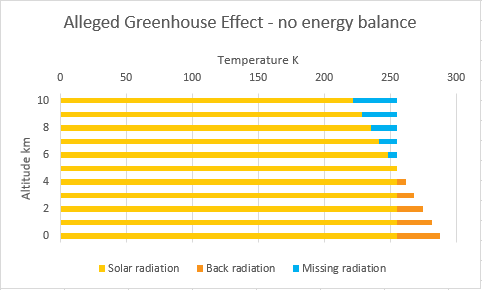
The common explanation nowadays is that 'Greenhouse Gases' trap thermal energy lower down and increase the amount of energy radiated from higher up, hence the lapse rate:

These two explanations are mutually exclusive. There is no mix and match. It's either one or t'other. Either you accept that the atmosphere is shaped by gravity and that temperature, pressure and density decline as you go up to balance out total energy (interesting but not very exciting); or you believe that a gas which makes up 0.04% of the atmosphere does all this.
There are even people at the more moderate end of the Warmenist spectrum (Clive Best or Roy Spencer) who insist that there has to be both gravity AND 'Greenhouse Gases' for there to be a lapse rate. Go figure.
Had the Warmenists refined the old explanation and split it into "mainly due to gravity" and "a bit more due to due to CO2 and methane" (as some of them do, to be fair), this would be 'at least plausible' and would not have aroused the suspicions of the layman:

But they are claiming the whole 33C for themselves and even worse, they usually gloss over the fact this is only true at sea level. They went all-or-nothing and have lost. This is why I have shifted from Skeptic to flat-out Denier.
Posted by
Mark Wadsworth
at
08:00
12
comments
Labels: greenhouse effect, Physics, Science
Saturday, 11 July 2020
Gravity and the Greenhouse Effect
I have added a new widget in the side bar (just below 'Martin Scriblerus Blogs') with links to some key articles that explain the kinetic-potential energy trade-off and balance in the troposphere. This in turn explains and ties in with many other observations.
Some explain it in simple layman's terms, some are very technical, but they all boil down to the same basic thing.
Enjoy!
Posted by
Mark Wadsworth
at
18:12
2
comments
Labels: greenhouse effect
Sunday, 21 June 2020
I'm shelving that plan for a book on the Real Greenhouse Effect...
It turns out that far greater and better qualified minds than mine have been pointing out the real (and blindingly obvious) reason for The Greenhouse Effect since the late 19th century, all to no avail. So it's not like I can make any difference and I'll just do one final blog post (I gave this a lot of thought while painting our kitchen cabinet doors last week but was too knackered to post anything) and call it a day.
A good place to start is at Tallbloke's Blog. Some of the modern day proponents are moderate and sensible, others seem to be a bit unpleasant and/or borderline mad. Take your pick, but that doesn't invalidate the explanation. Isaac Newton was a towering maths and science genius, but an unpleasant person to deal with and he also believed in transmutation of elements. So what?
All proponents have a slightly different way of explaining it, but it is of general application and explains so much that the Alleged Greenhouse Effect doesn't and can't. Suffice to say, the Consensus derides them all as crackpots and/or Science Deniers.
What it boils down can be illustrated for Earth's atmosphere as follows. The total energy (thermal plus potential) of any molecule at every altitude tends to equalise. Clearly, you don't measure potential energy in degrees K, you measure it in Joules, but they are of equivalent value. (Like somebody running a hydro-electric power station makes a trade off between "water up in the reservoir" and "kilowatt hours of electricity". There is a trade off between kg's and kWh's and they add up to the same total energy value, ignoring conversion losses/inefficiency):

That's my new flag! Fuller explanation (and the planned introductory chapters) as follows:
1. 'Energy' is just 'energy' and it takes on, or can be stored in, different forms, such as
- photons/radiation,
- kinetic energy (on large scale) or thermal energy (kinetic energy on a molecular scale),
- potential energy (height x gravity),
- latent heat of evaporation.
Those are the main ones we need to think about in terms of the atmosphere. There are others such as
- chemical energy,
- electrical energy,
- matter (which can be converted back to energy in nuclear fusion or fission)
but these are not so relevant here.
2. Energy can be converted from one form to another without overall losses. For sure, with plants and animals, or engineering, in any process some of your starting energy is converted to forms you didn't want or can't use, but that doesn't apply when energy in the atmosphere swaps between thermal energy and potential energy (convection) or back again, and this process is to all intents and purposes 100% efficient.
A good example of this two-way conversion is using spare/cheap electricity at night to pump water up into reservoirs (electrical energy is converted to potential energy). Then at times of peak demand, the sluice gates are opened, the water goes through turbines and generates electricity (potential energy is converted back to electrical energy). (Clearly this is not 100% efficient, in that some energy is lost to evaporation, vibration, heat/friction, sparks etc.)
Similarly, if you throw a ball vertically, it starts off with a lot of kinetic energy (it's moving fast); it then slows down and gains height (kinetic energy is converted to potential energy); it reaches a point where it is momentarily stationary (zero kinetic energy, maximum potential energy); on the way down, the reverse happens. Ignoring air resistance, the total energy of the ball remains constant. Analogies are never perfect, but this is similar to what happens in the atmosphere.
3. There are names for the processes when energy changes (or is converted) from one form to another.
Objects warm up when bright lights shine on them. When a warm object cools down, it 'radiates'.
We 'generate' electricity by converting thermal energy, solar radiation or kinetic energy into electricity. We 'use' electricity to create heat, light or movement.
When plants convert solar radiation to chemical energy, it is called 'photosynthesis'. We 'burn' things with stored chemical energy (wood) to create thermal energy and light.
When water evaporates, some of the thermal energy needed does not increase the temperature of the water directly. It is 'used' to convert water from liquid to gas and is stored by the water vapour as 'latent heat of evaporation'. So the land from which the water evaporates cools down by more than the water warms up, if you just measure it with a thermometer. This energy does not disappear (of course), it is just a different form of energy. When the water vapour condenses, it releases that latent heat as actual heat again (which is mainly why the observed lapse rate is only two-thirds of the predicted dry lapse rate).
I don't know if there is a word for kinetic energy being converted to potential energy (and back) when you throw up a ball (and it falls again).
When air is warmer than it surroundings, it expands, rises and cools ('convection') and thermal energy (kinetic energy on a molecular scale) is converted to potential energy (similar to a ball thrown upwards). For every bit of warm air that rises, another bit somewhere else falls down, is compressed and warms up, so the potential energy it had is converted to thermal energy again. Unfortunately there is no word for the opposite of 'convection'.
The meteorologists refer to the potential temperature of air. Although they are interested in unstable situations (because that's what makes the weather happen), it is the same sort of concept. The potential temperature is the temperature that the parcel of air would be if it were brought down to sea level atmospheric pressure. So it dry air at sea level is 288K, dry air which is 1 km above sea level and has an actual temperature of 278K also has a potential temperature of 288K and the two are in a neutral equilibrium.
It would be very helpful to split the potential temperature into a) actual temperature and b) the 'latent heat of convection' analogous to 'latent heat of evaporation' (or the 'latent speed' of a stationary ball at the top of its flight), because just like the 'latent heat of evaporation', which reappears as actual thermal energy when water vapour condenses, the 'latent heat of convection' (which cannot be measured with a thermometer) turns into actual thermal energy when air falls again.
For our purposes, we don't actually need to worry about whether energy in the atmosphere is transferred by conduction, convection, radiation, latent heat or anything else - the final distribution or equilibrium will be the same in the long run.
We also don't need to worry about how the energy gets into the atmosphere in the first place, which is mainly by solar radiation hitting the hard surface, the ocean surface or the clouds (occasionally it's a volcanic eruption or a meteor hitting it), because that doesn't affect the final distribution. That would be like assuming that the surface height of a lake depends on which ends is being rained on; or that a bath warms up more at the end where you pour in a bucket of hot water.
4. Energy tries to spread out as evenly as possible.
This is easy if we are just looking at one type. If rain falls at on end of a long lake, the water level in the whole lake rises by the same amount, or else the surface at the rainy end would be higher and have more potential energy than the sunny end. If you pour a bucket of hot water into one end of a lukewarm bath and wait for a few minutes, the temperature of the whole bath will go up by the same amount.
But in the atmosphere, potential energy can't be the same all the way up. This is the key to the whole thing. The top layer will always have the most potential energy and the bottom layer will have none. So energy does the next best thing and adjusts temperature so that the total energy (thermal plus potential) of any molecule at any altitude tends to equalise, which it is why it is so easy to understand the formula for the lapse rate (gravity ÷ specific heat capacity), it's just the trade off between the two forms of energy (on Earth, we have to adjust this down by one-third because of the latent heat of evaporation/condensation of water/vapour).
Rather unsurprisingly, because the average temperature of the atmosphere is 99.9% dictated by incoming solar radiation, the average temperature of the whole atmosphere is what you would expect it to be from that incoming solar radiation (i.e. 255 degrees K, the 'effective temperature'), but this thermal energy is not distributed evenly all the way up; there is more at sea level (288 K) and less at the top of the troposphere (213 K) - see chart above.
5. The normal gas laws have to be modified over large scales where gravity is relevant
The normal gas laws apply on a small scale in a sealed container (where you can safely ignore gravity) and tell us that temperature, pressure and density will all even out. But this does not apply on the large vertical scale in the atmosphere where gravity is important and where there are no sidewalls (a molecule that moves sideways hits another molecule, it never hits a wall) or lid (unless you count gravity as a lid?). Pressure and density fall as you go up through the atmosphere because of the effect of gravity, so why shouldn't temperature? Without gravity, there wouldn't be an atmosphere!
Molecules in the air are constantly moving and trying to reach an equilibrium. If a 'parcel of air' is slightly warmer than its surroundings, it will expand, rise and cool (these three go on tandem, you don't need to worry about what happens first). So it loses thermal energy (cools down) - and by rising, it gains potential energy. The potential energy doesn't come out of nowhere - thermal energy has been converted to potential energy.
For every 'parcel of air' that rises, other parcels move horizontally to fill the gap (aka 'wind'), and somewhere (over the Poles or on the night side) a parcel of air will be slightly cooler than its surroundings and it will fall to fill the gap left over by the last parcel that blew off horizontally. This parcel will be compressed into a smaller volume and its temperature will go up. That thermal energy doesn't come out of nowhere either - potential energy has been converted back into thermal energy. To use my terminology, the 'latent heat of convection' has been converted back into actual 'heat'.
Half way up the troposphere, a parcel of air has a certain amount of potential energy and a certain amount of thermal energy (that comes from solar radiation, which is our effective temperature of 255 K). The air above it will be cooler and the air below it will be warmer.
Summary... the Real Greenhouse Effect doesn't increase overall temperatures. It increases temperatures in the lower half of the troposphere and reduces them in the upper half. Same as a fridge, heat pump or vortex tube, which warm and cool simultaneously, they take thermal energy from somewhere and push it somewhere else. They do not increase overall average temperature or energy in the whole system. You don't get something for nothing!
6. The Consensus view (to the extent it has a view, each climatologist offers two or three self-contradictory explanations) makes unsupported assumptions and reaches unrealistic conclusions (see for example here):
- in the absence of Greenhouse Gases, there would be no lapse rate, temperature would be 255K all the way up;
- Greenhouse Gases trap thermal energy at the hard surface/sea level by reflecting/re-radiating it downwards, making and lower layers warmer and the upper layers colder;
- potential energy can be ignored completely.
Which can be illustrated as follows:

--------------------------------------------
7. This appears to me to be science denial on a grand scale, and ignores and/or can't explain all the stuff we can observe and have reasonably good measurements for. If I had written the book, these would get a chapter each:
- it ignores the fact that the top of the troposphere and hence the peaks of very high mountains are a lot colder than we would calculate from solar radiation alone (see first chart). Their get-out is that Greenhouse Gases trap the heat lower down and keep the higher layers cooler, but that ignores potential energy completely and ignores the fact that mountain tops also receive solar radiation (so must be wrong);
- it ignores the fact that air is good at storing thermal energy, it warms slowly during the day and cools down even more slowly during the night. The total stored energy in the atmosphere and hard surface/ocean surface only goes up by 'a few per cent' on the day side and down by 'a few per cent' on the night side ('a few per cent' is probably about 5%). During the day, the air has a net cooling effect on the surface (like a car radiator) and vice versa during the night (like a radiator in a room);
- it ignores the fact that the oceans store more heat in their uppermost 3 meters than the entire atmosphere (let alone the thousands of metres of water below that);
- how clouds of hydrogen and helium gas contract to generate the pressure and temperature needed to kick start nuclear fusion;
- why there is a lapse rate on Jupiter or Saturn, even though their atmospheres are hydrogen and helium, which are officially not Greenhouse Gases (nitrogen and oxygen aren't officially Greenhouse Gases either). (Some astrophysicists consider Jupiter and Saturn to be failed stars - they are emitting more energy than than they receive from the sun, so must be gradually using up mass somehow);
- why the cores of Jupiter and Saturn are so hot, despite getting effectively zero solar radiation and why the hard surface of Venus is so hot, even though it only gets 17 W/m2 solar radiation (about one-tenth of what Earth's surface gets - clue - Venus' troposphere is heated from the clouds downwards using whatever the opposite of 'convection' is);
- why the Greenhouse Effect is stronger on the night side of Earth (which is getting zero solar radiation) and actually negative on the day side (which is getting all the solar radiation). The daytime temperatures on the surface of Earth are a lot cooler than the daytime temperatures on the Moon. On Venus, there is practically no difference between day and night surface temperatures;
- why the troposphere emits twice as much radiation or thermal energy towards the ground than it does out into space. The troposphere at sea level is warmer and hence emits more radiation that the layer higher up, which is colder and so emits less radiation, full stop.
- why water vapour and clouds (taken together) can't be a 'greenhouse gas', although this is based on observation as much as physics, which is really complicated.
- why the 'greenhouse effect' on Mars is barely measurable (no more than 5 degrees), even though there is twenty-five times as much CO2/m2 surface area as there is on Earth.
- why you can plot the Greenhouse Effect on Mars, Earth and Venus against the total mass of their atmospheres per m2 of surface and get a straight line, even though Earth's atmosphere is only 0.04% CO2 and Mars' and Venus' atmospheres are > 95% CO2.
- and so on and so forth.
It's all well and good having a theory or an explanation, but you have to be able to apply it to all the cases listed above and see whether they still hold. The kinetic-potential energy trade off explains 99% of all that without breaking a sweat. The Consensus have to invent all sorts of different explanations to paper over the cracks.
------------------------------------------
8. If I had a few million quid to spare, I'd settle the matter once and for all by buying an old industrial chimney or cooling tower - the taller the better - sealing it at the top, painting it white on the outside and insulating it with polystyrene on the inside walls, top and bottom - and then just measuring the temperature at top and bottom.
We would have real fun with this - we could test the theory to extremes by cutting holes near the top and bottom (on the side that gets the least solar radiation) and installing fans to pump in/suck out air; we would install radiators and cooling pipes at the top and bottom and turn them on and off; we would pump out the air and re-fill it with a mix of 80% nitrogen, 20% oxygen and zero Greenhouse Gases (H20, CO2 or methane).
I am quietly confident that, whatever you do; after you have turned off the pumps and closed the holes; or turned off whichever radiator or cooling pipes you had turned on; and left the column of air alone for long enough, the lapse rate will re-establish itself and the column of air will be cooler at the top than at the bottom by about 0.65 degrees per 100 metres of height (or nearly 1 degree if you manage to eliminate water vapour).
The only interesting thing left to resolve will be whether it takes seconds, minutes, hours or even days for the lapse rate to be re-established. If it hasn't happened after a week, if it's warmer at the top or if it's the same temperature all the way up, that's still a few million quid well spent and I shall spend a few quid more on a nice hat to eat.
I just wonder whether The Consensus would be prepare to enter into a bet and pay the costs if the explanation is correct. And I'll buy them a nice hat to eat as a consolation prize!
Posted by
Mark Wadsworth
at
14:49
0
comments
Labels: greenhouse effect, Physics, Science
Monday, 25 May 2020
Climate science - as easy as A, B, C.
We all accept that the actual average sea-level temperature of the Earth (288K) is about 33K higher than its 'effective temperature' i.e. what it would be if Earth had no atmosphere (255K). That's basic physics - average incoming solar radiation in W/m2 minus amount reflected as light (known figures) raises temperature of the 'surface' (as defined - see below) to whatever it needs to be to radiate the same amount of W/m2 back out to space.
The Consensus is that the entire 33K discrepancy is due to the presence of minor trace gases in the atmosphere, such as the +/- 2% water vapour or 0.04% CO2 ('greenhouse gases'). The surface converts short wave visible radiation from the Sun to longer wave infra red radiation, and this is trapped/absorbed or reflected by the 'greenhouse gases', which in turn warms up the surface even more, so it emits even more infra red in a vicious circle. Here is a typical article explaining this, which includes the energy budget diagram which doesn't add up as a bonus. Parts of that explanation are correct, parts are guesswork and assumptions, it is riddled with contradictions, leaves a lot of loose ends and unanswered questions, and overlooks some important basic physics.
Actually, if you sift out the basic physics from the guesswork and just apply the basic physics, it is quite easy to work out that the hard surface should be 45K - 50K warmer than the effective temperature. The formulas and calculations are the same whether or not there are any 'greenhouse gases', which suggest that they do not increase temperatures. As a matter of fact, there is only a 33K discrepancy, because water vapour and water in the troposphere have a moderating influence and reduce surface warming and temperature fluctuations (which accords with everyday experience and like-for-like comparisons of temperatures in humid and dry areas).
They could and should teach this as part of GCSE level physics, it wouldn't take more than two or three lessons.
A. Barry
You can easily work out that there are about 10,000 kg of air (101,325 Pascal ÷ 9.807 m/s/s) for every m2 surface. We know that 1 m2 of air at sea-level has a mass of 1.293 kg. So if atmosphere were same pressure and density all the way up, with a hard edge, it would be 7.7 km high.
You can guess intuitively that the atmosphere gets thinner as you go up and gradually tapers off into space and that there is no hard edge. So let's assume actual average density is half that at sea-level, a reasonable guess is that most of the mass of the atmosphere is up to an altitude of 15 km or so, and atmospheric pressure falls by about 7% for each km you go up, at least for the first five or ten km (which is not far off actual measurements).
If you want to calculate this properly, you use the Barometric Formula (or 'Barry', as I affectionately call it) which is based on actual ideal gas laws and gives you reasonably accurate predictions for pressures at different altitude, at least for the troposphere (which is all we really care about, i.e. is the bottom 11 km, others say bottom 13 km, it's thicker at Equator and thinner at the Poles). The formula is very clever. I can just about understand how they work it out, but I would struggle to reverse engineer it or explain how to derive it.
B. The lapse rate
In an intuitive way, you can also guess that the temperature at the top of the atmosphere is close to the temperature of the nearly empty vacuum of space, which is either close to 0K or has no measurable temperature at all, depending on your point of view. So temperature falls the higher you go, as anybody who has been up a mountain knows.
Remember that 'energy cannot be created or destroyed, it merely changes from one form to another'. Air at sea level as thermal energy (aka kinetic energy) and no potential energy (it can't fall any further down). Air higher up has the same amount of total energy - less kinetic energy and some potential energy. It is reasonable to expect the total amount of energy to be the same at different altitudes.
Once you accept this, you can work out the lapse rate. I'll show you how, just for fun and because it is important:
Potential energy in Joules = mass x gravity x height.
So J = m x g x h
Joules required to increase temperature of 1 kg of a substance by 1K = specific heat capacity ('cp' ) of that substance.
So T = J ÷ (m x cp)
We can simplify/merge those two equations as follows: T = (m x g x h)/(m x cp); cancel 'm' top and bottom; T = g x h/cp; divide both sides by h; T/h = g/cp.
(Thanks to Tallbloke for this short-cut - Wiki gives an explanation which is almost impenetrable to the layman, although it ends with exactly the same formula)
1 kg of air which is 1,000 metres higher up has got 9,807 more Joules of potential energy than 1 kg 1,000 metres lower down, so the air lower down must have 9,807 more Joules of kinetic energy (and vice versa).
How much warmer is the air 1,000 metres lower down?
Specific heat capacity of air = 1,006 J used/needed to increase 1 kg of material by 1K
T/1,000 = 9.807/1,006
T/km = 9.75K
Hence the predicted lapse rate = 9.75 K/km altitude.
[I think it makes more sense to a) use the specific heat capacity for constant volume rather than constant pressure, and b) to calculate J/m3 rather than J/kg. That means first using Barry to find pressure, at different altitudes and then finding the temperatures which balances Joules of kinetic energy and Joules of potential energy (basing calculations on density at different altitudes, not on pressure, so you need to know pressure and temperature to work out density, and the temperature is the thing you are looking for!), which is why the lapse rate I worked out was 8K/km. I'm not sure if my logic on a) and b) is 100% sound, but my method gives an answer which is closer to the real world observed typical rate of 6.5 K/km, so I'm happy with my method for now.]
C. What is the surface of the Earth?
The Consensus give a nod to Barry and the main reason for the lapse rate. They don't deny they exist, they give the formulas but then downplay them as irrelevances and draw no conclusions from them. It's like the road sign saying turn left and the sat nav saying turn left, but turning right anyway. It's all about radiation from the surface being reflected back down by those dastardly 'greenhouse gases'! Any other explanation is heresy!
The Consensus' most heinous and borderline criminal obfuscation is in their definition of the 'surface'. They define 'the surface' as the hard surface at sea level, or the surface of the oceans (two-thirds of Earth's surface is ocean).
Here are a few reasons why that is wrong:
1. If you calculate the 'effective temperature', you should also be looking at 'effective surface', which is whatever the sun light hits first, Earth has a lot of clouds, so the 'effective surface' is NOT at sea-level.
2. If you approach Earth at speed from space, you feel it when you hit the atmosphere. That is the real surface.
3. If you scale down the earth to the size of a football, the troposphere is only 0.2 mm thick. You think it's thick when you look up at an airliner, but it's only 11 km away, you could drive that far in a few minutes.
4. There are about 10,000 kg of air (mass) for every m2 surface (see above)
5. The sun only warms the top few inches of the hard surface (or water), that's a few kg of mass per m2. So if the atmosphere is 0.2 mm thick, the hard surface or sea-level is barely a couple of molecules thick.
6. When we talk about the surface of the ocean, we mean the top of the water, not the hard surface at the bottom.
7. When we talk about the surface of the Sun or a Gas Giant, we mean the surface of the atmosphere, not the hard surface lower down (to the extent there even is one). Why do we change the rules when looking at rocky planets with thinner atmospheres?
8. As far as heat distribution goes, we might as well treat the top few inches of the hard surface as the bottom part of the troposphere. It's usually the same temperature, and must be the same pressure.
Therefore, the real surface is the whole troposphere, not the hard surface or the surface of the oceans.
Summary
The troposphere is the surface, and as a whole and on average, is the temperature you would expect from incoming solar radiation = +/- 255K. This is what you would expect, and this is what you get. I don't see why anybody taking this view should be on the defensive in a discussion. It is those trying to say otherwise who are struggling.
The troposphere itself, it is not a constant 255K. There has to be - and there is - a lapse rate. There are different ways of calculating/predicting it, and it can be observed/measured, so it's about 33K warmer than 255K at the bottom (the hard surface); it's about 255K half-way up (as defined); and it's about 33K cooler than 255K at the top of the troposphere.
Bonus
This A-B-C easy GCSE-level approach also explains a lot of things which the Consensus explanation can't and doesn't (and by and large, just glosses over to save embarrassment), for example:
1. Why the top of the troposphere (or the peak of a very high mountain) is colder than the 'effective' temperature, i.e. colder than it would be if Earth had no atmosphere.
2. Why the day/night temperature range on Earth (+/- 15K) is so much smaller than the day/night temperature range on the Moon (+/- 300K).
3. Why, despite the 'greenhouse effect', Earth's day-time temperatures at the surface are lower than what they would be without an atmosphere.
4. Why the 'greenhouse effect' is much stronger at night (i.e. actual temperature minus expected temperature of the night side of Earth if it had no atmosphere) than in the day time (when the Sun is blazing down on us and there is plenty of radiation sloshing about).
5. Why 'heat rises' is a truism only observed in enclosed spaces kept above the temperature of their surroundings (central heating in buildings; actual greenhouses/polytunnels) and why convection doesn't actually transfer heat upwards. For sure, there are thermals above hot surfaces (like square miles of dark tarmac at airports, which can make landing trickier than it need be on hot days), but for every molecule that goes up, one has to come down. One molecule converts kinetic energy to potential energy and the one coming down does exactly the opposite.
6. Why there is no need to get tied in knots over which methods energy (in its various forms - visible and infra red, kinetic energy, potential energy, latent heat of evaporation/condensation etc) is distributed in the troposphere (conduction, convection or radiation). All you need to know is that energy tries to distribute itself as evenly as possible (governed by the physical laws discussed here, or by winds/weather, if you want an everyday term for a complicated process).
7. Why the troposphere emits twice as much radiation towards the ground than it does out into space. This cannot be satisfactorily explained by 'greenhouse gases trapping and/or reflecting heat', it is because the troposphere at sea level is warmer and hence emits more radiation that the layer higher up, which is colder and so emits less radiation, see here.
8. Why water can't be a 'greenhouse gas', although this is based on observation rather than physics, which is really complicated with water vapour and water (see here).
9a. Why it is irrelevant that N2 or O2 are transparent to, and cannot absorb or emit infra red (even if this were true, which is questionable). They can certainly warm up, and they in turn keep the hard surface at the same temperature. So even if N2 and O2 aren't emitting infra red themselves, the hard surface converts that warmth back to radiation anyway. The total infra red leaving the hard surface is the same whether it is bouncing back and forth as infra red between hard surface and troposphere (the Consensus), or whether the hard surface has to convert kinetic energy from N2 and O2 back into infra red first (the actual explanation).
9b. Why, even if the troposphere were indeed completely transparent to and unaffected by infra red radiation, incapable of absorbing or emitting it, the temperature at the hard surface would be the same as it is now. The hard surface would quickly reach 255K (accepted by the Consensus) and it would warm up the troposphere by conduction and convection until the whole troposphere (the effective surface) were 255K on average (it being incapable of radiating heat to space, that's the Consensus). That 255K would be the average, there would still be a lapse rate and so the temperature of the hard surface would increase to 288K (and the top of the troposphere would be about +/- 222K). The hard surface would then be warm enough to emit the required amount of infra red straight through the troposphere and back into space (not being able to lose any more energy to the troposphere by conduction or convection).
10. Why there is a lapse rate on all planets with an atmosphere, even Gas Giants (Jupiter, Saturn), which have no hard surface (and if they do, radiation from the Sun never gets there) and which consist mainly of 'non-greenhouse gases' (mainly hydrogen and helium); why they are insanely hot at their centres; and why those Gas Giants are actually emitting more radiation to space than they get from the Sun.
11. Why the 'greenhouse effect' on Mars is barely measurable (max 5K), even though there is twenty-five times as much CO2/m2 surface area as there is on Earth.
12. Why you can predict Venus' hard-surface temperature fairly accurately using the same basic physics (here). All you need to know is distance from Sun and albedo, from which you work out 'effective temperature'; the height of 'effective surface'; the acceleration duty to gravity and specific heat capacity of the gases in the atmosphere, from which you work out the lapse rate up- and downwards. Whether or not the constituent gases are 'greenhouse gases' is entirely irrelevant. Knowing the mass of constituent gases in kg/m2 helps as well for cross checking.
Posted by
Mark Wadsworth
at
16:17
9
comments
Labels: greenhouse effect, Logic, Maths, Physics, Science, Weather