
Seeing as we are laying into Alarmism this week, here are a few questions which need to be answered, even if they refuse to accept that the 33 degree GHE is a massive great lie (based as it is on selectively ignoring clouds):
1. What is the optimum CO2 level to get an optimum climate?
2. In which earlier periods of at least a century was CO2 at this level?
3. Can you confirm that the weather was objectively better in most of those centuries - very few natural famines (this is the most important one), floods, droughts, hurricanes, forest fires etc, with steady rainfall patterns in most places, etc, or at least, a lot fewer/steadier than in the last half a century?
4. Can you also confirm that temperatures were stable throughout most of those centuries, varying by no more than +/- 1 degree per century?
I doubt whether the mantra "pre-industrial levels" is the right answer - during the last period when CO2 was this low was the Little Ice Age, which as far as we can tell was a global phenomenon. Mass famines and at least as many floods, droughts etc as nowadays. We don't want that!
And we know that temperatures have never been that stable; climate change is a constant and always has been. The ups and downs of the last 150 years are nothing unusual.
Friday, 25 November 2022
Questions for Alarmists, which they will never answer.
Tuesday, 4 October 2022
Now it's getting silly...
Nuclear War Could Reverse Global Warming
says the Huffington Post quoting the National Geographic.
Hey, instead of waiting decades for climate change to make the world uninhabitable (which isn't going to happen anyway), let's do it in days with a nuclear war.
Monday, 3 October 2022
"To understand the scale of the climate emergency, look at hurricanes"
... says everybody's favourite go-to source of Climate Change Porn.
Let's follow their advice and look at long term records.
And... we establish that there is no discernible pattern or long term trend, it's entirely random, and this year 2022 (so far) has seen relatively few major hurricanes.
Admittedly there is a lot of cherry picking with this - the Alarmists sneak in definitions like 'costliest' (of course $ damages are going up, the Yanks have built a lot more valuable stuff near the coastline over the past century); or include weaker sub-hurricanes (which show up more in the records because people didn't used to bother counting them, or they formed and dissipated far out at sea); or select shorter time periods over which there appears to be a trend (2004 was a bad year, but preceded and followed by several years with no landfalling hurricanes) and so on.
So believe who you want, I always prefer raw data where the parameters are clear and consistent. The raw data just shows random patterns since 1851, and if we're using hurricanes as a yard stick, there is no climate crisis.
Tuesday, 16 August 2022
Scientists paid to find evidence find evidence - shock
From the BBC:
The record temperatures in the UK last week would have been "almost impossible" without human-induced climate change, leading scientists have concluded...
The findings are released by the World Weather Attribution group - a collection of leading climate scientists who meet after an extreme weather event to determine whether climate change made it more likely.
When they say "determine whether", they clearly mean "determine that". They are hardly likely to spend years putting out press releases saying "nothing to see here", are they?
The whole thing is nuts anyway. Temperatures have been going up and rainfall patterns changing in many parts of the world since the Little Ice Age ended (they have been surprisingly stable in other parts). By definition, higher (or indeed colder) temperatures and different rainfall patterns indicate "climate change". Their job is entirely superfluous.
We have few records on the what happened during transition from the Dark Ages cooler period to the Mediæval Warm Period and even less (fewer?) on how quick the start of the Roman Warm Period was, so nobody has any idea whether this is "normal".
Saturday, 9 July 2022
Just Stop Oil... price hikes?
The Just Stop Oil/ XR people don't understand science, but fair enough, they are at least intellectually consistent from there on in. They do shit like gluing themselves to road surfaces to piss off motorists.
For some reason, some people whose interests are diametrically opposite have adopted a similar rolling roadblock tactic.
If you were stuck in the queue behind all this, how would you know whom to rail against? The climate idiots or the tax idiots? (The recent price rises are apparently due to lack of refining capacity, which in turn are partly due to 'green' policies, and little to do with changes in fuel duty?)
Also, I'm looking forward to the day when the climate idiots and the tax idiots organise a joint protest; the rolling road block can slow the cars to a halt, and then the Just Stop Oil/XR people can then sit down across the carriageway and refuse to move afterwards.
----------------------
The choice of The Haywain for a recent stunt is particularly ironic. In their apocalyptic version, the trees are all dying. In truth, the amount of tree cover in that region has steadily increased over the past two centuries (as anybody who's actually been there will attest), broadly in line with increases in temperatures/CO2 levels. Trees - like most plants - thrive where it's warm and wet (hence 'tree lines').
The climate people flip flop on whether warmer temperatures mean more or less rain - but whichever it is, it is BAD. A dried out river bed is the last place you should build a new road, it will still flood occasionally. There's an old car dumped in the background - so what? That's just fly tipping and wrong anyway. And commercial planes would never be allowed to fly that close together on the same path. Deliciously wrong on so many levels...
Thursday, 26 May 2022
Thou shalt neither mock nor question the Holy Scriptures.
From the BBC:
HSBC has reportedly suspended a senior executive who accused central bankers and other officials of exaggerating the financial risks of climate change... During the 15-minute address at the FT Moral Money Summit, Mr Kirk said "Climate change is not a financial risk that we need to worry about."
"Unsubstantiated, shrill, partisan, self-serving, apocalyptic warnings are ALWAYS wrong," a slide shown as part of the presentation said... Later in the presentation, he said: "Who cares if Miami is six metres underwater in 100 years? Amsterdam has been six metres underwater for ages and that's a really nice place."
In cases of transgression, thine employer shalt say Three Hail Mary's and beg for forgiveness:
... a spokesperson shared a statement by HSBC Asset Management chief executive Nicolas Moreau referring to climate change as "one of the most serious emergencies facing the planet... HSBC Asset Management is committed to driving the transition to a sustainable global economy and has a fiduciary responsibility to ensure its clients' monies are managed for positive long-term environmental and social outcomes."
Amen.
Wednesday, 4 May 2022
Not a religion.
From Al Jazeera:
The sea level is rising twice as fast as previously forecast around parts of New Zealand, according to research published on Monday, putting the country’s two largest cities at risk decades earlier than expected... Prime Minister Jacinda Ardern said adaptation planning was already under way, including budgeting for the relocation of some communities and infrastructure away from vulnerable coastlines.
“The first port of call isn’t necessarily managed retreat because there are a range of options that can be used,” she told Radio New Zealand, “We’re working alongside local government and insurers to work through who bears the costs of some of these options. The cost that needs to be borne won’t fall on one party.”
Ardern said New Zealanders should not accept that sea level rises are inevitable beyond those predicted for the near term, and every citizen should do all they can to reduce emissions and diminish the effects of climate change.
Hopefully she has tipped off the Dutch. Instead of spending all that money on flood defences, they should spend in on Tesla cars. Apparently the results are the same.
Saturday, 5 February 2022
More on our favourite religion...
The problem with websites like the Daily Sceptic is that they too are trying to get you to share their beliefs, instead of just reporting the facts. It's like arguing with an atheist as opposed to an agnostic. The agnostic isn't trying to get you to believe anything, but the atheist is trying to get you to believe that there is no God.
Yes, it's interesting that Google has gone all Spanish Inquisition on Dr Roy Spencer for publishing this graph:
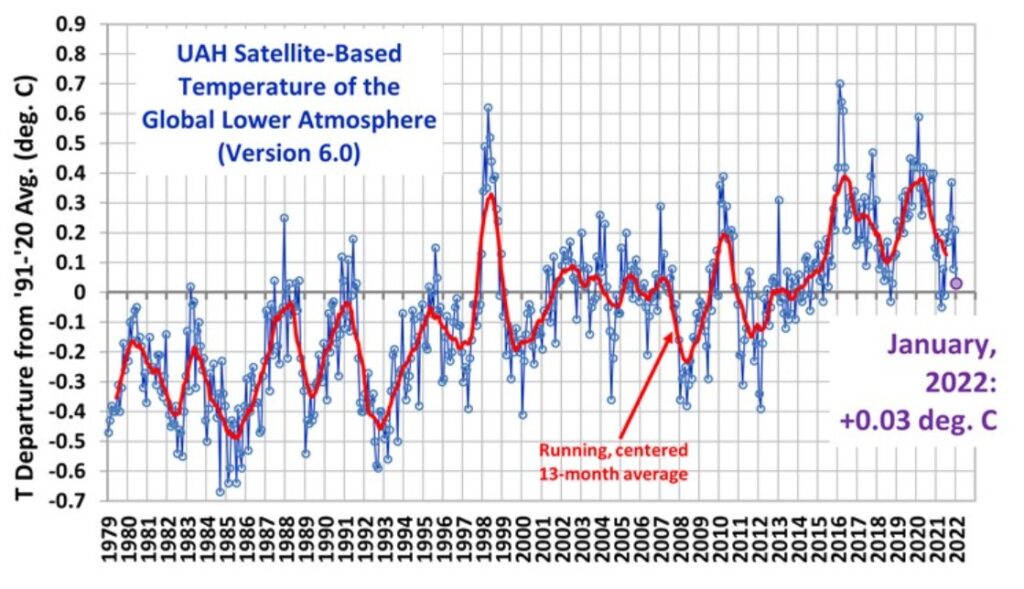
and the graph itself is interesting, showing evidence that there has been no warming for the last seven years, but the facts should be allowed to speak for themselves, without the tone of the rest of the article which is the same "bad men are out to rip you off" of the Alarmists, just with different bad men.
In any case, the Alarmists know that warming has stopped, that's why Anthropogenic Global Warming has been rebranded as Climate Change and we are no longer talking about extreme temperatures and are now talking about extreme weather events.
Tuesday, 25 January 2022
Not a religion
On the subject of people inventing religions as a way to gain and maintain power, dividing things into Good and Evil is an indicator of what we are dealind with.
Tuesday, 18 January 2022
The Guardian's alternate reality
From The Guardian:
The climate crisis is damaging the health of foetuses, babies and infants across the world, six new studies have found.
Scientists discovered increased heat was linked to fast weight gain in babies, which increases the risk of obesity in later life. Higher temperatures were also linked to premature birth, which can have lifelong health effects, and to increased hospital admissions of young children.
Right. The 'cimate crisis' leads simultaneously to more premature babies, which tend to be underweight, and also faster weight gain/obesity?
The burning of fossil fuels drives the climate crisis but also causes air pollution and a new study in Denmark assessed the impact of dirty air on 10,000 couples trying to conceive naturally. It found that increases in particle pollution of a few units during a menstrual cycle led to a decrease in conception of about 8%.
A recent study in China also found that air pollution significantly increased the risk of infertility, but the average pollution level was more than five times higher than in the Danish study. “Air pollution [in Denmark] was low and almost entirely at levels deemed safe by the European Union,” said Wesselink. “Current standards may be insufficient to protect against adverse reproductive health effects.”
Of course pollution is unhealthy, nobody is disputing that. But it doesn't seem to have that much effect - the birth rate in Denmark is only ever so marginally higher than in China.
Wellenius said an important aspect of the studies was that they showed that vulnerable people often suffered the worst effects, for example people of colour and those on low incomes who did not have air conditioning or lived in areas with higher air pollution. “This is absolutely a health equity and justice issue,” he said.
Right. The number of babies being born seems to be inversely proportional to how urbanised or economically developed a country is (it's a fascinating topic in its own right); the world's overall birthrate has plummetted quite precipitously over the last century. The only continent where they are still getting on with it and popping out lots of babies is also the poorest, and probably the hottest and most polluted one - Africa. But according to the Guardian, the opposite is happening.
Sunday, 9 January 2022
"Don't look up"
I had no intention of watching this film until I noticed that the Alarmists assume that this film is a parable about politicians and the media ignoring the 'Climate Crisis'.
Having misunderstood* the whole premise, The Guardian gave it two stars, describing it as a "shrill, desperately unfunny climate change satire"**.
Duly heartened, I watched it yesterday and I must say, it is gruesome and splendid. It's basically Dr Strangelove, except with a giant meteor instead of a nuclear war.
* It's quite possible that they are right and the film is supposed to be a parable for the 'Climate Crisis'. If so, the film is an epic fail on its own terms, but succeeds nonetheless because you can watch it ironically.
** For more top-drawer Guardian hand-wringing, read this article.
Monday, 1 November 2021
Is Climate Alarmism a religion?
From the BBC:
Thousands of activists arrived in Scotland's largest city to make their climate change concerns known.
They included Greta Thunberg who was mobbed as she arrived by train in Glasgow. The Swedish activist was surrounded by police, media and activists at the city's Central Station.
Earlier, faith groups making pilgrimages to Glasgow converged in the city as protests build ahead of COP26 which starts on Sunday. Many had walked thousands of miles to join in a procession through the city centre.
Hundreds of people from Extinction Rebellion (XR) Faith and pilgrimage groups converged at the McLennan Arch on Glasgow Green, where XR Scotland's "Blue Rebels" formed a guard of honour for them. The bells at St Mary's Episcopal Cathedral in Glasgow led a UK-wide toll from 18:00, offering a traditional warning to humanity to "pay heed to the climate crisis".
Those arriving in the city include Marcha Glasgow, a group of Spanish activists who took a ferry from Bilbao to Portsmouth to embark on a 30-day hike to Glasgow. Camino to COP26* members have walked from London and Bristol to Glasgow in just under two months. Young Christian Climate Network activists arrived in the city on Saturday after walking 1,200 miles from Cornwall**.
This wasn't just about getting there, it was about playing the martyr or finding redemption through suffering or some such bullshit. After many similar publicity stunts, Ms Thunberg is now venerated as a minor saint.
* Google Maps says that London to Glasgow is 387 miles on foot, do fifteen to twenty miles a day, you could do it in half the time.
** Did they get lost along the way or is this just poor reporting by the BBC?
Friday, 2 April 2021
Firm conclusions based on total guesswork
From The Guardian:
The climate crisis is already eating into the output of the world’s agricultural systems, with productivity much lower than it would have been if humans hadn’t rapidly heated the planet, new research has found.
Advances in technology, fertilizer use and global trade have allowed food production to keep pace with a booming global population since the 1960s, albeit with gross inequities that still leave millions of people suffering from malnutrition.
But rising temperatures in this time have acted as a handbrake to farming productivity of crops and livestock, according to the new research, published in Nature Climate Change. Productivity has actually slumped by 21% since 1961, compared to if the world hadn’t been subjected to human-induced heating.
And from Nature.com itself:
Abstract
Agricultural research has fostered productivity growth, but the historical influence of anthropogenic climate change (ACC) on that growth has not been quantified.
We develop a robust econometric model of weather effects on global agricultural total factor productivity (TFP) and combine this model with counterfactual climate scenarios to evaluate impacts of past climate trends on TFP. Our baseline model indicates that ACC has reduced global agricultural TFP by about 21% since 1961, a slowdown that is equivalent to losing the last 7 years of productivity growth.
The effect is substantially more severe (a reduction of ~26–34%) in warmer regions such as Africa and Latin America and the Caribbean. We also find that global agriculture has grown more vulnerable to ongoing climate change.
Is there any part of this whatsoever that doesn't scream 'total guesswork'? You can't just add up inputs and assume a linear rise in outputs. Your factors are land, water and sunshine, seeds, labour, machinery, other capital and fertiliser, it's all trade-offs. How on earth do you ascribe one set of relative values? Machinery will be used if it is cheaper than using labour, so you use more tractors in high-wage countries and more labour in low wage countries.
Using 'enough' fertiliser will get you an optimum result; there is no point using more than that because the extra yield does not justify the extra cost. And the extra yield depends on how much you can sell your produce for. All plants require a minimum amount of land to grow, although you can enhance that by building greenhouses and polytunnels etc.
Billions of farmers worldwide have been making these calculations since farming was invented and they seem to have got it right most of the time. Somehow or other, food production has always kept pace with population growth (by definition) and there's no reason to assume that this won't continue for the foreseeable future.
There used to be famines all the time, but there haven't been many in the past couple of decades apart from those imposed by governments (North Korea) or warfare. Sure, there are droughts, floods and outbreaks of pests now and then, here and there, always have been and always will, but you don't read about hundreds of thousands or millions of people starving to death like you did for most of the 20th century.
So sorry, really not bothered.
Tuesday, 9 March 2021
"Global heating pushes tropical regions towards limits of human livability"
I know we've done this sort of story before, but they are an easy target.
From The Guardian:
The climate crisis is pushing the planet’s tropical regions towards the limits of human livability, with rising heat and humidity threatening to plunge much of the world’s population into potentially lethal conditions, new research has found.
Should governments fail to curb global heating to 1.5C above the pre-industrial era, areas in the tropical band that stretches either side of the equator risk changing into a new environment that will hit “the limit of human adaptation”, the study warns...
“If this limit is breached, infrastructure like cool-air shelters are absolutely necessary for human survival,” said Sadegh, who was not involved in the research. “Given that much of the impacted area consists of low-income countries, providing the required infrastructure will be challenging. Theoretically no human can tolerate a wet bulb temperature of above 35C, no matter how much water they have to drink,” he added.
"Theoretically"? Maybe not. In practice, clearly we can.
Timeanddate.com shows that in Calcutta (the first hot, humid place that sprang to mind, I'm sure there are even hotter and more humid places) there are two months in which the average daytime high is over 36 degrees and for ten months of the year the average daytime high is 30 degrees or more. How often does the temperature go over 35 degrees with high relative humidity?
I have no idea, but I am sure the answer is "quite often" and they seem to manage just fine. Even London breached 35 degrees on a couple of days last year. Was it unpleasantly hot if you're not used to it? Yes. Did everything grind to a halt and Londoners start dropping like flies? Not that I recall. But there again, I am a climate denier, so maybe it did and we did and I have just suppressed that memory.
Wednesday, 24 February 2021
RE: ozone depletion - how does the extra Ultraviolet B radiation affect clouds?
That's a question to which I have found no obvious answer, but I assume that if there is a bit of extra high intensity UV-B hitting the atmosphere, it will evaporate some of the clouds, i.e. turn water droplets back into water vapour. The wavelength of UV-B is orders of magnitude less than that of infra red, so the chances of it being absorbed by a molecule in a tiny water droplet is commensurately higher. And 'absorbed' just means that radiation energy is converted to some other form of energy.
This can lead to a disproportionate effect on surface and atmospheric temperatures. This theory might be totally wrong of course but it seems plausible to me. The effect must be warming, however slight. I've not put numbers on the effect because you have to make far too many assumptions so that would 'prove' nothing. This is a wait and see operation. If I live long enough to see the 'ozone hole' repair itself (perhaps by the middle of this century?) and temperatures fall again even though CO2 levels have increased (and they will), then that would support the theory but not really 'prove' it either way:
1. Starting position pre-ozone depletion
Some sunlight hits the surface, most of it hits clouds and is partially reflected:
 2. There is now more UV-B (imaginatively coloured violet, even though it is invisible)
Some hits the surface; most of it hits clouds:
 3. Cloud cover is reduced
Some of the energy in UV-B evaporates water droplets and so is converted to latent heat of evaporation (no measurable temperature increase). That thins the clouds slightly and reduces the amount of cloud cover. This allows more sunlight at all other wavelengths through to the surface.
So it's not so much the bit of extra UV-B which warms the surface; it is all the other sunlight that isn't reflected and that now gets through. An average reduction in cloud cover of 2% reduces albedo and increases the amount of sunlight getting through by about 1%, sufficient to cause about 1 degree of surface warming:
 4. At night, the water vapour condenses into clouds again
The energy converted to latent heat of evaporation during the day turns back into extra thermal energy when the water vapour condenses again (or the rate of cooling is lower than it otherwise would be). This warms the atmosphere slightly. The surface is also slightly warmer. The pink arrows denote the extra infra red and warmth generally:


Wednesday, 14 October 2020
"Natural disasters are turning the world into an uninhabitable hell"
From The Daily Mail:
The number of natural disasters around the world has doubled since the turn of the century, with climate change to blame according to the United Nations.
Speaking on Monday, the UN Office for Disaster Risk Reduction said 1.23 million people have been killed in natural disasters since 2000.
Around the world, 7,348 disasters including earthquakes, tsunamis and droughts have cost nearly $3 trillion, nearly double the numbers for the previous 20-year period.
That sounds a bit worrying, but is it really?
Remember that most 'natural disasters' are failures of town planning. If you build in areas prone to earthquakes, floods, forest fires or tornadoes; on cliff edges or unstable ground; if inequality is so extreme that people are forced to live in shanty towns on steep slopes or flood plains or do subsistence farming on marginal land (yes, it always boils down to land inequality...), then it's only a matter of time.
Although they try to pin this all on 'climate change', they state that "Geo-physical events such as earthquakes, tsunamis and volcanoes have killed more people than any of the other natural hazards reviewed". If more than half died as a result of "geophysical events"*, that brings the total deaths which might or might not have been caused by 'climate change' (rather than failures of town planning or land inequality) down to about 600,000 in about 7,000 events classified as natural disasters over 20 years.
That averages out at 350 events a year (or two per country per year) with 85 people dying in each event = 30,000 deaths per year. There are over seven billion people, about 100 million of whom die each year on average. The extra 30,000 deaths a year (slightly less than the number of road deaths in the USA each year) are nowhere near turning the world into an "uninhabitable hell", are they? And $3 trillion is a lot of money, but that averages out at $150 billion a year. Global GDP is about $80,000 billion a year, so the cost of sorting this all out is about 0.2% of global GDP or about $20 per person per year. And half of that is due to earthquakes and volcanoes.
* I think that's what they meant. The two biggest disasters were caused by earthquakes, which have nothing to do with 'climate change'. About 450,000 people died in the Boxing Day Tsunami and the Haiti earthquake (Haiti is an uninhabitable hell anyway, I believe, that's a political thing), with plenty of other earthquakes and volcanic eruptions which you've forgotten about that would bring up the total deaths to more than half the headline 1.23 million.
Monday, 3 August 2020
A survivor from a parallel apocalyptic universe speaks...
From the BBC:
A new campaign called "Badvertising" is demanding an immediate end to adverts for large polluting cars...
Andrew Simms, one author, said: "We ended tobacco advertising when we understood the threat from smoking to public health. Now that we know the human health and climate damage done by car pollution, it’s time to stop adverts making the problem worse. There’s adverts, and then there’s badverts, promoting the biggest, worst emitting SUVs is like up-selling pollution, and we need to stop."
I've no sympathy with people who drive unnecessarily large vehicles (whether gas guzzler or SUV, it's all just conspicuous consumption and a pain in the arse for pedestrians and people in sensibly sized cars), but I doubt that an advertising ban is going to make the slightest bit of difference.
The car manufacturers probably won't care too much. The main purpose of advertising is to retain market share and not increase the size of the overall market. So it's an arms race and an advertising ban is a straight cost-saving.
But it gets funnier. The Stigler, on Twitter, asked:
Andrew Simms? The bloke from NEF who was saying we only have 100 months to save the planet from irreversible climate change back in 2008?
Presumably.
Saturday, 25 July 2020
Pointless publicity stunt of the week
From the BBC:
An Australian student has filed a lawsuit against her government for failing to make clear climate change-related risks to investors in government bonds. It is thought to be the first such case in the world...
What does the lawsuit say?
"Australia is materially exposed and susceptible" to climate change risks, according to the statement filed with the Federal Court of Australia in Victoria state.
It alleges that the country's economy and the national reputation in international financial markets will be significantly affected by the Australian government's response to climate change.
You can only bring a civil case like this if:
a) you have suffered a loss (which she hasn't shown), and
b) the counter-party completely misrepresented what you were investing in, or at least, deliberately withheld certain important facts and you wouldn't have invested if you had been told those facts.
She knew perfectly well what she was investing in.
And I see no reason why the Australian government has to state the blindingly obvious like "the weather is unpredictable" and "Australia always has been - and always will be - susceptible to heat waves, floods, droughts and wild fires".
But I suppose the lawyers will make a shed load of money from this.
Wednesday, 22 April 2020
"Climate change: 2019 was Europe's warmest year on record"
From the BBC:
Europe is heating faster than the global average as new data indicates that last year was the warmest on record.
While globally the year was the second warmest, a series of heatwaves helped push the region to a new high mark. Over the past five years, global temperatures were, on average, just over 1C warmer than at the end of the 19th century.
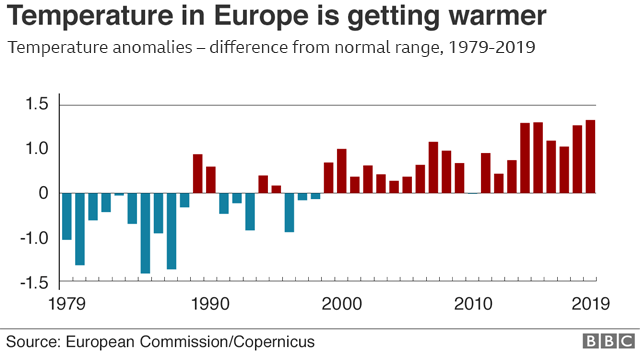
Because as is well known, there are no European temperature records from before 1979. The Central England Temperature record going back to 1659 is an urban myth.
Jeez.
Saturday, 18 April 2020
When is climate change not climate change?
From Eco Watch:
Global heating from the climate crisis is rapidly melting glaciers, revealing treasures underneath the ice from long ago. Retreating ice in Norway recently revealed a lost Viking mountain pass strewn with artifacts, according to a new study in the journal Antiquity.
The first discovery was an 1,800 year-old shirt, which spurred researchers to find what else was strewn around near the Lendbreen ice patch outside the alpine village of Lom, Norway. That led to an exploration that uncovered artifacts dating back to the late Roman Iron Age all the way to the Viking Age and the medieval period, as Scientific American reported.
When the researchers traipsed into the abandoned mountain pass that is rapidly melting due to warmer global temperatures, they found broken sleds, tools and other elements of daily life dating back nearly 2,000 years, as National Geographic reported...
They found nearly 1,000 artifacts that run the gamut from 300 to 1500 AD, with the mountain pass falling out of use after the Black Death in the medieval period. The researchers used carbon dating to pinpoint when each finding is from. The bulk of what they collected comes from the period around 1000 AD at the height of the Viking era when trade and mobility in the region peaked, according to The Guardian.
"A lost mountain pass melting out of the ice is a dream discovery for us glacial archaeologists," said Pilø in a statement, as CNN reported. "In such passes, past travelers left behind lots of artifacts, frozen in time by the ice..."
"Oh no", thinks the unsuspecting reader, "we're all going to drown".
Or are we?
The finds actually remind us that there was a Roman Warm Period and a Mediæval Warm Period (referred to here as 'the Viking era'), when the pass was relatively ice-free and in regular use. They didn't magically drop stuff under the ice, they dropped stuff and the ice then formed and covered it. Which is why the oldest finds are from the RWP and most are from the MWP:
The first discovery was an 1,800 year-old shirt... That led to an exploration that uncovered artifacts dating back to the late Roman Iron Age...
The bulk of what they collected comes from the period around 1000 AD at the height of the Viking era when trade and mobility in the region peaked... with the mountain pass falling out of use after the Black Death in the medieval period.
Now we are in the Modern Warm Period (they seem to come along every thousand years or so) and the ice has retreated to where it was during the earlier warm periods. The Black Death happened around the same time as (and was possibly caused by) the end of the MWP and the onset of the Little Ice Age. But it was the LIA that put an end to the use of this mountain pass, not the Black Death. There are plenty of e.g. Roman roads/routes that have been constantly in use for thousands of years, uninterrupted by the Black Death.
H/t Ben Pile