
From the FT:
The UK government is set to book a loss of around £800m from its largest privatisation of student loans, raising questions over the valuation of tens of billions of pounds of remaining graduate debt.
The controversial sale of a batch of student loans this week is expected to raise around £1.7bn, according to a Financial Times analysis of deal documentation.
The loans, which had a face value of £3.7bn last year, are part of a total of £43bn in loans made to students up to 2012, which are currently on government books valued at just under £30bn, according to the Department of Education’s latest published accounts, as of the end of March this year.
Greater minds than mine have already pointed out, if the government happy to sell on the loans for 40p in the £1* to loan sharks, why not just give ex-students the right to buy back their own debts for 40p in the £1, i.e. pay 40% of the face value in cash and have the rest written off?
An MSP (can't track down who) said that this would be a good kind of "Right to Buy".
Bonus:
Barclays is acting as sole arranger for the sale, alongside bookrunners Credit Suisse, Lloyds and JPMorgan. Rothschild is acting as an independent adviser to the government.
If ex-students buy back their own loans, these middlemen won't earn their juicy commissions.
* The number is not plucked out of thin air, the loans being sold that cheaply are ones originally made between 2002 and 2006, so it's unlikely they'll ever be fully repaid. But let's gloss over that bit.
Friday, 1 December 2017
A version of "Right to Buy" we can fully support
Monday, 11 September 2017
Fun Online Polls: Student immigration numbers, hurricanes and man-made climate change.
The results to last fortnight's Fun Online Poll were as follows:
Should students from overseas be included in the UK's maximum immigration target?
Yes - 58%
No - 21%
We shouldn't have a maximum immigration target - 8%
I'm heartily indifferent to the whole topic - 12%
Other, please specify - 2%
That answers that question, I suppose. But as the official target is a made-up number which the UK government cannot achieve and has no intention of achieving anyway (it's an 'aspiration' rather than a 'target) and the net number of overseas students who overstay is apparently quiet small, I don't suppose it matters.
------------------------------
It's hurricane season again. It's been pretty bad this year in the Caribbean/Gulf of Mexico and this year's monsoon was pretty hefty in India.
I'm pleasantly surprised to see that many (possibly most) BBC articles or news bulletins don't contain the solemn statement that the severity of hurricanes has increased because of man-made climate change.
So that's this week's Fun Online Poll:
Are this year's strong hurricanes and Indian monsoon evidence of man-made climate change?
Vote here or use the widget in the sidebar.
Tuesday, 29 August 2017
Fun Online Polls: Protest marches; students and immigration targets
The results to last fortnight's Fun Online Poll were as follows:
What's the correct response if people with whom you disagree organise a march?
Ignore them, hope they get bored and perhaps organise your own event a few weeks later - 84%
Organise a violent counter-protest to ensure maximum coverage and encourage them even more - 9%
Other, please specify - 8%
Good, I was with the majority on that. People don't seem to get the "other, please specify" option, it got eight votes but only three people left comments, heck knows what the other five were voting for.
Thanks to everybody who took part (104 voters).
---------------------------------------------
Just to change the topic a bit, let's look at the whole mess that Ms T May is making of immigration targets, in particular how students from overseas fit in.
The debate seems to jumble three topics;
a) whether we should have immigration targets at all (large employers against; nationalists and low-paid Brits in favour);
b) whether overseas students should be included. One the one hand, they pay top dollar to be here and should be welcomed like any other high-spending tourists IMHO; on the other, some of them overstay their visas (again, whether that is acceptable or not depends on your point of view)
c) what the actual figure for over-stayers is. For some reason the lefties (see linked article from NS) seem to think that the fact that the true number of over-stayers is very small (allegedly) is a reason to exclude them. Logic fail - if the number is so small, it doesn't matter whether they are included or not (seeing as the official target is a made-up number to start with, which the Tories have no intention of actually delivering).
So that's this week's Fun Online Poll.
Vote here or use the widget in the sidebar.
Tuesday, 25 July 2017
Fun Online Polls: Influencing the goverment; HS2 vs student loan write-offs.
The results from last week's Fun Online Poll were as follows:
Which is the better strategy for influencing Labour or Tory policies?
Join the party and agitate from the inside - 11%
Vote for another party whose policies you agree with - 89%
Which is what I have observed. I'm relieved that so many agree. Thanks to all who took part.
-------------------------------------------------------------------
I know that it is silly to match receipts from particular taxes with particular items of government expenditure, but it's sometimes useful to do so to put things into perspective.
Last week, the Transport Secretary insisted that the white elephant vanity HS2 railway line would come in on time and on budget at £55.7 billion.
Most are agreed it is a waste of taxpayers' money, of benefit only to a very few (the construction companies and some landowners) and nobody in his right mind believes it will be on time and on budget. In fact, we know it won't, because the original budget set in 2010 was £32.7 billion.
The Tories then went on the offensive and claimed that it would "cost" £100 billion to write off student debts, forcing the innumerate Labour education spokeswoman into an embarrassing and unnecessary climb down. That's the nominal amount of the outstanding loans, but they will be collected via a graduate tax and lots will be written off, so what's relevant here is the net present value of the tax receipts, let's call it £60 billion in round figures.
So you could argue, future graduates are paying 9% extra income tax on income above the £21,000 allowance in order to fund HS2.
Which I hope most would agree is completely bonkers.
So that's this week's Fun Online Poll.
Vote here or use the widget in the sidebar.
Tuesday, 18 July 2017
Student fee and loan wibble.
From Fullfact.org:
"[The Labour] party’s education spokesman has admitted that the tuition fees policy has a £100 billion…She has admitted that there is a £100 billion black hole in Labour's student fees policy.”
Damian Green MP, 12 July 2017
Fullfact then explains that the net cost will be a lot lower than that, bearing in mind write offs and so on.
The point is surely that student loans are the worst of both worlds, they have the characteristics of loans and of a super-tax on income (9% of income over £21,000 p.a.). So writing them off or down is not an upfront 'cost' the government but a reduction in tax revenues.
The best way of looking at govt tax revenues is the annual amount. The best summary I have found is by the Institute for Fiscal Studies. Page 22 suggests that expected the extra revenues from the 9% surcharge will be about £6 billion a year, covering two-thirds of the £9.7 billion upfront cash cost of higher education. That's not nothing, but only about one per cent of UK govt revenues/spending.
Here comes the real wibble, and article by somebody from the (right wing/supposedly free market) Institute for Economic Affairs in City AM:
Moreover, deeply regressive policies are finding their way back to popular status, with very little push back. That Labour has been able to get away with linking the abolition of tuition fees to “fairness” is shameful; expecting workers on the minimum wage to subsidise students attending Oxbridge – whose career prospects are likely to earn them a much higher salary in the future – is anything but fair.
As our Lord and Saviour said on Twitter recently:

Education is A Good Thing (up to a point, I'm not talking about Mickey Mouse degrees) for the nation as a whole, so I've no objection to the taxpayer chipping in as that's the best way of ensuring that everybody has an equal-ish chance in life. It's like a non-cash citizen's dividend. We'd expect those that go to uni to end up earning more than they otherwise, that's sort of the whole point isn't it?
For sure, the 7% of kids who went to private school have a better chance of going to uni, but is that really so unfair? Their parents have waived a state education place (cost to the taxpayer approx. £70,000 per child) and they have pissed well over £100,000 up the private school wall, most of that goes to teachers or suppliers, so that generates a minimum of £40,000 in tax revenues per child (PAYE, irrecoverable VAT, corporation tax on suppiers etc), more than enough to cover the cost of a normal three year degree of £35,000-ish.
The only reason for tuition fees is that government spending on higher education has remained constant but student numbers have doubled. If we halved them again and kept net spending constant, we wouldn't need tuition fees. If student numbers were slimmed down to a sensible level, say 25% of school leavers, and all private school kids went to uni, that still means that one-in-five state schools kids would get to go to uni "for free" on top of the "free" state education they have already enjoyed [sic].
If their is any "unfairness", it is that a lot of the 'professions' are really just leeching off the fact that the government lays down stupid and complicated rules which the layman can't fathom. So we have lawyers (if judges weren't so useless, we wouldn't need barristers on £5,000 a day to explain things to them), auditors etc. What they earn is just rent, it is an appropriation of other people's earnings or wealth without adding to it.
And as it happens, most people in these 'professions' went to uni and have a very middle class background. I'd be all in favour of stemming this flow of rent by radically simplifying the rules, having judges who apply common sense and abolishing the audit requirement. Or imposing price caps on them. Or failing that, subjecting their income to a higher tax rate. In an ideal world there's be a flat income tax of no more than 20%, but a higher rate of 50% for the 'professions' seems fair and reasonable to me.
That levels out the only real unfairness that I can see - that some high earners didn't go to uni, or did but do something useful and made their way in the productive economy. So a tax on the 'professions' would be a much more sophisticated version of the graduate tax.
And with a Citizen's Income system, student maintenance grants/loans would not be an issue, of course students would get it.
Sorted.
Friday, 24 April 2015
"Cockroaches in infested halls refuse to pay rent until the students are gone"
From The Evening Standard:
Cockroaches and mice living in halls infested with students are refusing to pay their rent until accommodation managers get rid of the humans. Cockroaches living in Dinwiddy House and Paul Robeson House have been plagued by students from the School of Oriental and African Studies in their flats since the start of term in September.
The halls, located in Pentonville Road, Kings Cross, are managed by university accommodation providers Sanctuary and cost £147.28 a week to rent a single en-suite room. "The only way we can afford this is by sharing thousands to a room," added a spokesroach. "The mice chip in what they can, but that isn't much."
One cockroach claims that 38 of his friends and family were killed by a student in an unprovoked, sustained and violent attack on her first day of moving in, while mice scuttling in the kitchens have complained about being tricked into ingesting poisonous substances which have led to dozens of slow, lingering deaths.
Monday, 3 June 2013
Fun Online Polls: Chemtrails; a Master's degree in Irish history
The response to last week's Fun Online Poll was as follows:
Chemtrails: do commercial airlines deliberately add barium, aluminium, polymers and radioactive material to their fuel for Purposes Unknown?
No - 67%
Yes - 26%
Other, please specify - 7%
The number of people who reckoned there might be something in this had hovered at about ten per cent until a couple of days ago, but then there was a late surge of people voting "Yes", as a result of which we ended up with a good turnout of 138 votes. Maybe somebody linked to it or something?
Thanks to everybody who took part. As it happens, I bumped into the man behind Critical Thinking (who had inspired the poll) on Saturday, I put the various objections to him but he was having none of it and came up with plausible counter-counter-arguments to all my counter-arguments. I'm still not convinced, but hey.
Top comment, from the poll:
Spadger: The only fuel additive I know of is a commercial product called Prist, added to standard Jet-a1 fuel for small high flying jets, such as the Lear, it is an anti-icing and biolgical inhibitor for cladosprium resinaii, the so called diesel bug used to prevent fuel filters from blocking by ice or bugs.
It is Diethelene glycol monomethyl ether. I don't know what happens when you burn it, it can be purchased ready mixed but as airliners don't need it and as it is an added cost, don't use it. I have only ever used it in aerosol can form, added when refuelling.
----------------------------------------------
My oldest son has finished his degree in economics at Munich (nope, he did not manage to convert them all the Georgism) and now wants to tack on a Master's degree in early 20th century Irish history.
He's been offered places at Dublin, Belfast and Coleraine (County Derry), the tuition fees seem to be the same in all three places and he asked me which place sounds best. I don't have a clue about universities in general or Ireland in particular, so I'll throw this one open to the crowd.
Cast your vote here, preferably with an explanation of points for or against.
Saturday, 17 December 2011
Youth unemployment (2)
Here's the chart that the BBC published recently:  The fall between 1993 and 2000 looks very dramatic, as is the fact that youth unemployment has doubled again since then.
I can't find a similarly handy chart for students, but statistics for each year since 1994-95 are available here. I used the figure for full-time undergraduate HE students and we can tack on the figures for 1992 to 1994 from Figure 2.1 here. We can then chuck both sets of figures on one chart to see the total number of young people not in work (whether 'unemployed' or 'full time student'). Is the suspicion that UK governments tried to get as many young people as possible into university in order to mask rising youth unemployment justified?
As ever, it's make up your own mind* time (click to enlarge):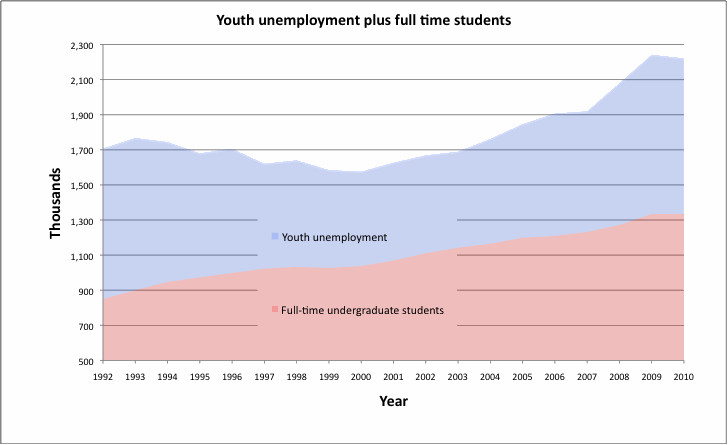 * The question is, do we go with the official version that youth unemployment fell by 400,000 between 1993 and 2000 and then rose by 500,000 by 2010, or did it in fact only fall by 200,000 between 1993 and 2000 and then rise by 600,000?
Wednesday, 12 October 2011
Cunning Plan # 9,837
Ho hum, I like to muse on different topics simultaneously, and every know and then, I manage to join the dots...
Exhibit One
With longer life expectancies, we are going to have to increase the state retirement age. But as the PPI pointed out (in 2003): "The gap in average life expectancy at birth between manual men and non-manual men is 3.5 years; for women it is 2.8 years". So increasing the retirement age by three years would, for example, reduce the amount of pension collected by blue collar workers by a larger fraction that for white collar.
I'm a simplification campaigner, so I believe in having a Citizen's Pension, call it £8,000 a year for sake of argument, with the same retirement age for men and women, but this doesn't address the difference in life-expectancy.
Exhibit Two
The whole question on who should pay university tuition fees - the students themselves (to be repaid with an ugly mixture of interest and higher tax rates) or the taxpayer in general (education is a merit good, borderline public good)?
It appears that universities operating in a free market would charge around £8,000 a year, i.e. that's the price they can charge and the price which covers their running costs per student.
Exhibit Three
Who should pay for student's living costs - the students themselves (again, via stupid loans collected by charging them a higher tax rate as above) or the taxpayer generally?
Again, as a simplification campaigner, I believe in scrapping all these separate benefits, like unemployment benefit, incapacity benefit, New Enterprise Allowance, statutory maternity pay, tax credits, even the tax-free personal allowance and replacing the whole lot with a Citizen's Income, which for working age people would be £4,000 a year for sake of argument.
Cunning Plan #9,837
How about reducing tuition fees by half, to £12,000 for a three year course, which is a perfectly manageable sum for qualified students to pay off, by working part-time, cadging off their parents, taking out a short term loan from a bank etc, and the taxpayer funding the other half - but as a quid pro quo, people who have enjoyed a university education (whether they benefit from it financially is their problem, not mine) have a retirement age which is three years more than those who haven't?
In other words, they get an extra £4,000 a year from the taxpayer for three years when they are young (towards their tuition fees), but when they are old, they can't shift from Citizen's Income of £4,000 a year to £8,000 a year until three years later, so they lose the same amount later on?
This is the sort of thing you can apply retrospectively, i.e. the government could merrily announce that the retirement age is to be increased to 66 by 2016. After that, they could announce that the retirement age for people who studied at the taxpayer's expense (i.e. before 1998) are going to have a retirement age of 67,68, 69 and so on, but non-students can stick with a retirement age of 66 for a much longer period.
At first, this will only affect a few people, because decades ago, only a tenth of people went to university, so the overall effect will not be very dramatic.
Disclaimer: yes I did go to university, I've got two degrees, I contributed towards my fees (long story) and I didn't get a student grant but it was still clearly being subsidised, so if they slap me with an extra three years before I can claim my pension, I'd be willing to accept that as some sort of rough justice - all I'd be losing is £12,000 difference between CP and CI (which is a small fraction of the extra I've earned because of having been to university).
Tuesday, 16 August 2011
Hmm, but what will happen next year?
From The Metro:
The ‘popularity and desirability’ of some universities has led to increased living costs for students who are already facing higher tuition fees, a study has found.
The cost of a room in a shared house has risen by three per cent to £67.11 a week on average across Britain, according to the agency's study. But rental costs in Leamington Spa, close to Warwick University, jumped by 16 per cent this year, while student rents in Edinburgh rose by eight per cent and Cardiff, York and Reading all saw a six per cent rise.
The results of the survey come days after university guide Push found that student debts for this year’s freshers will rise by 6.4 per cent to an average of £26,100 on graduation, with London students owing the most. This year’s intake will be the last to escape top-up fees of up to £9,000 per year, which will be introduced in 2012.
You'd expect rents to increase slightly this year, because anybody who can bring forward his studies by a year saves £6,000* fees (do you avoid them for the whole three years, or just the first?), so there'll be a slight increase in the number of students (there is a practical upper limit), so what's going to happen to rents next year, when the number of students falls again and the number of students who stay living with their parents increases?
* Tuition fees are already about £3,000 a year.
Tuesday, 7 June 2011
NIMBYs Of The Week
See if you can guess the town concerned before you click through to the article:
MORE than 140 businesses have objected to controversial plans to put students' flats on St Clement’s car park... The developer, the Watkin Jones Group, is planning to build accommodation blocks to house 141 students on the ... Council-owned car park.
If the £8m scheme gets approval from city council planners only 76 of the 120 car parking spaces will remain. Digging work has already started to find out if there are any significant archaeological remains on the site and traders say this has already taken up about 30 spaces next to Angel Meadow...
The council has pledged to look for a location for a temporary car park while the work takes place but so far a suitable place has not been found. Clinton Pugh, who runs Kazbar, Cafe CoCo and Cafe Tarifa in Cowley Road, fears businesses would be forced to shut.
He said: "Earlier this week the city council received objections from 145 businesses in St Clement’s, Cowley Road, High Street, King Edward Street and Turl Street. If this scheme goes ahead, there will be nowhere for shoppers to park for about a year and it will be incredibly damaging to shops and businesses in St Clement’s and the surrounding area.
"This plan will destroy St Clement’s and without a shadow of a doubt it will put some traders out of business. I personally knocked on the door of lots of shops and the traders I spoke to were happy to add their objections."
Spotter's Badge: Angry People In Local Newspapers.
Tuesday, 14 December 2010
Tuition fees
Saw this article over at the Daily Mail
As this relates specifically to my own career I thought I'd make comment.
I started out my career path to accountancy as a university student, got myself a small pile of debt circa £13k as I was lucky enough to start under the previous system before fees were upped from £1.2k to £3k.
Having seen this announcement of plans by Deloitte to start looking more into apprenticeship style placements I have to commend them for bringing this route to a professional career more into the mainstream. As a college student I studied A-Level accountancy and I have to say that this route was almost totally glossed over when discussions were had over next steps and university courses are actively encouraged. So like a good little sheep at the time I applied for university, was accepted and subsequently studied the first two years of my course.
It was only after beginning my work placement year that I discovered not only can you obtain the professional qualification on a purely work-based learning basis but that the ACCA also have a degree partnership with the Oxford Brookes University by which you turn 9/14 exams into a BSc via two written pieces of work.
To put this into perspective it is possible to achieve much the same end result but one route potentially puts you into ~£40,000 debt!! where the other you earn a wage and obtain a degree just the same. The additional fee on top of the professional exams you ask? £95!!
After working for a year in a small accountancy practice along with discovering this information, my own decision was as a rational human being to ditch university and head out into the world of work. Instead of increasing my student debt I am now already paying it off whilst continuing along the path to obtaining my exact same end result.
I hope that more people will do the same.
Tuesday, 30 November 2010
University Tuition Fee Tomfoolery
David Cameron, in today's Evening Standard:
Unlike our predecessors we won't patronise the public by pretending there's a bottomless pit of money we can dig into. There isn't, and that means difficult choices need to be made. The public subsidy for higher education is massive — this year the Government will spend around £5 billion on teaching costs in English higher education alone — and in the context of spending restraint it cannot be exempted from cuts.
A lot has been said in recent weeks about what is in the interests of students, but this government is also responsible for the interests of taxpayers — and at a time of real financial hardship, a time when we have no choice but to make cuts across public spending, I don't believe it is right that we ask those on low incomes to pay taxes to prop up an unaffordable university funding system that they are not benefiting from directly.
Seems fair enough to me, sure, soften the blow by paying students a grant or a Citizen's Income, give them low interest loans so that people from poor families etc can go (which is sort of what the Lib-Cons are doing).
But that '£5 billion' figure reminds me of something else I read today, what was it.... ah... here we go:
Schools, employers, the food and drink industry and communities themselves are being urged to do their bit to make the nation healthier. Ministers said they wanted to tap into the potential of all of society in setting out their public health plans. Projects being promoted include everything from bike training in schools to voluntary cuts in salt and fat content by food manufacturers.
Councils will get a ring fenced budget to coordinate the push in England. This pot, which will be handed over from the NHS, will total at least £4bn a year from 2013, the government's public health white paper, Healthy Lives, Healthy People, said. It will be accompanied by the transfer of local public health directors from the NHS to local government.
It's funny how the money has run out for something half-way sensible, like universities, but there's plenty left over for these entirely made up schemes. As a taxpayer, I'm not keen on over-subsidising other people's university courses, but I'd rather pay for that (which does have some overall benefit to society, and maybe my kids will benefit from it) than this quango shite which is clearly of no benefit at all to anybody apart from the quangocrats running the scheme.
Wednesday, 10 November 2010

Friday, 5 November 2010
More Student Loan Repayment Fun
In order to illustrate the interaction of the three main rules that apply to Student Loan Repayments (interest rate increases with salary; repayments increase with salary and any balance outstanding is written off after thirty years) which I wrote about yesterday evening, I have done two charts in Excel.
The first shows the total nominal repayments - and it is quite clear that somebody who leaves university and earns £45,000 a year for the next thirty years pays a lot more in pure cash terms than anybody else. So the Torygraph wails that Mr £45,000 pays more than Mr £20,000; and Ed Miliband wails that Mr £45,000 pays more than Mr £100,000.  But just adding up the total cash repayments is quite misleading, as it does not take the time value of money into account. It is about as informative as saying that if you repay your mortgage over ten years (which I once did, just for a giggle), you pay a lot less interest than if you repay it over twenty years. Of course you do - it's like saying it's cheaper to rent a car for a week than for two weeks.
It is far more realistic to discount the future repayments at (say) 5%, which shows that the three rules, as bizarre as they might be, sort of arrive at an equitable result - provided you are part of the flabby LibLabConsensus that finds it sensible for the taxpayer to lend people money to go to university who don't even expect to earn £21,000 at the end of it, and then write off the debt after thirty years. 
Thursday, 4 November 2010
Daily Telegraph: Lying or stupid?
I'm surprised that Leg-Iron fell for this clap trap in The Daily Telegraph:
Successful graduates will be penalised most by the introduction of variable interest rates on the loans they take out to pay the fees. A university leaver with debts of £30,000 and an annual salary of £45,000 will have to pay back about £2,160 a year for about 30 years. Someone earning £25,000 will have to pay £360 a year for the same debts because a lower interest rate will be applied.
Nope, nothing of the sort. The new rules appear to be (see Box here):
a) The nominal interest rate is set at nil if you earn less than £21,000; at the rate of inflation if you earn £21,000, with a sliding scale so that if you earn over £41,000, the rate is (inflation + 3%).
b) Your repayments (interest and principal) are set at 9% of your gross salary minus £21,000,
c) After thirty years, any residual debt is written off.
It is rules b) and c) which make all the difference - not rule a).
a) If our higher earner on £45,000 a year repays £2,160 a year for thirty years to repay an initial debt of £30,000, the implied nominal interest rate is 5.92% using Excel's IRR function. If we assume 3% inflation + 3%, that means the real interest cost is in fact 3% (by definition). This is the worst-of-all worlds in terms of the total nominal repayments - if you earned less, some of the principal would still be outstanding after thirty years and would be waived (see c); and if you earned more, you would repay the debt much more quickly.
b) So if you earn £45,000, your repayments are (£45,000 - £21,000) x 9% = £2,160. If you earn £25,000, your repayments are (£25,000 - £21,000) x 9% = £360, which tallies with what the article says.
c) Which is why the graduate who earns £25,000 would only repay part of the interest and none of the principal on the debt, whereas the higher earner would repay it in full.
This is just the way the rules work. It has little to do with the interest rates.
-------------------------------------------
Of course, the lefties are just as bad - they claim that a higher earner would pay less interest than somebody on a lower salary. Also complete bollocks:
For sure - somebody who earns £100,000 a year graduating with £30,000 of student debt would repay (£100,000 - £21,000) x 9% = £7,110 a year for five years and that would be the end of that, so he pays about £5,550 in nominal interest (in real terms, he pays half that).
A median earner on £25,000 would pay £360 x 30 years = £10,800 nominal interest (nothing in real terms) - and also gets the £30,000 waiver after thirty years. And if somebody earns less than that - let's say £21,000 - he pays neither interest nor principal - and also gets the £30,000 waiver after thirty years. The lefties focus on the £10,800 nominal interest paid by Mr £25,000 and gloss over the 'waiving' bit at the end.
But... the worst case scenario is somebody who earns £45,000 a year - he repays (£45,000 - £21,000) x 9% = £2,160 a year but this is just enough to cover the interest and principal repayments over thirty years and his nominal interest cost is £34,800 (in real terms, he pays half that), so yes, he pays more than the person who earns £100,000.
------------------------------------------
So in a bizarre sort of way, they are both complaining about the same thing: The Torygraph is complaining that Mr £45,000 pays more than Mr £21,000 - and Red Ed is complaining that Mr £45,000 pays more than Mr £100,000!!
------------------------------------------
The way round all this would be to go back to the old ways and have fixed repayment terms that treat everybody the same - if you have a student loan, the interest rate is set at below market rates (let's say inflation) and the fixed repayment term is ten years (or whatever it was, I know I paid off a student loan after 1996 from the interest I was earning on the proceeds of the loan that I had promptly paid into an ISA account).
In olden times, your income was irrelevant in calculating the amount repaid each month, unless you earned very little (less than £12,000 a year, from memory). Once I'm in charge, the repayments will simply deducted from your Citizen's Income, of course, to save 'churn'.
Monday, 18 October 2010
Fun Online Polls: Tuition Fees & Price Comparison Websites
The results for last week's Fun Online Polls were as follows:
What is the best way of funding university degrees?
Tuition fees. 66%
General taxation. 28%
Other. Please specify. 6%
What is the least bad way of making university degrees affordable? (multiple choices allowed)
Low interest loans to students. 48%
Allowing students to claim the same benefits as other unemployed. 28%
A cap on tuition fees. 8%
Expecting employers to pay better salaries to graduates. 10%
A graduate tax. 8%
Other. Please specify. 20%
So that's that settled then. We could have saved Lord Browne all the bother.
PS - I'm a bit disappointed that "allowing students to claim the same benefits as other unemployed" was relatively unpopular. For a start, a full student grant is pretty much the same in cash terms as Jobseeker's Allowance at 18 - 24 year old rates. The unemployed can claim Council Tax Benefit and students can claim Council Tax exemptions, so that more or less cancels out (the landlord just hikes the rent by the amount of Council Tax which the occupants would otherwise be paying).
The big differences are:
i. The unemployed can claim Housing Benefit but students only get low-interest loans.
ii. If students can go out and work part time, they lose little or none of their grant, but the unemployed lose most of their benefits if they find a part time job.
iii. Benefits are means tested on the basis of the household in which the unemployed person lives; student grants are means-tested on the basis of their parents' income, even if they no longer live with them.
I see absolutely no reason why one group should be treated more or less favourably than the other, and seeing as ultimately the differences aren't that huge, I see no reason why they shouldn't both get the same, i.e. a Citizen's Income (how high or low that should be is a separate debate).
I won't mind too much having to shell out tuition fees when the times comes, but the idea that my kids will get less from the government if they are studying that if they are just hanging about is rather galling.
Just sayin', is all.
---------------------------------
Out of interest, which is your favourite financial price comparison website? Do not deduct marks for how annoying their television advertising is!
Vote here or use the widget in the sidebar.
Tuesday, 12 October 2010
Fun Online Polls: Homosexuality & Tuition Fees
Thanks to everybody who took part in last week's Fun Online Poll:
Gays and lesbians: in your experience, are there...
More gay men than lesbian women? - 67%
About the same number of each? - 19%
More lesbian women than gay men? - 14%
Which is what I have observed myself. As to why I asked, see here.
----------------------------------
It now appears that the Lib Cons have made up their minds on university funding, although cowards that they are, they had to cloak the whole thing in the respectability of an independent review (headed, incidentally, by Lord Browne, who happens to be gay).
So this week's Fun Online Poll is a two-parter; what is the best way of funding university degrees and what is the least bad way of subsidising them?
Vote here and here or use the widgets in the side bar.
Monday, 11 October 2010
Tuition Fee Fun
From today's Evening Standard (I couldn't find the article online):
Students also fear they will be forced to drop subjects they love in favour of "sensible" courses that will guarantee them a job.
Max Waldron, 22, from Wimbledon is studying for a masters at King's after graduating in politics from Durham. He lives at home with his mother and is already £30,000 in debt. He said: "The days when students chose a subject they loved and enjoyed their degrees are long gone. There is already a sense of urgency now about getting a job. If fees go up, people will have to take jobs they don't like just to pay off their loans."
Mr Wain added: "Fewer people will do subjects like classics and philosophy, which give you transferable skills but not necessarily a definite job. People will get more single-minded and will have to decide what career they want at the age of 18."
PS, before I'm accused of being a hypocrite or laughing at the misfortunes of others, let me also inform you that my parents took me out of school at 15 (for no particular reason - I had a free place at a good grammar school) and I didn't go to university - to do an eminently "sensible" course which I hoped would guarantee me a job - until I had saved up for my own living costs at the age of 27 (although to be fair the fees were subsidised).
I then did two further professional qualifications, which I paid for out of my own money, and finished off by doing a degree part time/in the evenings while doing a full time job (again, to be fair, the fees for this were subsidised. I paid about £125 for each 'unit', i.e. 12 lectures, 12 tutorials and one exam or marked coursework).
Friday, 16 July 2010
(Non) Graduate Tax
I am not Mark Wadsworth
If Wince wants a tax on the incomes of graduates in perpetuity to 'pay for their ed-yew-kay-shun' a few choices will present themselves (as eny fule no):
1. Will any of my children who don't have a degree get a tax cut in perpetuity?
2. If they take and pass a degree I will recommend that they emigrate
3. I might decided to take them out of the state funded sector after 'A' Levels and do my own finance package to pay for a degree at a competing university elsewhere in the World.
4. ...and since I have a business I might be able to claim that as a business expense as I think you can for 'staff training'. Anyway I'd hide it somehow.
5. I might think that as it's now taxed, education is clearly a Bad Thing and get them to work (cleaning chimneys?) from age 16.
6. ...any more ideas?
(Personally I think all this is Just Wince politicking, the silly old fool. Move along. Nothing to see here)
Lola