
Follow-up to Bayard's post of Wednesday. For sure, some Climate Scientists exaggerate or make false claims, but that doesn't invalidate anything.
For example, nuclear power stations 'work'. They use uranium etc to produce electricity, fact. They also appear to be profitable. We can argue - quite reasonably - about the risks and costs of pollution, safety, terrorism, nuclear proliferation, decommissioning and long term storage etc, but those are not nuclear science issues. Just because some politicians make outlandish claims like them producing "electricity too cheap to meter" does not invalidate the science.
My big bugbear with Climate Science is that it is based on the bald claim that Earth's surface is 33 degrees warmer than it should be based on incoming sunlight.
Therefore, they say, something must be 'trapping' thermal energy in the atmosphere; and that something is Greenhouse Gases (which sometimes includes water vapour and sometimes doesn't, depending what point they are trying to make).
And therefore, if Greenhouse Gases at 'pre-industrial levels' cause 33 degrees of warming, any increase in them must cause more warming (whether linear, logarithmic of geometric). And as a matter of fact, things have warmed up a bit since the end of the Little Ice Age.
The 33 degree claim was originally made, and the calculation explained by Hansen back in the late 1980s and has been Climate Gospel ever since, completely unquestioned, even by many Climate Deniers. Some Climate Deniers have put forward other explanations, some with good pointers, none watertight and some pretty flaky.
So how do they calculate the 33 degrees? By comparing half an apple with an imaginary pear is how. Here are the workings (refer to Stefan-Boltzmann equation to convert between temperature and W/m2):
 What are the obvious flaws here?
- They take clouds into account when calculating weighted average albedo of Earth's effective surface (which means that part of the surface that can absorb radiation FROM and emit it directly TO space - oceans/land under cloud cover simply can't, so can be ignored here) , which reduces solar radiation IN to 238 W/m2, but then just ignore clouds from there on.
- They then assume that solar radiation IN is all absorbed by oceans/land. Nonsense, over half is absorbed by clouds, less than half by oceans/land.
- The actual question is: is the effective surface at the right temperature to emit this much (238 W/m2 on average) back to space?
- They skip these this question, come in at a tangent and say that a black body (an imaginary pear) would have to be 255K to emit as much radiation as the effective surface absorbs in solar radiation IN (this is true).
- They compare this with part of the effective surface (half an apple) which has an average temp of 288K (also true), discrepancy = 33 degrees (mathematically correct).
- They then put forward an explanation for the 33 degree difference - it's Greenhouse Gases, and the rest is all built on that - all the pseudo-scientific mumbo jumbo like "radiative forcing" and "fluxes" and "effective emitting altitude" and "atmospheric windows" and "computer models" and "positive feedbacks" until your head spins (I know what these all mean. They are all dead ends or working backwards from the wrong answer).
Why not compare a whole apple with a whole apple, and take all its physical properties into account, in particular the low temperature and emissivity of clouds? That seems to be a lot more rigorous to me, so you should consider clouds and cloud-free oceans/land separately when looking at solar radiation IN and LW emissions OUT.
This is the more scientific approach. For sure, it's all rounded and mid-points of estimates and so on, but it follows the general idea based on what information I can glean. I could keep digging and add more and more lines and home in ever closer to an even more robust answer:
 If you do it properly, you find that Earth's oceans/land and the clouds above them are the right temperature to emit as much LW radiation as they absorb in solar radiation. Sure, the sea level surface is warmer than in the pseudo-scientific calculation, but so what? An aluminium frying pan in the sunshine gets warmer than the pavement it is resting on, that has largely to do with aluminium's lower emissivity (plus/minus dozens of other adjustments). Look at the whole of the real apple and all its physical properties, not just a part of it/them!
[Completely different sets of rules apply when considering the temperature difference between sea level and clouds - the gravity-induced lapse rate; latent heat of evaporation; reflection and re-emittance of of LW between the two; dew points at different absolute humidity, temperature, density and pressure etc etc. I can't cover all that here, but it is irrelevant to the actual topic of 'what gets to space'].
Therefore, I conclude, unless somebody can show why their approach is better than mine, I refuse to believe anything based on the 33 degree Greenhouse Effect, because there simply ISN'T ONE IN THE FIRST PLACE!!
Bonus: the above approach neatly explains the alleged Greenhouse Effect (or absence thereof) on Venus and Mars, regardless of the fact that their atmospheres are nearly 100% CO2 - it's the clouds (or absence thereof) wot dunnit.
Caveats:
- I have only been looking into this for two-and-a-half years and 'only' did O-level physics forty years ago, so clearly have plenty more to learn.
- Has the climate changed in many areas over the last century? It would appear so. Has it remained surprisingly stable in other areas? It would appear so. If the clever scientists with their millions of measurements say it has changed, then probably it has. Just because nobody is sure of the real reason doesn't mean that we should latch on to one particular explanation, especially if it based on pseudo-science.
- There are lots environmental, economic and political reasons for using less fossil fuels, sure, but those are quite different topics. For example, I'm against nuclear weapons, but that does NOT mean that I don't accept the science of nuclear fission. I am, in fact, broadly in favour of reducing fossil fuel use for precisely those reasons, but that does NOT mean that I just blindly accept their pseudo-science. We bribe our kids with the promise of Xmas presents for good behaviour; we don't waffle on about Santa's Naughty List. Treat people like adults and they might just behave like adults.
Saturday, 23 July 2022
Why "Climate Science" isn't really science (2)
Monday, 11 July 2022
Light passing through a pane, a prism and two prisms
Follow up to this post to illustrate the contradictions.
Light going through a pane is easy enough. All colours are bent by the same amount on entering and on leaving, and what goes in = what goes out, which is parallel to the original ray. We also know that light takes the fastest route from source to image (like the "dog crossing a canal diagonally to chase prey some way from the canal bank" problem in maths):
 Light going through a prism is easy enough as well. For some reason, longer wavelengths (red) are bent less than shorter ones (blue). You can read this one in either direction - either white light source on left being split into colours, or different colours coming in from the right to merge to white light on the way out (left):
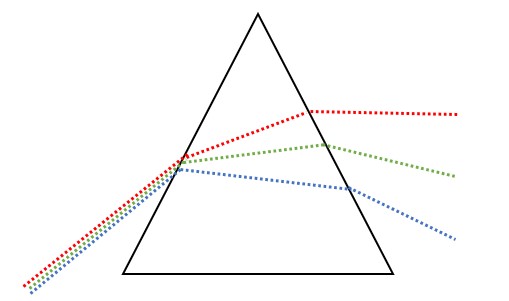 If you add a second prism flipped upside down with a gap between them, the second prism reverses everything back into a single white beam on the way out - the two prisms act much like a single pane with an air gap in it.
But what if the two prisms are polished so perfectly that they are flat on a molecular level, and you move the two prisms closer and closer together until they are 100% touching (forming a single pane). We know what goes in, we know what comes out.
- Do the different colours take different paths (as shown in my rather badly drawn picture below), or do they "realise" that they are being tricked and "decide" that they are actually dealing with a single pane and then all follow the same path (as in the first picture)?
- They can't "know" what to do on entering until they leave again. Or does the fact that light, in its own reference frame, travels instantaneously (if something is travelling at the speed of light, then time slows to zero), play a part here?
- The assumption that they all take the fastest route (in our frame of reference) from source to image breaks down, as the red light (being least bent) must have travelled a shorter distance through the glass than green and blue.
- Or, as I asked last time, is there some mysterious quantum mechanics effect happening on the tiniest level incomprehensible to humans, which means that each photon takes every possible path, has a "think" when it's got there and then "chooses" the best one?

Thursday, 7 July 2022
"Refraction of Light through Rectangular Glass Slab and Glass Prism"
Here is a great explanation of how to work out what comes out of the other side of the slab/prism. I'm sure he'd get top marks in an exam, and on the basis of 'what goes in and what comes out' we know the result is correct.
But what nobody can explain - a proper physics prof. explains the head scratching in this video - are the striking differences, which appear to be down to weird quantum stuff and the wave/particle duality. And he's just talking about light travelling more slowly through a pane, he doesn't mention prisms (I don't think).
The different behaviour through a pane vs through a prism struck me a couple of days ago. The unanswered questions are:
1. UPDATE. Following Mark In Mayenne's comment, I rethought this one, there is no contradication here.
2. Why is light at all wavelengths bent in the same direction when it enters and leaves the pane (so barring reflections and imperfections in the glass, the image is the same on the other side), but is split by frequency when it enters and leaves the prism (so the image is quite different on the other side)?
3. What would an observer see if he were inside the pane/prism, looking towards the light source? At that stage, the light hasn't been bent again on leaving and the light doesn't 'know' if it's in a pane or in a prism? Would the light be split by frequency or not?
4. With a pane of glass, you can assume that the light behaves as a wave. When waves in water reach shallower or deeper water, they change direction in predictable fashion (regardless of frequency - all light travels at the same speed). Does light behave as particles in a prism? Does that go some way towards explaining the differences?
5. It's a like the 'dog running from A to B via swimming a canal diagonally' problem in maths. The actual calculation is heinously complicated (simplified version here, and even that one stumped a lot of people), but somehow dogs seem to be able to do this calculation by instinct and choose the fastest route.
With a pane of glass, the light (which travels more slowly through glass) takes the route from source to end point along the route that takes the shortest possible time, almost as if it 'knows', or as if takes every single possible route and then 'chooses' the fastest. So does the light somehow already 'know' whether it's entered a pane or a prism as soon as it enters?
The joy of all this is that nobody seems to know and probably never will, least of all me. I guess that's quantum mechanics for you. Light is inanimate, it surely can't 'know' anything, can it..?
Something to think about when you're at a boring event or you can't get to sleep.
Sunday, 8 May 2022
Debunking the other cornerstone of AGW Theory
I have shown that the logic behind so-called '33 degree greenhouse effect' is naive to the point of being meaningless and/or deliberately totally misleading.
Now let's look at the next layer of piffle; Kiehl and Trembert's so-called 'energy budget':
 Most of the numbers in the arrows are correctly calculated and pointing in the right direction, if looked at in isolation. But because the logic is so deeply flawed and so many facts are simply ignored, we end up with the smoking gun arrow showing 324 W/m2 of 'back radiation' from 'greenhouse gases' (bottom left hand corner).
They are claiming that tiny amounts of CO2 and gaseous water vapour (about 0.04% and 0.2% of the atmosphere respectively) magically shine as brightly as the Sun, if measured in terms of energy being radiated to Earth. That in itself must strike the casual observer as completely fatuous.
The 324 W/m2 is just a balancing figure that doesn't exist in the real world! You can't just add and subtract 'radiation' at different intensities and frequencies anwyay, it is far more complicated than that, energy can take or be stored as lots of different types. Imagine a 3,000 Watt three-bar electric fire versus a 3,000 Watt radio transmitter!
That diagram is so appalling, that it's easier starting from scratch than it is correcting all the compounding errors, so here goes.
1. Basic physics says that the surface of a planet will warm (or cool) to the temperature at which is emits as much radiation to space as it receives from space i.e. from the Sun, that is its 'effective temperature'. Let's look at solar radiation first. We are looking at 'effective temperature' so we also have to look at how much solar radiation the 'effective surface' (this is my term, I haven't found an official one) absorbs. We do this by reducing solar radiation by the amount reflected (by the 'albedo'). The weighted average albedo of the effective surface (2/3 clouds and 1/3 oceans/land) is 0.3, so we reduce incoming solar from 342 W/m2 to 239 W/m2:
 This number has been estimated at anything between 235 W/m2 and 240 W/m2. This seems sensible, and nobody has seriously challenged it.
2. OK, the effective surface is absorbing 235 - 240 W/m2. Does it also emit 235 - 240 W/m2? If not, then we need an explanation (most people will assume 'greenhouse gases'). If it does, then AGW Theory is yet again debunked, and we don't need any further explanations.
We know the temperature and emissivity of both parts of the effective surface (oceans/land and clouds - typical altitude 5km and typical temp 255K), so we can calculate how much radiation each is emitting using Stefan-Boltzmann formula and adjusting for emissivity. We then take a weighted average of both, and... what a coincidence... the effective surface's emissions are slap bang in the middle of the 235 - 240 W/m2 range. Yes, there are approximations and uncertainties involved at all stages of this, many of which would cancel out:
 That's it, that's the end of the line. There is yet again no big discrepancy that needs to be explained. Solar energy absorbed = infra red energy emitted. If you just make realistic assumptions and apply basic physics (and completely ignore 'back radiation' and 'greenhouse gases'), you end up with a very plausible result. Therefore, your assumptions must be broadly correct (or at least, there's no evidence to say that they aren't). It seems to me impossible to splice in the 324 W/m2 of 'back radiation' without ending up with a nonsensical answer. End of.
3. What is really interesting is what goes on inside the amber box. That is heinously complicated and nobody really knows. Maybe the ficitious 324 W/m2 is in there somewhere, so it's relevant to the temperature balance between oceans/land and clouds, but it is irrelevant to what gets to space and so shouldn't be on the first chart at all.
Why does only one-tenth of 1% of 1% of all water on Earth end up as clouds? Why are clouds at the altitude they are? You'd need several degrees in physics and meteorology to even be able to understand the ground rules, let alone put numbers on the effects and work out how all they all interact (positive and negative feedbacks etc) to end up with things the way they are.
Needless to say, plenty of people have looked at isolated aspects of this; but even if somebody every aspect and explained how it all interacts, it I doubt I'd be able to follow and would end up taking it on trust. But no 'climate scientist' cares about these finer details, so why should I?
Saturday, 23 April 2022
Out of the frying pan... into the Greenhouse Effect
As is well known, if the sun is shining brightly enough, you can leave a frying pan in the sun and then fry an egg on it. This works because aluminium (and many other metals) have low emissivity.
And as we also know, if an object is absorbing solar radiation, it will warm up until it is emitting the same amount of radiation energy (ignoring other forms of heat transfer, like conduction etc).
If an object (the frying pan) has low emissivity, then for a given temperature, it is emitting less radiation than another object at the same temperature with higher or 100% emissivity (a 'blackbody'). But the amount of radiation absorbed, and hence emitted, is fixed, so the frying pan reaches a higher temperature (than the ground around it) before it reaches a steady-state temperature where solar radiation absorbed = radiation emitted.
So on a hot sunny day, ground-level air temp might be 'only' 30 degrees C, but the frying pan is more than 100 degrees C, hot enough to fry an egg. Key thing to note is that ground and pan are emitting a similar amount of radiation. Which is why you have to calibrate an IR thermometer to take the emissivity of the object into account - if you don't, it will tell you that the ground and the pan are a similar temperature.
[OK, I have glossed over the fact that pans are shiny and therefore reflect more, and absorb less, radiation, which would make them cooler than their surroundings, all things being equal. But all things are not equal and the lower emissivity outweighs the albedo effect.]
I doubt any Physics Denier looks at the hot frying pan and concludes that, because the frying pan's actual temperature is greater than the hypothetical temperature it would be if it were a 'blackbody' with 100% emissivity, this must be an example of the Greenhouse Effect.
-------------------------------
But this is the best (and basically only) evidence they have that there is a 33 degree Greenhouse Effect in the first place - they just compare actual temperature of oceans and land with hypothetical surface temperature of a planet with a uniform surface, all at the same temperature and with 100% emissivity. This is like saying that clouds, oceans and land are a) all at the same temperature and b) have 100% emissivity. Neither a) nor b) is correct, it would be fairer to say a) and b) are deliberately misleading assumptions. (Cooler clouds are missing from the first part of the comparison, this is a key part of the deceit).
There's a handy overview of cloud properties here. Note that typical or average cloud emissivity is given as 0.7. If you pick sensible estimates for typical or average cloud-top altitude, then you know how much warmer it is at sea level than at the cloud-tops (this relationship is fixed by the gravito-thermal effect), then you can work out total radiation emitted to space by clouds and cloud-free oceans/land respectively (oceans/land beneath clouds can't emit radiation directly to space, the clouds absorb, reflect and re-emit it). Take a weighted average and hey presto, the overall radiation being emitted spacewards is the same as incoming solar.
Therefore, no radiation is being blocked or absorbed by 'Greenhouse Gases'; there is no 'Greenhouse Effect' (unless you see clouds as acting like the roof of a greenhouse, which I suppose they do) and there is nothing left to explain away.
When I did the workings, I calculated that clouds emit about 47% of the total radiation reaching space, the 'official' estimate of "cloud amount weighted by the cloud IR emissivity" is 50%, so I'm not far off and I suspect the 50% is rounded.
And of course, clouds are nebulous. Nobody will ever know what the exact thickness; altitude; temperature; emissivity; or radiation being emitted by any particular cloud or cloud-top at any particular moment are. How many measurements would you have to make to have a fair picture of the global average over a year? Dunno, even though it wouldn't be that difficult with enough weather balloons and satellites.
But it's easy enough choosing reasonable mid-points of ranges of estimates to get sensible answers, and until these time wasters dedicate a bit of time and effort on doing actual observations of all these variables (and proving me wildly wrong), I will assume that they simply don't want to know (and they can't).
Saturday, 9 April 2022
Dear Climate Scientists - do clouds exist or not?
From NASA's Clouds and radiation factsheet:
The study of clouds, where they occur, and their characteristics, play a key role in the understanding of climate change.
Clouds exist. Before we worry about marginal changes, it's good to understand how clouds anchor sea level air temperature at average 288K.
The Earth's climate system constantly adjusts in a way that tends toward maintaining a balance between the energy that reaches the Earth from the sun and the energy that goes from Earth back out to space.
Correct and agreed.
Energy goes back to space from the Earth system in two ways: reflection and emission.
Part of the solar energy that comes to Earth is reflected back out to space in the same, short wavelengths in which it came to Earth. The fraction of solar energy that is reflected back to space is called the albedo. Different parts of the Earth have different albedos. For example, ocean surfaces and rain forests have low albedos, which means that they reflect only a small portion of the sun's energy. Deserts, ice, and clouds, however, have high albedos; they reflect a large portion of the sun's energy.
Over the whole surface of the Earth, about 30 percent of incoming solar energy is reflected back to space.
So clouds exist for the purpose of calculating albedo and are considered part of the surface. They said it themselves. Good. The 30% reflected is the weighted average of the two-thirds of the surface covered by clouds with albedo 40% and one third cloud-free oceans/land with albedo 10%. This leaves an average of 238 W/m2 being absorbed by clouds and cloud-free ocean/land. All coherent so far.
The top of the cloud is usually colder than the Earth's surface. Hence, if a cloud is introduced into a previously clear sky, the cold cloud top will reduce the longwave emission to space, and (disregarding the cloud albedo forcing for the moment) energy will be trapped beneath the cloud top. This trapped energy will increase the temperature of the Earth's surface and atmosphere until the longwave emission to space once again balances the incoming absorbed shortwave radiation.
Clouds still exist. The conclusion is broadly correct, but the explanation is poor or downright misleading. Clouds are emitting what LW they can. The upper layers that emit to space are average 255K (sea level temp 288K minus 5km altitude x 6.5 K/km lapse rate) and, given their emissivity of 70%, emit 168 W/m2. Note that the word or concept "emissivity" is not mentioned in the article. As they say themselves, there is a separate system that operates as between clouds and sea level; what we are looking at is the 238 W/m2 from the Sun and back out to Space.
So for every three square metres of Earth (two of clouds, one of cloud-free) total outgoing LW has to be 3 x 238 W/m2 = 714 W total. The two m2 covered by clouds are emitting 2 x 168 W = 336 W/m2. That means the remaining 1 m2 of cloud-free oceans/land has to be emitting 714 - 336 = 378 W.
[Analogy: it's like inflating an air matress with a puncture. Cloud-free areas are the puncture. The smaller the puncture a) the higher the air pressure in the mattress and b) the faster the air will leak through the puncture.]
Ocean/land emissivity is 96%, so working backwards from 378 W/m2, the temperature of ocean/land has to be 288K to bring up the overall average LW emitted to space of 238 W/m2. 168 + 168 + 378 = 714. The upwards LW absorbed by clouds and LW reflected or re-emitted down again by clouds need not be taken into account again - we have an answer that ties in with actual observed temperatures and the gravity-induced lapse rate of 6.5 K/km (assuming average cloud-top altitude to be 5km, which seems about right). The reflected and re-emitted LW is already part of that overall balance.
And now, having shown that the entire Greenhouse Effect can be attributed to clouds (once you factor in emissivity, which Climate Scientists seldom do), clouds leave the stage and The Villain makes a surprise entrance:
However, a significant fraction of the longwave radiation emitted by the surface is absorbed by trace gases in the air. This heats the air and causes it to radiate energy both out to space and back toward the Earth's surface.
So, let's ascribe the effect of clouds to 'trace gases', shall we? Ignore the big white fluffy things that cover two thirds of the surface and reflect and absorb significant amounts or radiation in both directions and provably cause the entire Greenhouse Effect? Let's focus on invisible trace gases?
To ram the deception home, they conclude with this:
The overall effect of all clouds together is that the Earth's surface is cooler than it would be if the atmosphere had no clouds.
That is quite simply untrue, they've provided all the evidence to show that clouds have - surprisingly perhaps - a warming effect at sea level. See the calculation a few paragraphs above. Which is why the Greenhouse Effect is much smaller in cloud-free deserts, non-existent on Mars (a few scattered dust clouds) and very high on Venus (100% covered in very thick, very high clouds). But let's not drag real life into this, eh? Let's live in our logic-free fantasty world?
Conclusion: the Climate Science argument is there is a 33 degree Greenhouse Effect (sort of true) and that this is down to 'trace gases'. Therefore, more trace gases = more Greenhouse Effect. But the Greenhouse Effect is actually a measurement problem - on closer inspection either there isn't one at all and/or it is down to clouds. Therefore trace gases have zero impact, therefore any change in trace gas levels can't have any effect either. I have no strong opinion on what causes small fluctiatons in surface temperatures over longer periods, but it sure as heck ain't changes in the amount of trace gases.
Monday, 4 April 2022
The Diagonal Comparisons that underpin 'Climate Science'
The very cornerstones of Climate Science are two Diagonal Comparisons.
[To give examples:
FAIR COMPARISON: women's current wages in the UK -vs- men's current wages for similar work. This means something. If there is a difference, it needs explaining and maybe action needs to be take to level up.
DIAGONAL COMPARISON: nominal women office workers' wages in 1982, not adjusted for inflation -vs- Premier League footballer wages in 2022. That would be a Diagonal Comparison and of no relevance to anything.
You have to measure and calculate things as accurately as you can and then compare like-with-like i.e. changing only one variable, or as few as possible.]
Unfortunately for me, you have to be well versed in the Climate Science belief system (which I am) to know what I am talking about. And most of the well versed are of course Believers who just believe it all; the Sceptics mainly quibble about the finer details and don't look at the very foundations of the belief system. I can but do my best...
-----------------------------------------
Here goes. From RealClimate.org ("Climate Science from Climate Scientists...").
Diagonal Comparison #1
33 ºC is the difference between the mean surface air temperature of the planet and the blackbody radiating temperature (i.e. the temperature a blackbody would need to radiate at to be in equilibrium with the incoming solar radiation given an albedo of about 0.3) ["effective temperature"]. So far so good.
They define the true meaning of "effective temperature" in parentheses and correctly calculate Earth's effective temperature at 255K. What they do not mention is that this a hypothetical value only! It is only a very rough indicator of the actual temperature of "the surface" (cloud cover and that part of the sea and land that is cloud-free)*. You have to make several adjustments to work out the likely actual temperature.
They pretend however that 255K is a reliable indicator. They then compare 255K with the measured temperature of one part of "the surface" (at sea level) which is 288K. Hey presto, 33 degrees of Greenhouse Effect!
The 255K calculation, while correct in an abstract sense, is wildly inappropriate as a basis for comparison. Unless you are prepared to make on one or more of the assumptions that:
- clouds, sea and land have 100% emissivity. This is the biggest one, the overall weighted average is more like 80% emissivity, which would get adjusted effective temp. up to about 270K (reducing the 33 degrees by half). That's why they refer obliquely to 'blackbody' (which means 100% emissivity) instead of saying "assuming 100% emissivity", which would have people asking "Why assume anything? Why not use actual emissivity if it's relevant?", and/or
- clouds are at sea level, and/or
- clouds, sea and land are all the same temperature, and/or
- clouds, sea and land are all a uniform pale blue colour with albedo 0.3, and/or
- clouds don't exist (even though their existence reduces albedo and hence reduces effective temp), and/or
- there is no lapse rate, and/or
- without 'greenhouse gases' there would be no lapse rate, and/or
- without 'greenhouse gases' there would be less cloud cover and/or cloud altitude would be lower.
None of those assumptions is in any way correct, they are all reality-denying nonsense.
The obvious flaw with the 255K vs 288K comparison is that it not comparing like-with-like. Effective temperature is based on "what does the planet look like from space?". What you see from space is two-thirds clouds with patches of cloud-free sea or land. So when you calculate effective temperature, you are estimating the weighted average temperature of "what you can see from space", which is clouds and cloud-free sea and land.
The bulk of sea and land which are beneath clouds most of the time are irrelevant here, they could be pitch-black in colour with zero albedo - that wouldn't affect albedo as seen from space so doesn't affect our spaceman's calculation of effective temperature. Similarly, our spaceman can't tell through his telescope whether the white patches are clouds (low emissivity; unknown altitude) or snow fields (high emissivity) so he knows that his calculation of a planet's effective temperature is only a rough guide to its actual temperature.
The sea surface and land are of course warmer than clouds, because clouds are higher up. So what the Climate Scientists are really saying is "a warm thing is warmer than the average of the warm thing and some cold things, especially if you calculate the average using the wrong method." which is meaningless and irrelevant.
In the table at the end of this post, I refer to the effective temperature calculated the wrong way as B, line 28. Measured sea level temperature is A, line 288.
-----------------------------------------
This is NOT how you work out 'effective temperature' (if you want to get a meaningful answer). What you do is: take emissivity and topography/altitude into account of all the constituent parts (and ignore sea and land that is below clouds - there is separate more or less closed cycle for this) of "the surface"* and work out what temperature all the constituent parts of "the surface" would have to be to emit as much LW radiation to space as they, in total, absorb from the Sun.
This calculation is a bit tricky, but it's easy enough working backwards from actual temperatures and emissivity of the constituent parts of "the surface"* to see if you get the 'right' amount of outgoing LW. This is the the scientific way. You find that clouds, sea and land are at the required temperature/altitude emit, overall and on average, the right amount of LW (E, line 35 - this is the same as absorbed incoming solar radiation, C, line 22).
So there is no discrepancy between actual temperatures and effective temperature, if you calculate effective temperature correctly and make a fair comparison, like-with-like. There is no 33 degree difference to explain away; it's not even 8 degrees, it is +/- nothing. Sea/land surface has to be warmer than expected to emit more LW than first expected to compensate for the fact that clouds are as warm as expected (257K, line 5 vs 255K, line 28) BUT have low emissivity and so emit less LW than first expected. The overs and unders cancel out. So when our spaceman lands and finds that the sea level surface of the planet is warmer or colder than he calculated from afar, he is not too surprised.
Diagonal Comparison #2
While that is one way to assess the strength of the basic greenhouse effect, another one is measure the amount of long wave radiation from the surface that is absorbed in the atmosphere (by greenhouse gases incl. water vapour, clouds, aerosols, etc.). That is currently about 150 W/m2 and would be zero with no greenhouse effect at all.
They are comparing upwelling LW from sea and land, assuming 100% emissivity (D, line 33 = 390 W/m2) with C, line 22, 240 W/m2. There is, unsurprisingly, a 150 W/m2 difference. They say "Look! GHG's are trapping or blocking 40% of outgoing LW. This is what is heating the planet.". To be fair to this lot, they do mention clouds, which are actually responsible for all the absorbing they try to blame on 'Greenhouse Gases'.
Two-thirds of that hypothetical 390 W/m2 LW emitted at sea level (D, line 33 - they should be using 367 W/m2 at line 34, but hey) hits the underside of clouds and is either absorbed by the clouds or reflected back down. What gets to space is the weighted average of what clouds emit upwards and what the cloud-free sea or land emits (E, line 35), which is exactly the same as incoming solar (C, line 22)*.
So again, this is like saying "a warm thing emits more LW than the average LW emitted by the warm thing and some cold things, especially if you overstate the LW emitted by the warm thing and ignore the existence of the cold things" i.e. meaningless and irrelevant.
-----------------------------------------
* I put an asterisk after "the surface" as this is a very important concept. Imagine a freshly made sponge cake, still warm from the oven that has just had some icing applied (I think you are supposed to let the sponge cool down first, but I'm in a hurry... to find an analogy). The main sponge part = sea or land. Two-thirds of the cake's surface is covered in icing = the clouds. "The surface" of the Earth cake is two-thirds icing and one-third exposed sponge. Whatever heat exchange there is between the sponge and icing is irrelevant as far as the outside world (space) is concerned. For the cake to cool down, all that matters is the LW which is emitted by the exposed (non-iced) sponge and the icing. Including the LW radiation hypothetically emitted by the covered part of the sponge is insane and insanely stupid.
On Venus, the high temperature of the sponge (hard surface) is irrelevant as it is all covered with a thick layer of icing (clouds). The temperature of the upper parts of the clouds is pretty much the same as the calculated effective temperature. There is a separate set of rultes to reconcile temperatures as between hard surface and clouds and there is no 'Greenhouse effect', let alone a 'runaway Greenhouse Effect' on Venus. On Mars, there is barely any icing (a few low altitude dust clouds) so although there is more CO2 per m2 on Mars than there is water vapour and CO2 added together on Earth, there is little or no Greenhouse Effect on Mars.
----------------------------------------
Here is my list of assumptions and summary workings in case anybody want to check. This is all the coherent bits of actual information and proper phsyics that I have pieced together from blogs and articles by 'Climate Scientists'. They can't deny that they have said all this, although they do when it suits them.
Click to enlarge/read more clearly.

Sunday, 20 March 2022
Belgian Waffle - the magical properties of CO2
In real life on Earth, the physical layer which absorbs most radiation from the Sun and which also emits most (= a lot more than half) radiation to space is the clouds. So the clouds have to reach a certain temperature dictated by SB-Law, and their actual temperature is higher than that because clouds have significantly less than 100% emissivity. Not uncoincidentally, typical average cloud altitude = effective emitting altitude of 5km (link to article with a classic 'let's ignore clouds and pretend that it's CO2 at work' explanation).
Clouds have to warm up the surrounding air to the same temperature. In turn, the air above and below the clouds is correspondingly cooler or warmer because of the gravito-thermal effect (the trade-off between thermal and potential energy aka the lapse rate, which is g/Cp as adjusted for latent heat of evaporation/condensation). That dictates the air temperature at sea level on Earth.
The extra bit of sunshine that directly hits (and warms) the land or ocean is a side show in these calculations because clouds are constantly moving sideways, evaporating and re-condensing. You do two calculations - what would temperature be with 100% cloud cover and what would temperature be with 0% cloud cover and choose the higher temperature. The air warms up and cools down very slowly and smooths out any extra from direct sunshine. And we have established that the 'greenhouse effect' is much smaller in largely cloud-free areas.
Nobody (apart from me) seems to have bothered doing the calculations, because it would debunk the CO2 theories. The calculations themselves are straightforward, the problem is the values for cloud altitude, thickness, emissivity, they are moving, disappearing and re-forming etc There are no exact or precise answers, it's all ranges, mid-points, averages and estimates. Nonetheless, the general principles are simple enough and we can work backwards from actual, averaged out temperature observations to get values (for altitude, emissivity, temperature, lapse rate etc) that stack up with measurements in real life.
-------------------------------------------
The CO2 theorists tie themselves in knots over this. They have to ignore clouds and reverse engineer an explanation of why CO2 *miraculously* has the same effect as clouds *actually* do. Here is the best they have dreamed up, from astronomie.be (hence the hilarious pun in the title of this article).
Surprisingly, CO2 has another side effect, a cooling effect. Stop yourself, however, if you think this could compensate for global warming. This process has been going on, and has been studied, for a long time already, and clearly, it hasn’t neutralised the warming trend. So, what is going on exactly..?
Carbon dioxide molecules are very efficient at absorbing and re-emitting heat in the form of infrared radiation. In the lower atmosphere, air molecules are tightly packed together, like people at a summer festival, and so the heat that one molecule re-emits is immediately absorbed in the same atmospheric region. This is the greenhouse effect, an overall heating of the troposphere.
The middle atmosphere is much less dense (the middle and upper atmosphere combined only hold 15% of the total mass). Here, the infrared radiation that is re-emitted by CO2 molecules is reabsorbed much less and more radiation escapes out into space. This leads to an overall loss of heat, and thus causes a cooling effect.
Based on these flawed assumptions, you can plot CO2 vs likely temperature thusly:
- No CO2 - no cooling or warming effect;
- Small amount of CO2 - cooling below initial temperature;
- Critical amount of CO2 - no cooling or warming relative to initial temperature;
- More CO2 than that - warming effect relative to initial temperature.
So it would look like this:

To use an analogy, a sheet of normal window glass reflect a tiny bit of light and lets most through - you normally don't notice this when you are looking out of the window by day. If you stack two or three panes of glass, you notice the reflections more. If you stack ten panes of glass, it's like a partially transparent mirror. If you stack twenty panes, you basically have a mirror. What they are saying is that one pane reflects no light at all; a few panes will allow more light through than hits them; if you have 'enough', the two effects cancel out; and if you have more than 'enough', you have a mirror.
There is no such curve for glass (if you plot 'amount of light reflected' vs 'number of panes'), it's an upwards slope and doesn't dip below zero. There is no reason to assume, to the extent that CO2 has any effect whatsoever, that it would be anything other than an upwards slope that doesn't dip below zero.
------------------------------------------
To sum up, air above the clouds (which the CO2 crowd call the 'effective emitting altitude') is cooler than Earth's 'effective temp' (which in practice is the cloud temp, duh, see first paragraphs above) but this is not because the CO2 is Hoovering warmth away into space. It is because the lapse rate works both ways. Below clouds = warmer, above clouds = cooler.
Thursday, 4 November 2021
Calculating the speed of a falling object etc. using the physics approach.
I like doing a bit of mental arithmetic, when I'm in a boring meeting or lying awake at night. A typical challenge is calculating the speed of falling objects; how long it takes them to fall etc. There's one constant, acceleration due to gravity (hereafter abbreviated to 'gravity' for brevity) = 9.8 m/s2 and then you have to work out how to work it out; then remember how to work it out while you actually work it out.
It's surprisingly fiddly, tedious and not much fun. Here's a link to an explanation with an embedded calculator.
It occurred to me this morning that taking the maths approach is a load of bollocks, it's quicker, easier and simply more fun taking the physics approach. You just have to remember a bit of GSCE level physics:
1. Initial potential energy of an object = kinetic energy of the object just as it hits the ground.
2. Potential energy = mass x height x gravity.
3. Kinetic energy = half x mass x velocity squared.
For simplicity, mass is always 1kg so does not appear in the answers (it would cancel out anyway), we're using SI units and we're ignoring air resistance.
Q1: Object is doing 60 m/s when it hits the ground. From what height was it dropped?
A: Closing KE = 1/2 x 60 x 60 = 1,800
∴ Starting PE = 1,800
∴ Starting height = 1,800/9.8 = 183 metres
Q2: An object is dropped from a height of 500 metres,
a) at what speed does it hit the ground
b) how long before it hits the ground?
A: Starting PE = 9.8 x 500 = 4,900
∴ Closing KE = 1/2 x 9,800
∴ Closing velocity squared = 9,800
∴ a) Closing velocity = 99 metres/second
(Calculating square roots made easy here)
∴ b) Time taken to fall (constant acceleration at 9.8 m/s2) = 99/9.8 = 10.1 seconds.
----------------------------------------------------------------------
The old fashioned maths approach is probably better (simpler calculation and more intuitive) if you are told time taken to fall:
Q3: An object falls for five seconds before it hits the ground. From what height was it dropped?
A: Closing velocity = 5 x 9.8 = 49
∴ Average velocity = 1/2 x 49 = 24.5
∴ Height = 5 seconds x 24.5 = 122.5 metres
The physics approach would be:
A: Closing kinetic energy = 1/2 x (5 x *9.8) x (5 x 9.8) (no need to calculate the actual number)
Starting potential energy = closing kinetic energy
Height = starting potential energy ÷ *9.8
∴ Height = 1/2 x 5 x 5 x 9.8 = 122.5 (the *9.8s cancel out)
Both approaches boil down to:
Height = 1/2 x time in seconds squared x gravity, but you'd have to remember this extra equation, so this approach is not advised.
Sunday, 17 October 2021
Why is there no Greenhouse Effect in the desert?
The GHE is calculated by working out the effective/expected temperature of 'the surface' of a planet by just looking at how much radiation it absorb (i.e. incoming solar radiation minus the amount reflected) and plugging the number (240 W/m2 average for Earth) into the clever formula.
The 'surface' means 'whatever the sunshine hits first', which on Earth is mainly clouds; or all clouds in the case of Venus. So you are actually calculating the expected temperature of the clouds; the Alarmist trick is to compare/confuse that 'surface' (from the point of view of incoming radiation) with what we mere mortals consider to the the surface i.e. land and oceans, which are of course a lot warmer because of the gravito-thermal effect (unless you go to the top of Mount Everest, which is above the clouds and hence no GHE there either).
The clever formula works much better when applied to Mars or the Moon, which have little or no clouds. The actual surface temperatures are pretty close to the calculated effective temperatures (if you adjust for solar angle and night-time cooling; but there's also little or no atmosphere so you don't need to worry about warmth being transferred from Equator to Poles or from day side to night side).
Luckily, on Earth there are also places with little or no clouds; they are called deserts. The Sahara straddles the Tropic of Cancer, so it gets peak 1,361 W/m2 sunshine at midday during the summer months. Divide that by the sq root of two to get average during a 12-hour day = 962 W/m2; halve that for the 12-hour night = 481 W/m2; then knock off one-fifth reflected = 385 W/m2.
Plug 385 W/m2 into the formula and you get an expected average temperature of 287K. Deserts have a large diurnal temperature range, just like The Moon (they cool down fast during the night because there is no cloud blanket), of (say) 40 degrees. A typical desert near the equator is just above freezing just before dawn and 40 degrees hotter in the early afternoon, so the average actual temperature is about 293K.
OK, that's six degrees warmer than expected and these are only back of an envelope calculations, but it's nowhere near the much vaunted 33 degree Greenhouse Effect, despite there being more CO2 than average above the Tropics (the troposphere is thickest over The Equator and thinnest over The Poles).
[We could also dispense with the whole concept of averaging sunshine over 24 hours and look at the hypothetical peak radiation of about 1,000 W/m2 at midday in summer, plug that into the formula and we get peak temp of 364K = 91C. Temperatures get nowhere near that, but to the extent they do, that might explain the 6 degree discrepancy?]
The answer to the question in the title is of course "Because there are no bloody clouds over the desert, and the Greenhouse Effect on Venus or Earth is purely down to clouds and their altitude!", just in case you were wondering.
Thursday, 7 October 2021
"Heat rises" and other Alarmist fairy tales...
Sorry to come back to this, but it has been bugging me for days.
Joseph Postma posted a video on YouTube. He is top man and a "climate denier" but he has sadly fallen into the Alarmist traps of:
a) ignoring clouds, and
b) assuming that the Sun warms land and oceans and that they in turn warm the troposphere from below.
So he fights the Physics deniers on their chosen territory, splitting hairs over radiation theory and thermodynamics and so on, all of which are actually largely irrelevant.
I pointed out in the comments how the Greenhouse Effect actually dictates surface temperatures (cloud temp is fixed by sunshine; add on lapse rate x altitude of clouds = surface temperature) and a self-appointed Guardian Of The Galaxy (a True Believer and regular commenter at Science of Doom) tied himself in knots trying to come up with killer arguments. Apart from the usual ad hominems and meaningless jargon/waffle, the best he could come up with was this:
"The Sun heats the Earth and the lower atmosphere is heated by the Earth's surface... No physics supports top down warming when heat naturally rises."
Let's do the last stupid statement first. In everyday life and on a small scale, sure, hot air (from a fire, for example) moves up vertically. That's only because hot air wants to expand, so becomes less dense than the surrounding air, so gravity pulls the denser air down in its place and this in turn pushes up the less dense air. It's the density that is key - you could put a helium balloon in the freezer for a bit, it will still float upwards in much warmer air.
'Heat' itself doesn't rise, and certainly not 'naturally'. 'Heat' doesn't really do anything, it just a measure of thermal energy that moves from a hot object to a cold object. Put some polystyrene between them, hey presto, much less 'heat'.
When hot or warm air rises and expands, its temperature falls. It has the same amount of energy as before, but it gains as much potential energy equal as it loses in thermal energy. That is key to this, the TOTAL energy.
People always forget potential energy (mass x altitude x gravity), because it's not much practical use. You have to convert it to kinetic energy first to be able to harness it, i.e. allow water from a high reservoir to fall through turbines to generate electrical energy.
Now the first stupid statement, "The Sun heats the Earth". The Sun warms up whatever it hits first, which is clouds for two-thirds of sunshine. And it warms them the same as anything else, you can calculate the likely end temperature (effective temperature) using the Stefan-Boltzmann equation and it's around 255K.
Let's say one-third of the sunshine actually directly hits Earth at ground or sea level, plus a bit more that gets through clouds, call it half in total, This is only sufficient to warm land and ocean surface to 234K. That can't warm something that must be at least 255K, can it?
[Question: if 'back radiation', which is emitted in all directions, can significantly increase the temperature of the land and ocean surface below it, why doesn't it increase the temperature of clouds above it by a similar amount? As a result of which they'd all evaporate?]
Third stupid statement: "The lower atmosphere is heated by the Earth's surface". They are to all intents and purposes the same temperature and are both warm for the same reason.
What actually happens is that clouds are a certain altitude and the Sun warms them to a certain temperature, which of course warms the surrounding air to the same temperature. Clouds are high up, so that air also has a lot of potential energy. Energy likes to spread out evenly, so the air lower down, which has less or no potential energy, has more thermal energy to balance it out.
That PE - TE trade-off is the whole basis for the dry lapse rate, which = gravity ÷ specific heat capacity, and is observed in real life. The Gas Laws just show that low and high temperatures will never equalise. Pressure falls faster than density as you go up, so temperatures have to fall as well as you go up. Temperature is proportional to pressure ÷ density all the way up.
To use a simple maths analogy, Dave is six inches taller than Jack; Jack is six inches shorter than Dave. That doesn't tell us how tall either is. If I tell you the height of one, then you know the height of the other.
The lapse rate also works in both directions; cloud temp is fixed and surface temp is simply cloud temp + their altitude x lapse rate. It would be one heck of a series of coincidences if it worked the other way round and the surface temperature magically adjusted itself to be whatever is required to give a cloud temperature that is exactly what you would expect if you calculated cloud temperature on the basis of the sunshine they receive.
The Guardian Of The Galaxy then played what he thought was another trump card, saying that clouds are below freezing (duh, I kept saying that) and so they can't warm the land or ocean surface. It's not as simple as "clouds warm the surface", it's to do with energy (in all its forms) trying to spread itself out as evenly as possible. I think the fancy term is 'entropy'.
And doesn't this nuke the Alarmist claim that radiation from cold things (CO2) makes a warm thing (the surface) even warmer? As any fule kno, CO2 absorbs/emits radiation mainly at 15 microns, if you plug that into Wien's Displacement Law, that's equivalent to radiation from a blackbody at about 200K (minus 73C).
---------------------------------------------------------
Is this really so difficult to understand?
Is there a proper physicist who can see a flaw in this logic - the approach reconciles even better on Venus with 100% cloud cover so we don't need to make adjustments for that sunshine which directly hits the land or ocean surface like on Earth. If surface temperatures there were purely due to 'back radiation', its atmosphere would have to amplify upwelling surface radiation several hundred times over. Our Alarmist twat insisted, unprompted by me, that "Radiative fluxes do not add, they average" which is not only contradicts his whole thesis (that 'back radiation' multiplies itself) but is complete bollocks anyway, radiation is far more complicated than that.
Monday, 13 September 2021
Why are clouds at that particular altitude?
If you round up two-thirds cloud cover to 100% cloud cover and assume they have an albedo of 0.3, then the real reason for the apparent 33 degree Greenhouse Effect is immediately obvious, as I explained a month ago.
The next question to be answered is, why do clouds form so that the average altitude of their upper surface (the surface which absorbs and is warmed by solar radiation) is at about 5 km* (with a resulting sea level temperature of 288K)? Why not 4 km or 10 km? I've struggled with this for the past month, and, much head scratching, calculating, sketching and Bingling later, what it boils down to is as follows:
* Clearly, cloud cover is not 100% at 5 km and clouds don't have an alebdo of 0.3. Cloud cover is about two-thirds; their upper surface is higher than 5 km (call it 7 km); and clouds have an albedo of 0.4. But if you do a weighted average altitude and albedo of 'what the sunshine hits first' it's 5 km and 0.3.
1. The dew point of the water vapour in any 'parcel' of air depends on three variables. For a start let's focus on i. air temperature and ii. air density/pressure. We'll get back to variable iii. Relative Humidity later, You can merge ii. and iii. into one variable called 'partial water vapour pressure', but it's easier to treat them separately:
For a given R.H., in warm air, water vapour is likely to stay as a gas; in cold air it is more likely to condense and fall as rain. There's a narrow range of temperatures where it remains as tiny droplets which remain suspended in the air:
 2. For a given R.H., if air has low pressure/density, the water vapour is more likely to remain as vapour. If it's high pressure/density, it is more likely to condense and fall as rain:
 3. We can put those two together into a table of all possible temperature/pressure combinations.
Some vapour in the air will condense into tiny droplets, small enough to stay suspended and form clouds. Only those clouds which happen to form at the altitude where that particular temperature-pressure combination is in the white band will remain as clouds. So they could be low and warm or cold and high: 4. But the upper surfaces of clouds tend towards the same temperature because they absorb solar radiation. With an albedo of 0.3, they will reach an average temperature of 255K (average of day and night). So they mainly form at the altitude where the pressure/density is such that they fall into the white 'just right' band. Any higher, they will evaporate again, any lower and they will condense and fall as rain:
 5. OK, so some clouds have formed at the 'right' altitude and are stable for now. We know the temperature of their upper surface, and that that temperature plus altitude x lapse rate (also known) determines sea level temperature.
But wouldn't this be positive feedback? Higher clouds = warmer surface = overall warmer atmosphere = atmosphere expands verrtically = higher clouds? For example, the whole tropsphere over the Equator and Tropics is twice as high as over the Poles, with a correspondingly higher 'right' cloud altitude.
What sets the upper limit..?
 6. The upper limit is set by the third main factor for determining dew point - Relative Humidity. It is chaotic and dynamic but self-correcting. If the clouds are too high, so is sea level temperature, which leads to more evaporation, higher R.H. and higher R.H. means lower clouds again, and vice versa:
 7. Some clouds will form at the 'Goldilocks' altitude where the resulting sea level temperature generates enough R.H. to maintain the clouds at that particular altitude. This is arrived at by trial and error, and while the precise calculations are beyond human comprehension, clouds do it for us by simply following basic laws of physics until they 'get it right':
 8. Finally, you end up with what you expect to see. Sea level temperature 288K; clear air up to a certain altitude (too warm for clouds to form); a layer of clouds 1 or 2 km thick (the 'Goldilocks altitude'); above that clear air again (the pressure/density is so low that clouds evaporate again). Clearly, this is weather, so these are not exact values. They are all constantly overshooting in both directions, but it all oscillates around some sort of equilibrium and averages out.
 9. What other evidence to we have to support this, apart from it matching up to observations and being entirely consistent with basic physics and everything else in the overall theory?
a. All I can think of for now is that areas with higher R.H. tend to have lower clouds (as you would expect. If there's more water vapour it's more likely to condense at a lower altitude) and their sea level temperature tends to be a bit lower (lower cloud altitude means the difference in temperature between upper surface of clouds and sea level is lower, as there are fewer km to multiply by lapse rate) than in drier areas.
b. Higher R.H. and lower clouds also mean a much smaller day-night ('diurnal') temperature range - water vapour is good at holding on to thermal energy and the lower clouds are good at reflecting upwelling IR back down to sea level in the night time. This is also observed in real life.
c. Venus and Mars follow exactly the same pattern, even though their atmospheres are nearly 100% CO2 and other 'greenhouse gases'.
Wednesday, 26 May 2021
"pV = nRT"
Alarmists and Physics Deniers don't actually know what this equation signifies and make themselves look silly by trotting it out as if it somehow supports Alarmist Theory and/or debunks the Gravito-Thermal Effect.
Nothing of the sort. There's a full explanation and worked example at ChemGuide.co.uk. This is basic first year level GCSE Physics and nothing controversial.
-------------------------------------
Let's apply it to typical temp, pressure, density at sea level:
Pressure = 101,325 Pa
Volume = 1 m3
Mass of air in 1 m3 at 'standard temperature and pressure' = 1.227 kg
n = number of moles of gas in 1 m3 = mass/m3 divided by molecular mass of 'air', which is 29g/mole
R = universal gas constant* = 8.31441 J/K/mol
Temp = 288K
Stick in the numbers on the right hand side, 1,227/29 x 8.31441 x 288 = 101,314. Close enough to 101,325!
------------------------------------
Now we've got the hang of it, what's the likely temperature at 10 km altitude?
Wiki tells us that pressure up there is 26,300 Pa, density is 416 g/m3.
The left hand side is 26,300 x 1 = 26,300
The right hand side is 416/29 x 8.31441 x T = 119.3 x T
So 119.3 T = 26,300; and T = 26,300/119.3 = 220K
Which is exactly what the blue line on Wiki's chart - and real life measurement - show. Wiki's chart is what you get if you just start by assuming ever increasing density in a gravitational/acclerating field and working from there (see diagram 5).
In fact, you can assume constant density, desnity which increases linearly or geometrically as you go down, there would still be a similar profile with increasing pressure and hence temperature towards the surface. Basic maths. Any other outcome is mathematically impossible unless you assume that density increases with height at an implausible rate (in which case, what happens at the top?).
------------------------------------
* Keen-eyed readers will know that this is Avogadro's number x Boltzmann's constant.
Saturday, 22 May 2021
Let's see if Harry Dale Huffman's approach works with Titan
Titan is my new favourite moon/planet. It orbits Saturn, is a bit bigger than our Moon, and has an atmosphere that is strikingly similar to Earth's - it's mainly N2, with 5.65% CH4 to spice things up - with a surface pressure 1.48 times as much as Earth's surface pressure.
Harry Dale Huffman pointed out that comparing the surface temperatures of Venus with the surface temperature of Earth 288K is a diagonal comparison. Venus' surface temperature is ~737K, largely because atmospheric pressure is 92.1 times as much as on Earth. A direct comparison is the temperature of Venus' atmosphere at the altitude where atmospheric pressure happens to be equal to Earth's surface pressure versus Earth's surface temperature, so we compare 338K with 288K.
Then you just adjust Venus' temperature down to compensate for the fact it is nearer the Sun and the solar radiation it gets is more intense. The adjustment factor is the fourth root of (2,601 W/m2 ÷ 1,361 W/m2) = 1.91 ^ 0.25 = 1.176*. Divide 338K by 1.176 = 287.4K, that's as close to 288K as makes no difference, job's a good 'un.
HDH does not claim to be able to explain why this is so (see discussion here), but that's just how science works. First step is observe stuff, recognise clear patterns, and then you try and work out why. His guess appears to be that you can ignore a planet's albedo when looking at temperatures, because higher temperature causes clouds; clouds increase the albedo; thus reducing incoming solar radiation; which would reduce the temperature. So we would end up in a circular calculation. Or something like that.
-------------------------------------------------
OK, let's strap on our space suits, fire up the rockets and head off to Titan. Temperature at the surface is measured/estimated to be 93.7K. It receives 14.8 W/m2 solar radiation (same as Saturn, but knock off 0.8% because it is in Saturn's shadow 0.8% of the time and add on 0.08 W/m2 which Titan receives from Saturn itself).
Let's adjust Earth's surface temp (288K) down using the same method as above: 288K x ((1,361 W/m2 ÷ 14.8 W/m2)^0.25) = 93K. That's pretty close to 93.7K!
However... HDH's direct comparison method is the temperature on Titan at the altitude where pressure = Earth's surface pressure versus Earth's surface temperature, which happens to be at ~8 km. With a lapse rate of ~0.5 K/km, the temperature there is ~89.7K, against our predicted 93K. So it's ~3 degrees cooler than predicted by HDH's approach, which is still close enough, I think.
Which all demonstrates that a planet's albedo and the precise composition of its atmosphere are probably irrelevant, and whether or not the constituent gases can 'trap' radiation is almost certainly less than irrelevant.
-------------------------------------------------
* The short cut is divide distances from the Sun and take the square root = (149.6m km ÷ 108.2m km) ^ 0.25 = 1.176.
Tuesday, 4 May 2021
AGW theory is based on two blatant 'diagonal comparisons' (Part 2)
In Part 1 I showed how they use a sneaky 'diagonal comparison' (i.e. they don't compare like-with-like) to create the illusion that Earth is warmer than it should be. Part 1 covers the balance between Earth's system and the Sun/outer space.
Then there's what goes in within the Earth's system itself. The other sneaky thing they do is to say that the atmosphere is far warmer than it is, it's just a straight lie. From NASA's Earth Factsheet:
Terrestrial Atmosphere
Surface pressure: 1014 mb
Surface density: 1.217 kg/m3
Scale height: 8.5 km
Total mass of atmosphere: 5.1 x 10¹⁸ kg
Total mass of hydrosphere: 1.4 x 10²¹ kg
Average temperature: 288 K (15 C)
Say what?
Imagine you are asked to measure the average temperature of the water in a deep lake. If you just take the surface temperature, you might get ~288K. But that's not the average temperature of the all the water in the lake. By and large it gets colder as you go down, so the true average is much lower.
The reverse applies in the troposphere (the lowest ~11km of the atmosphere). This is the bit we are interested. It's where the weather happens and the layer which warms and cools the surface.
It gets cooler as you go up, so if you only measure the temperature in the warmest layer, at or slightly above sea-level (where most measuring stations are), you will get an artificially high average temperature (i.e. ~288K).
~288K is fair estimate of the average surface temperature, but that's something completely different to the average temperature of the air in the troposphere. That's a lot colder. If you take a fair sample of readings at all altitudes, you would get ~255K, which is not uncoincidentally the temperature we expect from looking at the Earth vs Sun/outer space balance. See also Climatologists are Flat Earthers.
The vertical temperature gradient is no mystery. Basic maths, a rudimentary understanding of the Gas Laws and common sense (principles and worked example) tell us that it must be warmer than the ~255K average at sea level and colder than the ~255K average at the top of the tropopause. They worked this out in the 19th century and it was part of normal physics textbooks until a few decades ago. There's a given amount of thermal energy, and gravity and the Gas Laws constantly recycle it downwards.
The precise temperature gradient (aka 'lapse rate') is primarily the trade off between thermal energy (temperature) and potential energy (altitude). We all know that warm air cools as it rises. Energy cannot be created or destroyed, so what happens to the 'lost' thermal energy? Easy - air loses thermal energy as it rises... and gains potential energy. The reverse happens with Chinook and Föhn winds (Föhn is German word, pronounced 'fern' and is also the name for a hand-held hair dryer), when falling air warms up. So the lapse rate = gravity ÷ the specific heat capacity of 'air'.
(The lapse rate is reduced by the latent heat of evaporation, which has the opposite effect. The surface is cooled when water evaporates, the latent heat manifests itself again higher up when water vapour condenses. The latent heat in one gram of water vapour is enough to warm a cubic metre of air by about 2 degrees, it's a lot.)
------------------------------------------
The AGW theorists make great play of the fact that Earth's surface (being ~288K, not ~255K) radiates ~390 W/m2 but only ~240 W/m2 gets to space. They claim that the missing ~150 W/m2 is trapped by 'greenhouse gases'. This is part of Diagonal Comparison #1. Two-thirds of the surface doesn't radiate directly to space because it's covered by clouds; some of the surface radiation is reflected back down (in a quite literal sense, like clouds reflecting visible light) and the clouds themselves emit the required ~165 W/m2 to space. The average emitted to space ≈ 240 W/m2, which is what Earth receives from the Sun.
The AGW steamroller never stops of course. For sure clouds reflect some infrared radiation back down (which is why a cloudy night is warmer than a clear night), but clouds don't 'trap' radiation or warm the surface overall; on the whole, it's cooler if it's cloudy (there's no 'positive feedback'). And clouds certainly do not warm the atmosphere overall, the extra warmth under a cloud is equal and opposite to the missing warmth above it.
Radiation isn't pollution like plastic in the oceans, it can transform into other forms of energy instantaneously. Trying to account for it is like trying to catch sunshine in your hands. You cannot add, subtract, multiply 'radiations', the maths is insane but entirely unnecessary to explain and understand the basic equilibrium position with temperatures etc. You need to bring in radiation to reconcile the warming effect of Ozone Depletion, but that's another story...
Saturday, 1 May 2021
How to estimate pressure and temperature using density as a starting point
As a fun maths challenge, I decided to apply the principles outlined in Acceleration ≈ gravity and see whether I could get sensible results by applying basic maths, basic physics and common sense.
Let's assume that you are only given the following measurements (taken from the US standard atmosphere):
1. Pressure at sea level = 101.325 Pa
2. Temperature at sea level = 288 K
3. Density at sea level = 1,200 kg/m3 (a bit on the low side?)
T x D ∝ T. We would do it the long way round by using Barry to find pressure at each altitude; then inserting the temperautre based on the lapse rate to find density at each altitude.
But what if you are also told that D at the top of the troposphere (10 km altitude for simplicity) = 400g/m3? It's actually much easier. You can interpolate everything else, including the likely lapse rate.
1. Set up your Excel sheet, type in the given numbers (pale yellow)
2. You can assume that density changes in straight line, but it is more realistic to assume it changes geometrically, so it goes up by a factor of 1.011 (3^0.1) for each km lower (doesn't make much difference)
3. Then work out the 'mass of the air/m3' for each 1 km 'slice' of altitude. That's just density x 1,000. I hid this column to simplify it a bit.
4. We know that the total mass of air at sea level must be enough to create a pressure of 101,325 Pa at sea level, so it must be 101,325/9.801 ≈ 10,338 kg total, so you put in 2,649 kg (pale blue) as a balancing figure (to get it to add up to 10,338 kg).
5. Pressure = force ÷ area, so it is simply 'mass of air above that altitude' x gravity (9.801 m/s2) per m2, so e.g. at 9 km, it's 2,649 kg + (446 g/m3 x 1,000 m) = 3,095 kg x 9.801 = 26 kPa
6. Temperature ∝ pressure/density i.e. temperature = pressure/density x constant 'k'
7. Work out 'k' = (288 x 1.2)/101 = 3.411 in this example (it's not a universal constant, you work it out individually each time)
8. Temperature at each altitude = pressure/density at that altitude x 3.411.
The results match the Standard Atmosphere very well. The T, and P results for top of troposphere are pretty bang-on. It does show that the lapse rate is lower than the accepted mid-figure 6.5 K/km at low altitudes and higher at higher altitudes. This is not unrealistic, as there is more absolute humidity at lower altitudes, but that's probably a happy accident and it averages out to ~6.5 K/km overall:
 All this neither proves nor disproves the Physics Denier's contention that sea level temperature would be ~33 degrees cooler without 'greenhouse gases' (disproving that is far simpler and requires little or no maths, just facts and logic), but I love a maths challenge.
------------------------------------------
These workings also give a good understanding of the real world, against which you can test various Physics Denier theories - like the 'Top Of Atmosphere' theory, which says the temperature at the Effective Emitting Altitude (about 5 to 6 km up) is fixed at 255K, but sea level temperatures are 33 degrees warmer than that solely because of 'greenhouse gases'. This is an alternative explanation for the observed lapse rate of ~6.5 K/km, but it has to be that much anyway because of gravity, in other words... the 'Top of Atmosphere' theory assumes that gravity doesn't exist.
Or... do they mean that without greenhouse gases, the Effective Emitting Altitude would be sea-level (so sea level temperature would be 255K) and the gravity-induced lapse rate would stay much the same? On Mars, there is about thirty times as much CO2 as there is on Earth, but the Greenhouse Effect is negligible on Mars (5 degrees at most) and the Effective Emitting Altitude is no higher than it is on Earth. So that fails on the facts. Hmm.

Sunday, 25 April 2021
Acceleration ≈ gravity
The effects of acceleration and gravity aren't exactly the same of course, but we can generate 'artificial gravity' by spinning things round, like swinging a bucket of water in a horizontal plane - the water stays in, the same as it would if you just put the bucket down. As a reality check, I put some marbles in the centre of a smooth, flat plate on a record player turntable. When I lifted the needle to get it turning, all the marbles hit the edge of the plate within a second or so.
For all the 'Physics Deniers' out there, let's work out what would happen if you had a large, well-insulated tube of air (the larger and longer the better) being spun around an axis at one end (the faster the better).
1. While standing still, the density, pressure and temperature are constant along the whole length (I haven't bothered with units or numbers on the axes, this is about basic principles):
 2. When it is spinning around the axis, the gas will be pushed towards the outer end (the same as the marbles on a plate). So density goes up at the outer end and down at the axis end. I've assumed that the increase is linear for now:
 3. The pressure at any point along the tube is the mass of all the gas to the left of it pressing 'down' on it, which is the area of the 'density' shape to the left of that point (multiplied by the strength of the artificial gravity). The length and height of the upper triangle both increase by the same multiple with each step to the right, so the area increases by that multiple to the power of 2. So pressure increases geometrically from left to right:
 4. Temperature is proportional to pressure divided by density. There are no physical barriers along the tube, it's all in equilibrium, so you can use the Gas Laws to calculate T if you know D and P (or indeed, calculate any variable if you know the other two). The ratio of P/D increases from left to right. So temperature goes up from left to right in a straight line (crudely speaking, T ∝ P/D and P ∝ D^2, so T ∝ D^2/D => T ∝ D):
 This is the bit the Physics Deniers can't or won't understand. The gas can't become isothermal again, because the density and pressure at each point in the tube are dictated by the amount of gas, the length of the tube, how fast it is spinning etc, and temperature is the result of all that, temperature can't just make up its own mind what to do. So the inner surface at the outer end becomes warmer than when it was standing still, and the inner surface at the axis end becomes cooler. No thermal energy has been added to the gas - it is just distributed differently.
A real life application of a similar effect is the vortex tube, which uses centrifgual forces to split air at a certain starting temperature into a stream of much colder air and a stream of much warmer air.
5. What relevance does this have to the gravito-thermal effect? Simple, you just rotate Diagram 4 clockwise by 90 degrees and relabel the axes. This now resembles the measured profile of the troposphere. You can multiply T and D at any altitude, divide that by P at that altitude and you get the same answer.
 The other and even easier to understand explanation for the temperature profile in the atmosphere is that when air rises, it converts thermal energy to potential energy (cools); when air falls (or presses down on air beneath it), it converts potential energy to thermal energy (warms). Actually it is gravity and the Gas Laws that says there must be a lapse rate and the formula g/Cp just tells us how much the lapse rate is.
So the other way of modelling the whole thing is by just knowing the effective/average temperature and the lapse rate. We know that Earth receives enough sunshine to warm the atmosphere to an average of ~255 degrees (effective temperature), which is (by definition) the temperature half-way up the troposphere (the same as the temperature half-way along the spinning tube = the starting temperature). So you subtract ~5.5 x lapse rate ~6.5 degrees to find temperature at tropopause and add the same amount to find the temperature at sea level. You can work backwards to find pressure and density at different altitudes (for example by using the Barometric Formula or trial and error).
The equilibrium and actual observed profile is that for every 100m fall, density increases by ~1.115%; pressure increases by ~1.373%; and the ratio pressure-to-density increases to give a lapse rate of ~6.5 degrees/km. These three variables are inter-dependent, one does not 'cause' the others, they are in balance, like two playing cards balanced in an inverted 'V'. Each card is holding the other one up.
And if we have two different approaches which both give you the correct answer, you can be fairly confident that the approaches themselves are correct.
But whatever the explanation, it reminds us that the effects of gravity and artificial gravity/acceleration are very similar; and acceleration due to gravity is a lot, it is slightly more than the acceleration of a car that can do 0 to 60 mph in three seconds*. The laws of physics that apply to a bucket of water also apply to a spinning tube also apply to the troposphere.
---------------------------------------
6. "But what about radiation and greenhouse gases?" shout the Physics Deniers. Well, what about them? You can explain what happens in the spinning tube or the vortex tube without mentioning them and they are irrelevant when you rotate the diagram and have real gravity instead of artificial gravity. In the spinning tube, there was a fixed amount of thermal energy to start off with, which was recycled towards the outer end. Earth gets enough sunshine to keep the whole system at a steady average ~255K (fixed - see 7.) and the laws of physics ensure that the thermal energy is recycled downwards to cool the air at higher altitudes to ~220K and warm the surface to ~288K.
7. For sure, land and the ocean surface are emitting more radiation than actually gets to space (which must be approx. equal to the amount received from the Sun each day) but there's no point subtracting one from the other, it's not comparing like with like. We calculate the effective temperature ~255K by treating clouds as part of the 'surface', so the 288K at the hard surface/ocean surface is a red herring; the effective temperature should be compared with the overall average temperature of the top surface of clouds (two-thirds) and land and ocean surface (one-third), which is a lot closer to ~255K than ~288K.
The surface is as warm as it is, and emits the corresponding amount of radiation, it simply doesn't care what happens higher up. Somehow or other, the whole system will ensure that incoming and outgoing radiation balance, whether we point the finger at greenhouse gases trapping radiation or the low emissivity of clouds. Nature finds a way**.
* People picture the atmosphere (or anything else) resting on the Earth's surface as a static situation. In some ways, you can imagine the surface accelerating upwards at 9.8 m/s (a car doing 0 to 60 mph in three seconds) and pushing everything up accordingly. Imagine a ship moored in a river flowing at 10 knots, there's a bow wave in front of it. Or the same ship travelling up a canal at 10 knots, there's the same bow wave. If you lean over the bow and look straight down, you can't tell whether the ship is moored or moving. So it's like the Earth's surface is a giant piston pushing and compressing (hence warming) a ten-ton 'bow wave' of air in front of it.
** The top 1m of the ocean surface only radiates away about 1.4% of its total (thermal) energy overnight, sufficient to cool it by ~4K, which matches up with the typical diurnal temperature range for the surface of a fairly still ocean and the air immediately above it. Losing energy by radiation is a slow and inefficient process - blacksmiths quench red hot steel by plunging it into water; how much longer would it take if they held the red hot steel just above the surface of the cold water and allowed radiation to do its thing?
Here endeth today's lesson. I'd rather be a Climate Denier than a Physics Denier.